A growth mindset means believing that abilities such as intelligence and skills can develop rather than being permanently fixed at their current level. Learning, practice, effective strategies, feedback, and support can all contribute to that development.
The idea, associated with Stanford psychologist Carol Dweck, changes the way difficulty is interpreted. Struggling with something does not automatically prove that you lack the ability to do it. It may instead show that you are still learning, need a different strategy, or have a specific skill gap to work on.
Growth mindset is not the same as positive thinking, however, and it does not promise that effort alone will produce success. Understanding that distinction is essential to using the idea well.
What Does Growth Mindset Mean?
At its core, growth mindset is a belief about whether abilities can change. Stanford’s Center for Teaching and Learning describes it as an approach that allows failures and challenges to be reframed as opportunities for learning and development.
Imagine that you are learning to give presentations and your first few attempts go poorly. One interpretation is, “I’m not a good speaker.” Another is, “My presentation skills are not where I want them to be yet.”
The second response does not pretend that the presentation was successful. It simply separates your current performance from a permanent conclusion about your ability.
This is the central idea behind growth mindset: where you are now does not necessarily determine where you can be after further learning and development.
Growth Mindset vs. Fixed Mindset
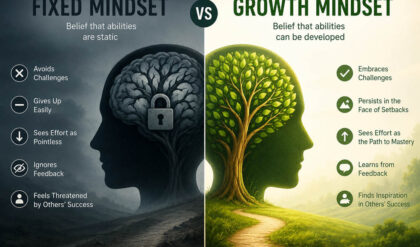
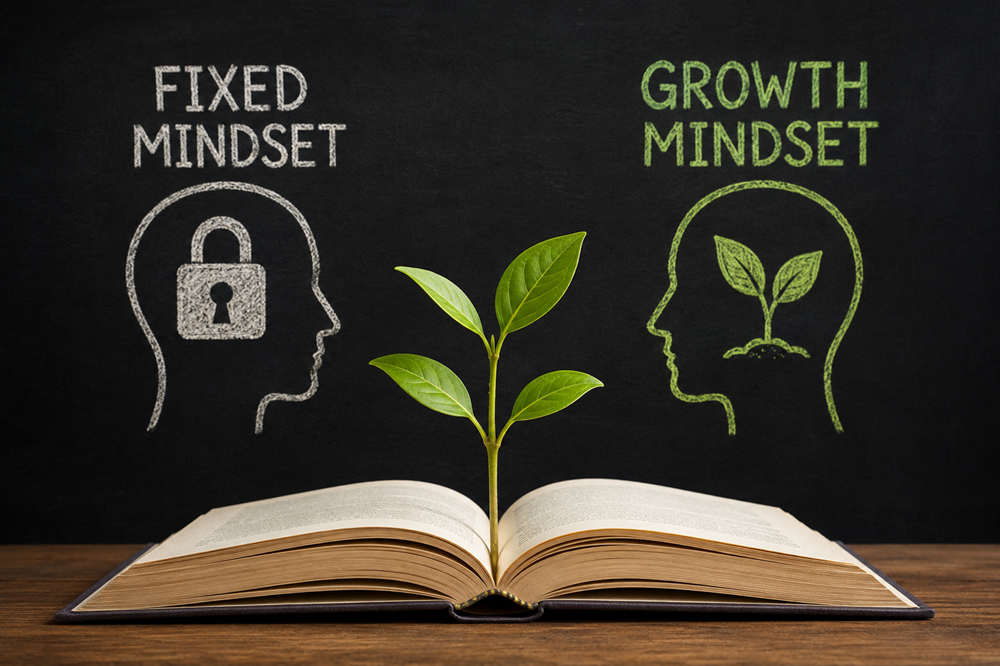
A fixed mindset treats an ability as relatively difficult or impossible to change. A growth mindset leaves room for development. These beliefs can lead to different interpretations of the same experience.
| Situation | Fixed-Mindset Reaction | Growth-Mindset Reaction |
|---|---|---|
| A difficult task | “Maybe I’m simply not good at this.” | “What do I need to learn to improve?” |
| A mistake | Sees it as evidence of limited ability | Looks for information in what went wrong |
| Constructive feedback | May feel that ability is being judged | Looks for useful information to apply |
| A weak skill | Sees the weakness as difficult to change | Sees the current level as potentially improvable |
| A setback | May lower expectations of future performance | Considers what could change before another attempt |
People do not necessarily belong permanently to one category. You might think about one ability in a growth-oriented way while being much more fixed about another. Someone could believe that professional skills improve through practice but still think, “I’ve never been creative, so I never will be.”
A more useful question than “Do I have a growth mindset?” is therefore: “Which abilities am I currently treating as fixed?”
What a Growth Mindset Looks Like in Everyday Life
Mindset is a belief, but beliefs can influence the choices people make when learning becomes uncomfortable.
Growth-oriented thinking may make someone more willing to:
- work on tasks that stretch their current skills;
- examine mistakes rather than immediately hiding them;
- ask for specific feedback;
- practice weak areas instead of avoiding them;
- seek instruction or support when needed;
- change an ineffective approach rather than repeating it indefinitely;
- pay attention to improvement over time.
These behaviors are consistent with a growth mindset, but having growth-oriented beliefs does not guarantee that someone will react this way every time. Confidence, motivation, environment, stress, resources, and the importance of the situation can all affect behavior.
Simple Examples of a Growth Mindset
Learning a Difficult Subject
A student struggling with statistics might say, “I’m terrible at math.” That broad conclusion gives little direction for improvement.
A more useful response would be, “I understand the formulas, but I struggle to recognize which one applies to each problem.” The difficulty has now become specific enough to practice.
Improving a Work Skill
Suppose your manager says that your presentations are hard to follow. Rather than deciding that you are naturally a poor presenter, you could identify the part that needs attention. Perhaps your ideas need a clearer structure, your slides contain too much information, or your delivery is too fast.
Breaking an ability into smaller skills makes improvement easier to approach.
Responding to Feedback
Growth mindset does not mean accepting every criticism as correct. It means considering whether the feedback contains useful information.
Instead of treating criticism as a judgment about your intelligence or worth, you can ask whether it identifies something specific that would improve the result.
Missing a Goal
If you repeatedly fail to follow a study or work routine, simply demanding more discipline may not solve the problem. Examining the system could reveal that the schedule is unrealistic, distractions are poorly controlled, or the task is too vague.
The useful question becomes not “Why can’t I do this?” but “What is preventing this approach from working?”
What Growth Mindset Does Not Mean
Some popular versions of growth mindset go further than the concept or evidence supports.
It Is Not Just About Trying Harder
Effort matters, but effort directed toward an ineffective method can produce little improvement. Stanford’s teaching guidance stresses the importance of strategies, constructive feedback, and support alongside effort.
Working longer is therefore not always the solution. Sometimes progress requires changing how you are learning.
It Does Not Mean Everyone Has Identical Potential
Growth mindset does not require believing that every person can achieve the same outcome in every field. People differ in previous experience, circumstances, opportunities, resources, interests, and individual characteristics.
The idea is narrower: current performance should not automatically be treated as the absolute limit of future development.
It Does Not Make Failure Automatically Valuable
A mistake becomes useful only when there is something meaningful to learn from it. Repeatedly making the same mistake without reflection is not growth.
Learning requires asking what happened and determining whether a different preparation, skill, method, or decision could improve the next result.
It Does Not Require Endless Persistence
Continuing with an ineffective strategy indefinitely is not evidence of a growth mindset. Changing methods, getting expert help, reducing the difficulty of a task, or sometimes choosing a different goal can all be reasonable decisions.
What Does Research Say About Growth Mindset?
Growth mindset has received considerable attention in psychology and education, but its effects should not be exaggerated.
A large national experiment published in Nature studied a brief growth-mindset intervention among U.S. ninth-grade students. The researchers found improvements in grades among lower-achieving students and increased enrollment in advanced mathematics, while also finding that the surrounding school environment influenced the results.
Large research reviews have produced a more complicated picture. One 2023 systematic review and meta-analysis found that estimated effects of growth-mindset interventions on academic achievement became statistically nonsignificant when researchers focused on higher-quality evidence.
Another 2023 meta-analysis emphasized that intervention results varied considerably. It found small positive academic effects when interventions were aimed at groups expected to benefit and were implemented with high fidelity.
Taken together, the evidence suggests that growth mindset should not be treated as a guaranteed method for improving grades, work performance, or other outcomes. Effects can vary with the person, intervention, goal, and surrounding environment.
Mindset also operates within real circumstances. A learner’s beliefs cannot substitute for good teaching, appropriate resources, time, access to opportunities, useful feedback, or a supportive environment.
The practical value of growth mindset is therefore better understood as a way of approaching development rather than as a shortcut to achievement.
How to Develop a Growth Mindset
Developing a growth mindset does not require forcing yourself to think positively. A more practical approach is to identify fixed assumptions and turn them into questions you can act on.
1. Notice When You Turn Performance Into Identity
Listen for statements such as:
- “I’m bad at technology.”
- “I’m not a leader.”
- “I’ve never been creative.”
- “I’m terrible at writing.”
- “I can’t understand this.”
Sometimes these statements describe a genuine current weakness. The problem is the assumption that the weakness defines what you can become.
2. Identify the Specific Skill Gap
Replace a broad judgment with a narrower description.
For example, “I’m bad at public speaking” could become, “I lose my train of thought when I speak without detailed notes.”
Now there is something concrete to practice. You could work on outlining, rehearsal, memory cues, or speaking in lower-pressure situations.
3. Use “Yet” as a Prompt for Action
Adding “yet” can help prevent a temporary limitation from sounding permanent:
“I don’t understand this yet.”
But the word is useful only when it leads to the next question: “What would help me understand it?”
That might mean studying a prerequisite concept, finding another explanation, practicing more examples, or asking someone for help.
4. Evaluate Your Strategy
When improvement stalls, do not automatically assume you need more effort. Examine how you are working.
- Which part keeps causing difficulty?
- Is my current method producing measurable improvement?
- What could I try differently?
- Do I need instruction or feedback?
Growth often depends as much on adapting the method as increasing the effort.
5. Ask for Actionable Feedback
General feedback such as “good job” or “this needs work” gives you little direction. More useful feedback identifies something you can change.
Ask questions such as, “Which part was confusing?” or “What is the first thing I should improve before trying again?”
Specific feedback makes deliberate practice easier.
6. Work Slightly Beyond Your Current Ability
Growth does not require jumping directly to the hardest possible challenge. Choose tasks that stretch you without being so difficult that you cannot practice the underlying skill effectively.
Someone learning public speaking might begin by contributing more often in small meetings before attempting a presentation to hundreds of people. Gradually increasing difficulty provides repeated opportunities to adjust and improve.
7. Keep Evidence of Progress
Improvement is easy to overlook when you compare yourself only with people who are more advanced.
Depending on the skill, you could keep old writing samples, project drafts, practice scores, recordings, exercise logs, or other evidence of performance. Looking back after several weeks or months can reveal whether your approach is actually producing change.
Growth Mindset Is About Learning, Not Constant Positivity
You do not have to enjoy struggling to have a growth mindset. You can feel frustrated by a setback, disappointed with your performance, or uncertain about whether you will reach a goal.
You can also recognize genuine constraints. Some goals require resources, opportunities, time, physical capabilities, instruction, or support that may not currently be available.
The growth-oriented response is simply to avoid turning difficulty into an automatic verdict about your ability. Where improvement is possible and worthwhile, you can identify what needs to change and decide what to try next.
Frequently Asked Questions
Can adults develop a growth mindset?
Yes. Growth and fixed thinking are not permanent personality categories. Adults can become more aware of how they interpret their own abilities and adopt more development-oriented approaches in areas where learning and improvement are possible.
Can you have both a fixed and growth mindset?
Yes. A person may approach different abilities differently. You might readily believe that you can improve your professional skills while assuming that you will always be bad at drawing, mathematics, exercise, or public speaking.
What does research say about growth mindset?
Research does not support treating growth mindset as a universal performance booster. Some studies have found benefits for particular groups and in supportive environments, while systematic reviews have found that average effects on academic achievement are small, variable, or uncertain depending on study quality and implementation. Growth mindset is best viewed as one factor within a much larger learning environment.
Does a growth mindset mean anyone can become anything?
No. Growth mindset concerns the possibility of developing abilities; it does not claim that everyone begins with identical characteristics, has access to identical opportunities, improves at the same rate, or can achieve every possible outcome.
Final Thoughts
Growth mindset is more useful when it is treated as a learning principle rather than a motivational slogan. The goal is not to convince yourself that anything is possible if you try hard enough.
A better question is: “If this ability can improve, what do I need to learn, practice, change, or get help with next?”
That shift turns a broad judgment about yourself into a specific problem you can begin working on.