
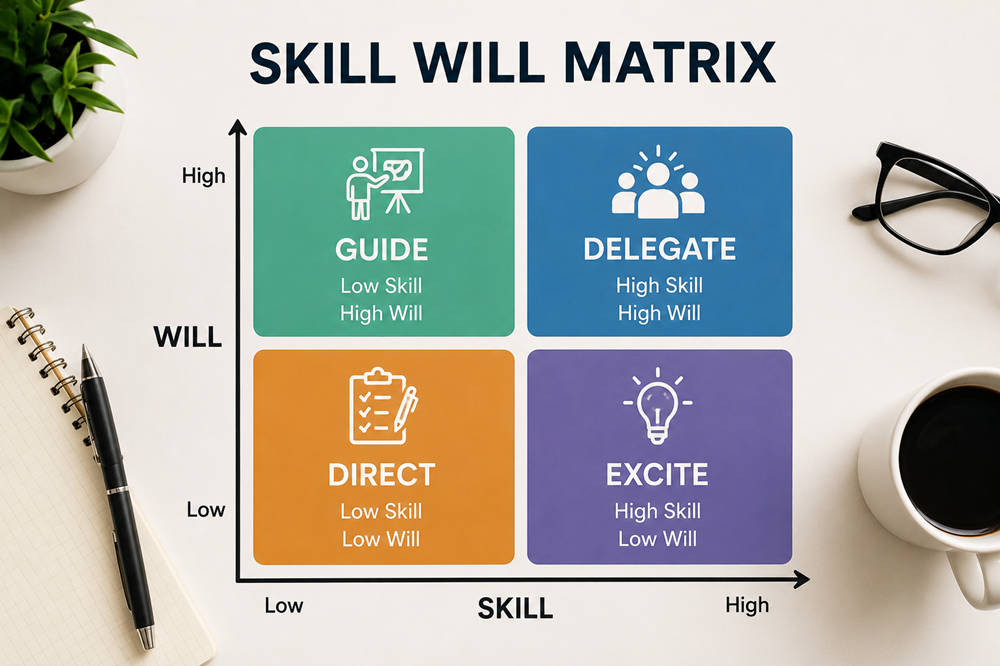
The Skill Will Matrix is a simple management and coaching framework for deciding how to support someone based on two factors: their ability to perform a specific task and their motivation to do it.
It creates four situational quadrants—Delegate, Guide, Direct, and Excite—that point toward different management approaches. The key is to use the matrix for a particular task or responsibility rather than treating it as a permanent label for a person.
What Is the Skill Will Matrix?
The Skill Will Matrix is a 2×2 framework that compares skill with will.
Skill refers to the knowledge, experience, and ability someone currently has to perform a task successfully.
Will refers primarily to the person’s current motivation and willingness to perform that task. Confidence, workload, role clarity, previous experiences, career goals, and working conditions can all influence that motivation.
The framework is commonly associated with coach and author Max Landsberg, who wrote about the Skill/Will Matrix in The Tao of Coaching.
| Skill | Will | Management Approach |
|---|---|---|
| High | High | Delegate |
| Low | High | Guide |
| Low | Low | Direct |
| High | Low | Excite |
The value of the matrix is that it separates two different performance questions: Can the person do the task? and Are they currently motivated to do it?
Those problems often require different responses. Someone who wants to succeed but lacks experience may need training. Someone who already knows how to do the work but has become disengaged probably needs a different conversation.
Skill vs. Will: What’s the Difference?
Skill and will can lead to similar performance problems, so managers need to distinguish between them before deciding how to respond.
What Skill Means
Skill describes a person’s current capability to complete a defined task. Depending on the responsibility, that may involve:
- Technical knowledge
- Practical experience
- Communication ability
- Decision-making
- Problem-solving
- Familiarity with tools or processes
- Accuracy and consistency
- Ability to work independently
Skill should always be assessed in context.
For example, a salesperson may be highly skilled at prospecting but inexperienced at negotiating complex enterprise contracts. A designer may be excellent at visual design but new to managing a project budget.
Neither person is simply a “high-skill” or “low-skill” employee. Their capability depends on the task being assessed.
What Will Means
Will describes a person’s current motivation and willingness to take on the responsibility.
Managers may notice it through initiative, persistence, engagement, or willingness to take ownership. However, motivation can be harder to judge from the outside than technical capability.
Low will should not automatically be interpreted as laziness or a bad attitude. A person may be less engaged because expectations are unclear, the work has become repetitive, previous setbacks have affected confidence, the workload is unrealistic, or the responsibility no longer feels meaningful.
That is why observation should usually be followed by a conversation rather than an assumption.
The Four Skill Will Matrix Quadrants
Each quadrant suggests a broad management response based on the person’s current combination of capability and motivation.
High Skill, High Will: Delegate
A person with high skill and high will can perform the task competently and is motivated to take responsibility for it.
The appropriate approach is usually Delegate.
Instead of prescribing every step, agree on the outcome, provide the authority and resources needed, and allow the person room to decide how the work should be completed.
Useful approaches can include:
- Giving greater ownership
- Offering stretch assignments
- Expanding decision-making responsibility
- Providing opportunities to lead
- Setting challenging but realistic goals
- Remaining available as a sounding board
Delegation does not mean disappearing. The manager still communicates priorities and stays available when needed but avoids unnecessary supervision.
Low Skill, High Will: Guide
Someone with low skill and high will is motivated but does not yet have enough experience or capability to perform the task independently.
This often occurs when someone joins a team, receives a promotion, starts using unfamiliar technology, or takes on a new type of responsibility.
The appropriate approach is Guide.
A manager might:
- Demonstrate the task
- Provide targeted training
- Break complicated work into manageable stages
- Give regular early feedback
- Pair the person with an experienced colleague
- Review initial work and explain improvements
Because motivation is already present, the priority is building competence. As the person’s skill improves, the amount of supervision should gradually decrease.
Low Skill, Low Will: Direct
A person with low skill and low will currently lacks both sufficient capability and motivation for the task.
The starting approach is Direct.
Clear structure is especially important. The person should understand:
- What needs to be done
- What acceptable performance looks like
- Which steps or priorities matter most
- What support is available
- When progress will be reviewed
Direction alone may not solve the problem. The manager should also try to understand why motivation is low.
Possible barriers could include unclear expectations, repeated setbacks, low confidence, missing resources, poor role fit, or frustration with the work. Identifying the real barrier makes it easier to decide whether the next step should involve training, clearer expectations, closer support, or a change in responsibilities.
High Skill, Low Will: Excite
Someone with high skill and low will has the ability to perform the task but is currently less motivated to do it.
The traditional Skill Will Matrix calls the response Excite. In practical terms, the manager is trying to understand the loss of motivation and find an appropriate way to re-engage the person.
Useful questions might include:
- Has the work become too repetitive?
- Does the person understand why the task matters?
- Do they have enough autonomy?
- Is the responsibility still challenging?
- Is an avoidable obstacle creating frustration?
- Have their goals or interests changed?
More basic training may accomplish little when capability is already strong. A better response could involve greater ownership, a new challenge, clearer purpose, or removing a frustrating obstacle.
How to Use the Skill Will Matrix
The matrix becomes useful when it leads to a better management decision. A simple process can keep the assessment focused on the work rather than turning it into a judgment about the person.
1. Define the Task
Start with the specific responsibility you want to assess.
Instead of asking, “Is Jordan highly skilled?” ask, “How capable is Jordan of independently leading this type of client presentation?”
The second question gives skill a clear context.
2. Assess Current Skill
Look for evidence of capability rather than relying on reputation or confidence alone.
Consider previous results, relevant experience, quality of work, consistency, knowledge of the process, ability to solve routine problems, and how much assistance the person normally requires.
3. Explore Will
Look at behavior, but do not stop there. Speak with the person about the responsibility.
Try to understand their level of interest and willingness, along with any obstacles making the task harder to engage with.
4. Identify the Closest Quadrant
Decide which combination best describes the current situation:
- High skill + high will
- Low skill + high will
- Low skill + low will
- High skill + low will
The goal is not to classify the person perfectly. The quadrant simply provides a starting point for deciding what type of management response may be useful.
5. Agree on a Practical Next Step
Turn the assessment into action. Depending on the situation, that could mean:
- Providing training
- Clarifying expectations
- Creating a smaller first milestone
- Giving more frequent feedback
- Increasing autonomy
- Assigning a new challenge
- Removing an obstacle
- Giving greater responsibility
The matrix is useful only when the assessment leads to an appropriate next step.
Quick Skill Will Assessment Questions
You do not need a complicated scoring system to start using the framework. A few focused questions can produce a more useful assessment.
Questions to Assess Skill
- Has this person successfully completed this type of task before?
- Do they understand the tools and processes involved?
- Can they produce consistent work without substantial assistance?
- Can they solve common problems independently?
- Which specific capabilities still need development?
Questions to Explore Will
Questions for the employee might include:
- How do you feel about taking responsibility for this task?
- How confident do you feel handling it?
- Which parts of the work are most or least engaging?
- Is anything making progress more difficult?
- What kind of support would be useful?
- Is there something about the responsibility you would change?
These are conversation prompts, not a formal psychological assessment. Their purpose is to uncover information that may not be visible from performance data alone.
Skill Will Matrix Example
Imagine a marketing manager assigning different responsibilities for an upcoming product launch.
Maya has successfully managed several launches and wants ownership of the next campaign. Her manager agrees on the objectives and major milestones, then gives her freedom to plan the execution. For this responsibility, Maya fits the Delegate quadrant.
Ethan recently joined the team and is eager to manage paid advertising, but he has limited experience with the company’s advertising platform. His manager provides training, reviews his early campaigns, and gradually increases his independence. Ethan fits the Guide quadrant.
Nina has little experience with the team’s analytics tools and has been reluctant to handle reporting. Instead of assuming she has a poor attitude, her manager talks with her, clarifies expectations, provides training, and begins with a smaller reporting assignment. Nina currently fits the Direct quadrant.
Daniel is an experienced email marketer who has produced similar campaigns for years, but his engagement has fallen. His manager learns that the work feels repetitive and that Daniel wants greater strategic responsibility. Rather than assigning more writing training, the manager asks him to design and lead a new email experiment. Daniel currently fits the Excite quadrant.
The important point is that these are not four permanent employee types. Each assessment relates to a particular responsibility at a particular time.
When the Skill Will Matrix Is Useful
The framework can help whenever a manager needs to decide what type of support a person needs for a particular responsibility.
Common situations include:
- Onboarding someone into a new role
- Delegating an important responsibility
- Coaching an employee
- Addressing a performance problem
- Introducing new technology or processes
- Assigning project roles
- Developing future leaders
- Managing a promotion or change in responsibilities
The framework is particularly useful when a manager is tempted to jump immediately to a solution. Before arranging training, increasing supervision, or trying to motivate someone, the matrix encourages a closer look at what the problem actually is.
Common Mistakes and Limitations
The Skill Will Matrix is intentionally simple. That makes it easy to remember, but it also means it cannot explain every factor that affects performance.
Treating the Quadrants as Permanent Labels
A person can occupy different quadrants for different responsibilities.
Someone might have high skill and high will when dealing with customers but low skill and high will when asked to use a new software platform. Assess the task rather than turning a quadrant into a judgment about the person’s overall ability or potential.
Assuming Low Will Means a Bad Attitude
Motivation can be affected by expectations, confidence, workload, resources, role fit, challenge, and many other circumstances.
Investigate before deciding why someone appears disengaged.
Treating Skill and Will as Truly Binary
Real people do not exist neatly at only “high” or “low” levels.
Someone may have moderate skill, fluctuating motivation, or a mixture of strengths and gaps within the same responsibility. The four quadrants simplify a more complicated reality.
Judging Motivation Without a Conversation
Managers can observe behavior, but they cannot automatically know why it is happening.
Hesitation might look like low motivation when the person is actually uncertain, overloaded, or concerned about making a mistake. Use the matrix to start a conversation rather than replace one.
Applying the Framework Mechanically
Two people in the same quadrant may still need different support.
The matrix points toward a broad coaching style. It does not automatically determine the person’s goals, workload, development plan, or exact management conversation.
Skill Will Matrix vs. Skills Matrix
The similar names make the Skill Will Matrix and a skills matrix easy to confuse, but they serve different purposes.
A conventional skills matrix maps the capabilities required within a role, project, or team and compares them with people’s current proficiency. It can help identify skill gaps, training needs, or areas where important expertise is missing. Some versions also include employees’ interest in using or developing particular skills.
The Skill Will Matrix is primarily a coaching and management framework. It considers someone’s current capability for a task alongside their motivation to perform it so that a manager can choose a more suitable response.
A useful shorthand is:
Skills matrix: Which capabilities do we have, and where are the gaps?
Skill Will Matrix: Given this person’s current ability and motivation for this task, what kind of support makes sense?
When Should You Reassess Skill and Will?
Skill and motivation change, so a person’s position in the matrix should not be treated as permanent.
It can be useful to reassess after:
- Completing training
- Taking on a new project
- Receiving a promotion
- Changing roles
- Achieving an important milestone
- Experiencing a noticeable performance change
- Adopting new tools or processes
- Receiving substantially different responsibilities
You do not necessarily need to maintain a formal chart for every employee. In many situations, the greatest value comes from remembering one question when performance changes:
Is this mainly a skill issue, a will issue, or some combination of both?
Then investigate before deciding what support is appropriate.
Final Thoughts
The Skill Will Matrix gives managers a straightforward way to think about why different people may need different kinds of support.
A motivated beginner may need guidance and practice. A capable and motivated employee may benefit from greater autonomy. Someone struggling with both skill and motivation may need clearer structure, while an experienced but disengaged employee may need a meaningful change rather than another training session.
The four approaches—Delegate, Guide, Direct, and Excite—are best treated as starting points rather than rigid rules.
Define the task, look at evidence of capability, talk with the person about motivation, choose an appropriate next step, and reassess as circumstances change. Used that way, the Skill Will Matrix becomes less about putting people into boxes and more about making better coaching and management decisions.