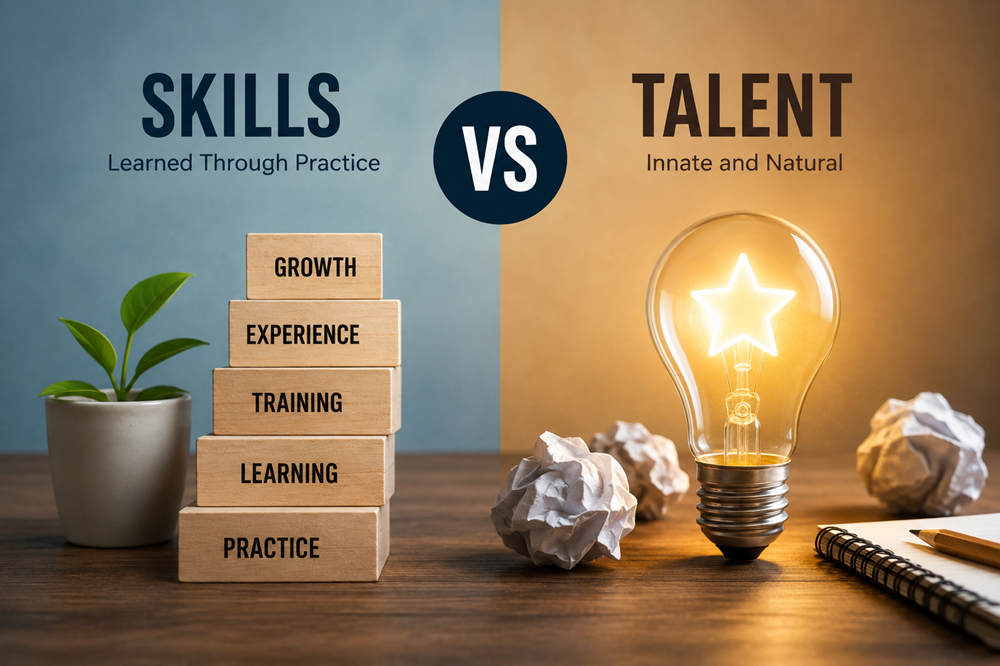
Skills and talent both influence what you can do, but they are not the same thing. Talent generally refers to a natural aptitude or an apparent early advantage, while a skill is an ability developed through learning, practice, and experience.
Talent may make certain activities easier to pick up, but it does not automatically produce expertise. Skills are built through action: learning what to do, practicing it, getting feedback, and becoming more consistent over time.
That distinction matters because your starting point does not tell you how far you can develop.
What Is a Skill?
A skill is a developed capacity to perform a particular type of activity effectively. Skills can be learned, practiced, refined, and applied in increasingly difficult situations.
Examples include:
- Writing clearly
- Public speaking
- Programming
- Negotiating
- Managing projects
- Playing an instrument
- Using spreadsheet software
- Selling a product or service
The O*NET occupational framework makes a useful distinction between skills and abilities. It describes skills as developed capacities that support learning and performance, while abilities are more enduring individual attributes that influence performance.
Skills also exist at different levels. Knowing basic spreadsheet formulas and building a complex financial model both involve spreadsheet skills, but the required proficiency is very different.
What makes something a skill is not that you have mastered it. It is that the ability can be developed and demonstrated through performance.
What Is Talent?
In everyday language, talent usually means a natural aptitude or an apparent early advantage in learning or performing an activity. Merriam-Webster, for example, describes talent in terms of special aptitude and natural ability that needs development.
Someone might show an unusually strong sense of rhythm before receiving much musical instruction. Another person may quickly recognize visual patterns, coordinate physical movements easily, or have an early feel for storytelling.
Examples commonly described as talents include:
- A strong sense of pitch or rhythm
- Excellent hand-eye coordination
- Fast pattern recognition
- Strong spatial awareness
- An apparent ease with language
However, an early advantage is not always purely inborn. Previous exposure, encouragement, coaching, environment, and opportunity can affect how capable someone appears at the beginning.
That is why talent is best understood as a useful everyday description of aptitude or potential, not as a precise measure of what someone will eventually achieve.
Skills vs. Talent: The Key Differences
| Difference | Skill | Talent |
|---|---|---|
| Basic meaning | Developed proficiency | Natural aptitude or apparent early advantage |
| How it develops | Learning, practice, feedback, and experience | May appear early but still requires development to become useful expertise |
| What it shows | What someone has learned to do | An area in which someone may have a favorable starting point or learning advantage |
| Role of practice | Builds and improves the skill | Helps turn aptitude into dependable performance |
| Examples | Coding, editing, negotiating, presenting | Musical aptitude, coordination, spatial aptitude |
The simplest distinction is this: talent is associated with potential or aptitude; skill is demonstrated capability developed over time.
In practice, the two often work together.
How Talent and Skill Work Together
A natural advantage can make learning faster or easier. It cannot replace learning itself.
Consider someone who seems to have an excellent musical ear. That aptitude might help with recognizing pitch and rhythm, but performing music also requires timing, technique, control, memory, interpretation, and many hours of applying those abilities to an instrument or voice.
A useful way to think about the process is:
Aptitude → learning → practice → feedback → developed skill → stronger performance
Not everyone moves through that process at the same rate. Some people begin farther ahead. Others improve quickly once they receive effective instruction. Motivation, resources, experience, opportunities, and the quality of practice can all influence what happens next.
Talent can shape the starting point. Skill development shapes what you become capable of doing reliably.
Examples of Talent and Skill in Everyday Life
The difference becomes clearer when the two are compared within the same activity.
Music
A person may have an unusually strong ear for pitch or a natural sense of rhythm. Those qualities can support musical development.
Playing scales accurately, reading notation, controlling an instrument, improvising, and performing difficult passages are skills. They require training even when someone begins with strong musical aptitude.
Sports
An athlete might have excellent coordination, speed, reaction time, or physical characteristics suited to a particular sport.
Sport-specific performance still depends on learned skills. A basketball player develops shooting mechanics and footwork. A tennis player practices serving and shot selection. A soccer player develops ball control, positioning, and tactical awareness.
Writing
Someone may show an early feel for language or storytelling, but effective writing involves many separate skills.
Researching, organizing ideas, constructing clear sentences, editing, adjusting tone, making an argument, and writing for a specific audience all improve through deliberate work.
Sales
Being naturally sociable may make certain conversations easier, but sociability alone does not make someone an effective salesperson.
Prospecting, asking useful questions, listening, identifying needs, presenting solutions, handling objections, negotiating, and following up are trainable sales skills.
Is Talent Something You Are Born With?
Talent is commonly described as natural ability, but real human development is more complicated than dividing everything into “born with it” or “learned it.”
People differ in characteristics that can affect performance and learning. They also grow up with different experiences, resources, teachers, expectations, opportunities, and levels of exposure.
That makes it difficult to look at an impressive beginner and know exactly how much of the advantage came from predisposition and how much came from earlier development.
A more useful view is that people can begin with different advantages, but those advantages interact with what happens afterward.
Natural aptitude may matter. It does not make development unnecessary or guarantee a particular outcome.
Can You Become Skilled Without an Obvious Natural Advantage?
Yes. In many activities, people can build substantial skill even when they do not show an obvious advantage at the beginning.
Think about public speaking. A naturally confident speaker may have an easier start, but many parts of a strong presentation are trainable. You can learn to organize ideas, control pacing, use pauses, explain difficult concepts clearly, design better supporting material, and respond to an audience.
The same principle applies to many professional and practical skills.
Starting slowly does not automatically mean you have reached your limit. It may mean you need more instruction, a better practice method, clearer feedback, or simply more experience.
At the same time, skill development should not be turned into the opposite extreme: a promise that everyone can reach any level in every field. People differ, and activities place different demands on them.
The practical lesson is narrower and more useful: do not mistake your beginner performance for your permanent ability.
Talent vs. Hard Work: What Does the Research Suggest?
There is no reliable universal formula saying success is a certain percentage talent and a certain percentage hard work.
Practice matters. Research on expertise has repeatedly examined the role of structured, task-relevant practice in improving performance, and studies in fields such as music show a meaningful relationship between accumulated practice and achievement.
But practice does not explain every difference between performers. Researchers continue to debate exactly how deliberate practice should be defined and how much variation in expert performance it accounts for across different fields.
The broader lesson is that high performance usually reflects several influences rather than one:
- Practice and training quality
- Individual characteristics and abilities
- Instruction and coaching
- Motivation and persistence
- Previous experience
- Feedback
- Resources and opportunities
- The demands of the activity itself
This is more useful than slogans about talent beating hard work or hard work always beating talent. Different people can arrive at strong performance through different combinations of advantages, effort, training, and opportunity.
Why Relying on Talent Alone Can Hold You Back
Natural ability becomes a disadvantage when it convinces you that improvement should always feel easy.
Someone who performs well early may be able to rely on natural strengths for a while. Eventually, however, the work gets harder, competitors become stronger, or expectations increase.
Relying too heavily on talent can make you more likely to:
- Avoid practicing weaknesses
- Repeat what already comes easily
- Expect progress without changing your approach
- Become discouraged when improvement becomes difficult
- Treat effort as evidence that you are not talented after all
The reverse can also happen. Someone who decides “I have no talent for this” may stop before developing enough skill to discover what they are capable of.
Instead of asking only, “Am I talented at this?”, ask a question that leads somewhere:
“What specific part of this could I get better at next?”
How to Turn Potential Into Skill
Whether something comes naturally or not, improvement becomes easier when you turn a broad goal into trainable parts.
1. Define the Actual Skill
Goals such as “be better at business” or “become a better communicator” are too broad to practice effectively.
Break them down. Business might involve negotiation, financial analysis, hiring, presenting, sales, or project management. Communication might involve listening, writing, explaining complex ideas, or speaking to groups.
2. Find Your Current Level
Identify what you can already do consistently and where your performance breaks down.
A work sample, recording, test, measurable result, or feedback from another person can help you establish a realistic starting point.
3. Practice the Weak Part
Do not spend all your time repeating what already feels comfortable.
If your presentations contain useful ideas but lack structure, work on organization. If your writing is clear but slow, practice producing and revising drafts more efficiently.
Specific weaknesses create specific practice targets.
4. Get Useful Feedback
Practice is more effective when you can identify what needs to change.
Feedback might come from a teacher, coach, manager, colleague, test result, customer response, recording, or performance metric. What matters is that it gives you information you can use on your next attempt.
5. Increase the Difficulty
Once you can perform something reliably, make the challenge slightly harder.
A speaker might progress from rehearsing alone to presenting to a small group. A programmer might move from guided exercises to building an independent project. A salesperson might move from practicing a script to handling unpredictable objections.
6. Measure Performance Instead of Labeling Yourself
“Talented” and “untalented” are not useful measures of progress.
Track something observable instead: accuracy, speed, consistency, quality, difficulty, results, or the number of tasks you can complete independently.
Improvement becomes much easier to see when you measure what you can do rather than trying to define what kind of person you are.
Skill, Talent, and Ability: What’s the Difference?
These words overlap in everyday conversation, but they can be separated in a useful way:
- Talent: a term commonly used for natural aptitude or an apparent early advantage in a particular area.
- Skill: a developed capacity to perform an activity.
- Ability: a broader capacity or attribute that can influence how a person performs or learns.
For example, a person might have strong auditory abilities, show an early talent for music, and develop advanced piano skills through training.
The boundaries are not perfectly rigid. The important distinction is between a favorable starting point and an ability that has been developed into reliable performance.
Frequently Asked Questions
Can talent be developed?
The underlying aptitude described as talent may provide a starting advantage, but the abilities used to express that talent can certainly be developed. A person with musical aptitude, for example, still needs to develop technique, timing, repertoire, and performance skills.
Can you lose a talent if you do not practice?
You may retain some underlying aptitude, but your actual performance can stagnate or decline when relevant skills are not used. Someone with less obvious natural aptitude but stronger training can therefore become the more capable performer.
Is creativity a talent or a skill?
Creativity can involve both individual tendencies and developed skills. Generating alternatives, building knowledge in a field, experimenting, evaluating ideas, solving constraints, and revising weak work can all improve with experience and practice.
The Bottom Line
Talent can influence your starting point, but skills describe what you have learned to do.
Some activities may come more naturally to you than others, and those advantages can be worth recognizing. They are not substitutes for learning and development. Likewise, struggling at the beginning does not prove that you cannot become capable.
For personal and professional growth, the most useful question is usually not how much talent you have. It is what you can learn, practice, measure, and improve next.
Choose that next skill, break it into manageable parts, and start building it.