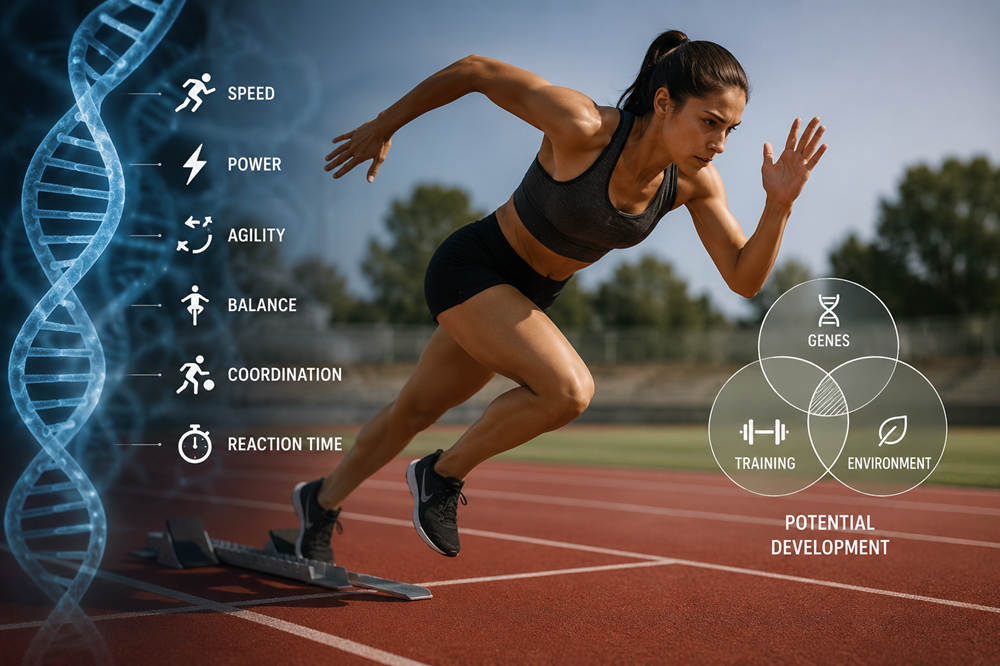
Heredity plays a role in skill-related fitness because the genes you inherit can influence physical and neurological characteristics involved in movement. These differences may contribute to natural strengths in speed, power, agility, balance, coordination, or reaction time. However, genetics does not determine how skilled someone will become. Training, practice, coaching, recovery, and experience all help shape physical performance.
What Is Skill-Related Fitness?
Skill-related fitness refers to abilities that help a person perform movements quickly, accurately, and efficiently. These abilities are especially important in sports and other activities that involve rapid movement, body control, or responding to changing situations.
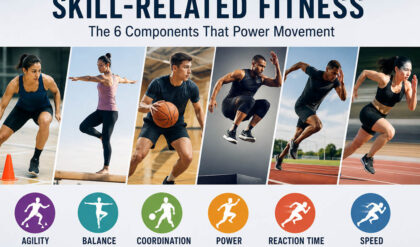
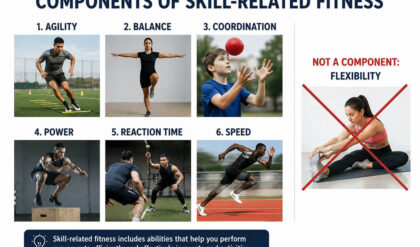
The six components of skill-related fitness are:
- Agility: the ability to change direction or body position quickly while maintaining control.
- Balance: the ability to maintain control of the body’s position while still or moving.
- Coordination: the ability to use different body parts and senses together smoothly.
- Power: the ability to produce force quickly.
- Reaction time: the time between receiving a stimulus and beginning a response.
- Speed: the ability to move the body, or part of the body, rapidly.
Although these components are described separately, they often work together during real movements. A basketball player reacting to an opponent and changing direction, for example, may use reaction time, coordination, balance, agility, and speed within a few seconds.
What Role Does Heredity Play in Skill-Related Fitness?
Heredity can contribute to the biological characteristics that influence physical performance. Genes inherited from parents are involved in traits related to skeletal muscle, body dimensions, neuromuscular function, and other aspects of human movement.
That can give different people different natural strengths. One person might show good acceleration and jumping ability with relatively little training, while another may demonstrate strong balance or coordination early on.
This does not mean that people simply inherit a fixed amount of athletic ability. Athletic performance is a complex trait influenced by many genetic and environmental factors. There is no single gene that decides whether someone will be fast, powerful, coordinated, or successful in sports.
How Heredity Can Influence Each Component of Skill-Related Fitness
Genetics can affect some of the characteristics underlying each skill-related fitness component, but the influence is different for every ability. Training and experience remain important across all six components.
Speed
Speed depends on several factors, including how rapidly muscles produce force, how effectively the nervous system coordinates movement, technique, and body mechanics.
Some of these underlying traits are influenced partly by genetics. This helps explain why people who have received similar amounts of training can still differ naturally in sprinting speed.
Technique and conditioning also matter. Starting mechanics, stride efficiency, strength, and sport-specific practice can all change how effectively a person uses their physical characteristics.
Power
Power is the ability to produce force rapidly. Jumping, throwing, accelerating, and many explosive athletic movements rely heavily on it.
Inherited differences in skeletal muscle can contribute to differences in power. One gene that has received considerable research attention is ACTN3, which provides instructions for a protein found predominantly in fast-twitch muscle fibers. Certain ACTN3 variants appear more frequently among some groups of power athletes.
That association should not be treated as a prediction of performance. ACTN3 is not an “athlete gene,” and having a particular variant cannot reliably determine whether someone will become good at sprinting, jumping, weightlifting, or any other sport.
Agility
Agility involves more than moving quickly. In many situations, a person must recognize a stimulus, decide how to respond, control the body, change direction, and accelerate again.
Heredity may influence agility indirectly through characteristics related to speed, power, coordination, and neuromuscular control. However, agility also depends heavily on learned movement patterns and the ability to respond effectively to changing situations.
For that reason, agility is not simply something a person either has or does not have. Appropriate practice can improve change-of-direction technique and the ability to react to sport-specific cues.
Balance
Balance requires the brain and body to work together to maintain a stable position. The nervous system uses information from vision, the inner ear, muscles, and joints to make continuous adjustments.
Inherited characteristics may contribute to individual differences in balance and motor control, but balance is also trainable. Activities that challenge stability, body positioning, and movement control can help people improve it over time.
Coordination
Coordination is the ability to organize different movements so that the body works efficiently as a whole. Throwing and catching a ball, dribbling while running, performing a dance sequence, or striking a tennis ball all require coordinated movement.
People may begin with different levels of natural motor control, partly because of inherited differences. Much of useful coordination, however, develops through learning.
Repetition, feedback, timing, and experience allow the nervous system to become more efficient at organizing a particular movement. This is why someone who initially appears uncoordinated can become highly skilled after sustained practice.
Reaction Time
Reaction time describes how quickly a person begins responding after detecting a stimulus. A sprinter hearing the starting signal is a simple example.
Differences in nervous-system function can contribute to variation in reaction time, but performance can also be affected by attention, fatigue, familiarity with a task, and other conditions.
In sports, reaction time should also be distinguished from anticipation. An experienced athlete may appear to react unusually quickly because they recognize useful movement cues earlier. A goalkeeper, for example, may use an opponent’s body position to anticipate where a shot is likely to go rather than relying on reaction time alone.
Heredity Influences Starting Characteristics, Not Fixed Limits
A useful way to think about heredity is that it contributes to a person’s starting characteristics. It does not establish an unchangeable ceiling on performance.
Someone with physical characteristics suited to explosive movement may initially find sprinting or jumping easier. Another person may begin with better balance or movement control. Training can develop these abilities further and can also strengthen areas that do not come as naturally.
| Inherited Influences May Include | Developmental and Environmental Influences May Include |
|---|---|
| Some skeletal muscle characteristics | Exercise and training |
| Body dimensions and proportions | Practice and repetition |
| Some aspects of neuromuscular function | Coaching and instruction |
| Predispositions affecting physical performance | Sport and movement experience |
| Individual differences in response to exercise | Nutrition, sleep, and recovery |
The two sides also interact. A training program acts on a body with its own individual characteristics, and different people may respond differently to the same exercises.
What Does Heritability Mean?
Discussions of genetics and athletic performance sometimes use the word heritability, but the term can be misunderstood.
Heritability describes variation within a population. It does not tell us what percentage of one person’s ability was caused by genes.
For example, if a particular trait had a heritability estimate of 60 percent in a study, that would not mean 60 percent of one person’s performance came from genetics and the remaining 40 percent came from the environment. The estimate describes how differences among people in the studied population relate to genetic differences under those particular conditions.
Heritability also does not tell us whether a trait can be changed. A characteristic can have a genetic component and still respond to training or changes in the environment.
How Training Develops Skill-Related Fitness
Skill-related fitness can improve through targeted practice even when genetics contributes to individual differences.
Different training methods emphasize different abilities:
- Speed: sprint technique, acceleration drills, and appropriate strength training can help develop faster movement.
- Power: resistance exercises and appropriately programmed plyometric movements can develop the ability to generate force quickly.
- Agility: change-of-direction drills and exercises involving external cues can develop different aspects of agility.
- Balance: exercises that challenge stability and body control can improve balance.
- Coordination: repeated practice of increasingly complex movements can improve movement accuracy and efficiency.
- Reactive performance: activities that require responses to visual, auditory, or movement cues can help athletes practice responding to changing situations.
Research supports improvements in sprinting and change-of-direction performance following appropriate exercise interventions. Training that includes perception and action together can also improve reactive agility. Improvements in isolated laboratory-style reaction-time tests, however, are less consistent.
The important point is not that training removes all biological differences between people. Instead, training allows each person to develop their abilities beyond their initial level.
A Simple Example of Heredity and Training
Imagine two students joining a basketball team for the first time.
Student A accelerates quickly and jumps relatively high but has trouble dribbling under pressure and changing direction smoothly. Student B is initially slower but has good balance and hand-eye coordination.
Those differences may partly reflect their individual physical characteristics and previous experiences. They do not tell us which student will eventually become the better player.
With structured practice, Student A can develop better coordination and movement control. Student B can improve acceleration and power through appropriate conditioning. Both can also learn basketball-specific skills, positioning, anticipation, and decision-making.
The example shows why natural ability should be viewed as a starting advantage in certain tasks rather than a final measure of someone’s potential.
Why Genes Alone Cannot Predict Athletic Potential
Scientists have identified genetic variants associated with particular characteristics involved in athletic performance, but sports ability involves far too many variables for a genetic result to reliably predict future success.
Performance may depend on technical skill, physical conditioning, decision-making, sport-specific experience, coaching, motivation, opportunity, recovery, and many other factors. Different sports also reward different combinations of abilities.
A genetic characteristic that might appear favorable for one type of performance may have little importance in another. Even within the same sport, players in different positions can benefit from different combinations of speed, power, coordination, endurance, size, and technical skill.
For this reason, genetic information should not be treated as a simple test of whether someone has athletic talent. Actual performance and development over time provide a much more meaningful picture of a person’s abilities.
The Bottom Line
Heredity influences skill-related fitness by contributing to physical and neurological characteristics involved in agility, balance, coordination, power, reaction time, and speed. Because people inherit different combinations of traits, some abilities may initially come more naturally to one person than another.
Those differences do not determine what someone can ultimately achieve. Practice, training, coaching, experience, and recovery help shape how skill-related fitness develops. Heredity is therefore best understood as one influence on physical performance, not a prediction of a person’s limits.