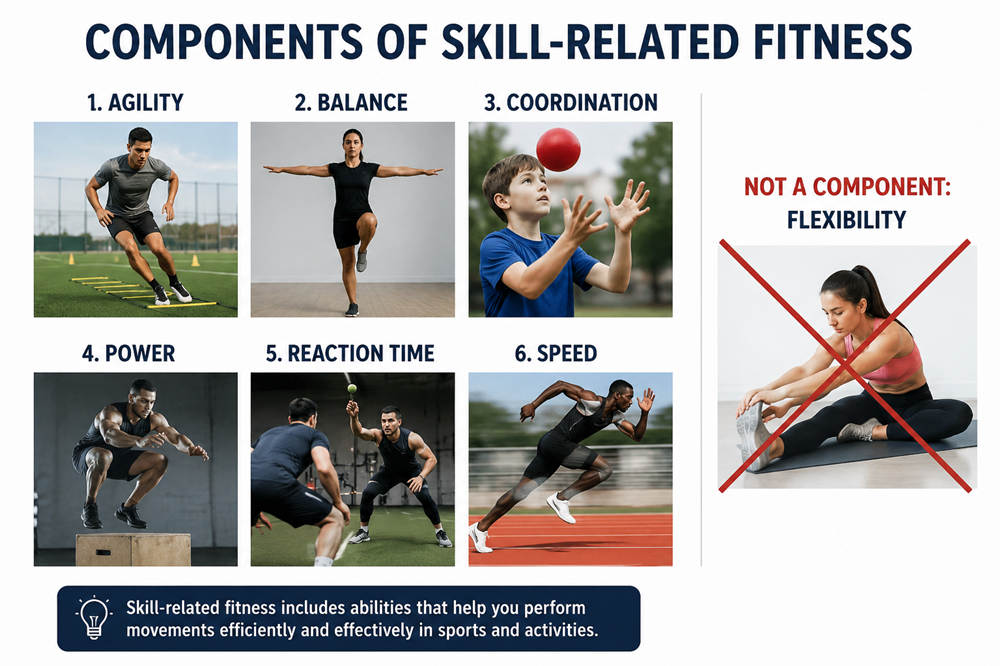
If your choices include flexibility along with agility, balance, coordination, power, reaction time, or speed, the answer is flexibility. In the traditional physical fitness framework, flexibility is a health-related component rather than a skill-related one.
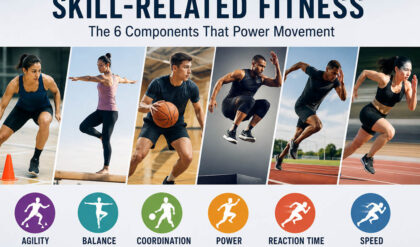
The six components of skill-related fitness are agility, balance, coordination, power, reaction time, and speed. Knowing this list makes it much easier to answer different versions of the same question.
Keep in mind that the exact answer depends on the choices. Muscular strength, muscular endurance, cardiorespiratory endurance, and body composition also fall outside the traditional skill-related group.
What Are the Six Components of Skill-Related Fitness?
Skill-related fitness describes physical abilities that help a person perform movements efficiently and effectively. These abilities are especially noticeable in sports and activities that require quick movement, control, timing, or precise responses.
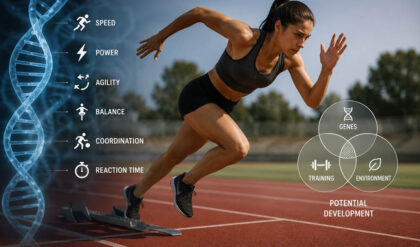
The traditional fitness framework identifies six skill-related components.
1. Agility
Agility is the ability to change direction quickly while maintaining control. A soccer player cutting around a defender or a basketball player rapidly changing direction uses agility.
2. Balance
Balance is the ability to maintain stability while stationary or moving. Gymnastics, skating, skiing, and many other activities depend on good balance.
3. Coordination
Coordination is the ability to use different body parts together effectively. Catching a ball, for example, requires the eyes, hands, and body to work together at the right time.
4. Power
Power is the ability to produce force quickly. Explosive actions such as jumping for a rebound, accelerating from the starting blocks, or making a powerful volleyball jump rely on power.
5. Reaction Time
Reaction time describes how quickly you begin responding to a stimulus. A sprinter reacting to a starting signal or a goalkeeper responding to a shot provides a clear example.
6. Speed
Speed is the ability to move the body, or part of the body, quickly. Sprinting is an obvious example, although speed also matters in swimming, skating, cycling, and many other activities.
Why Is Flexibility Not a Skill-Related Fitness Component?
Flexibility is traditionally classified as a health-related component of fitness. It refers to the range of motion available at a joint or group of joints.
This does not mean flexibility is unimportant for athletic performance. A gymnast, dancer, swimmer, martial artist, or other athlete may depend heavily on flexibility. The issue is simply how the traditional fitness framework classifies the attribute.
The CDC’s guidance on physical fitness for young people separates health-related and skill-related fitness. It places flexibility with health-related fitness and identifies balance, agility, power, reaction time, speed, and coordination as skill-related components.
So if a multiple-choice question gives you:
- Agility
- Power
- Speed
- Flexibility
the correct answer is flexibility.
Skill-Related Fitness vs. Health-Related Fitness
The distinction becomes easier to remember when the two traditional categories are compared directly.
| Type of Fitness | Components |
|---|---|
| Skill-related fitness | Agility, balance, coordination, power, reaction time, speed |
| Health-related fitness | Cardiorespiratory endurance, muscular strength, muscular endurance, flexibility, body composition |
The foundational physical fitness framework published in Public Health Reports describes physical fitness as a set of attributes that can be divided into health-related and skill-related categories.
Health-related fitness focuses on physical attributes traditionally associated more directly with health and functional capacity. Skill-related fitness focuses more on abilities involved in movement performance.
Neither group is inherently more important. A person can rely on qualities from both categories during the same activity.
Common Mistakes With Skill-Related Fitness Questions
Most questions on this topic become straightforward once you know the six components, but a few terms are easy to confuse.
Power vs. Muscular Strength
Power and muscular strength are related, but they are not classified in the same group under the traditional framework.
Power is skill-related, while muscular strength is health-related.
Muscular strength concerns how much force the muscles can produce. Power adds a time element: it involves producing force rapidly. A heavy lift demonstrates strength, while an explosive jump is a clearer example of power.
Reaction Time vs. Speed
Both reaction time and speed are skill-related, but they describe different things.
Imagine a runner waiting for the starting signal. How quickly the runner begins moving after hearing the signal involves reaction time. How quickly the runner moves down the track involves speed.
Assuming Every Athletic Ability Is Skill-Related
An ability can help someone perform well in sports without belonging to the skill-related category.
Flexibility, muscular strength, muscular endurance, and cardiorespiratory endurance can all contribute to sports performance. Their usefulness in sports does not change their traditional classification as health-related components.
An Easy Way to Remember the Six Skill-Related Components
For a test or quiz, the most reliable strategy is simply to learn these six terms:
- Agility
- Balance
- Coordination
- Power
- Reaction time
- Speed
You can also group them loosely to make memorization easier:
- Body control: balance and coordination
- Quick movement: agility and speed
- Performance response: power and reaction time
These groupings are only a memory aid, not an official fitness classification. The important part is recognizing the six individual components.
Final Answer
Flexibility is commonly the correct answer to “Which of the following is not a component of skill-related fitness?” It belongs to the traditional health-related fitness category.
The six skill-related components are agility, balance, coordination, power, reaction time, and speed. If your question uses different answer choices, look for the option that is not one of those six rather than assuming flexibility will always appear.