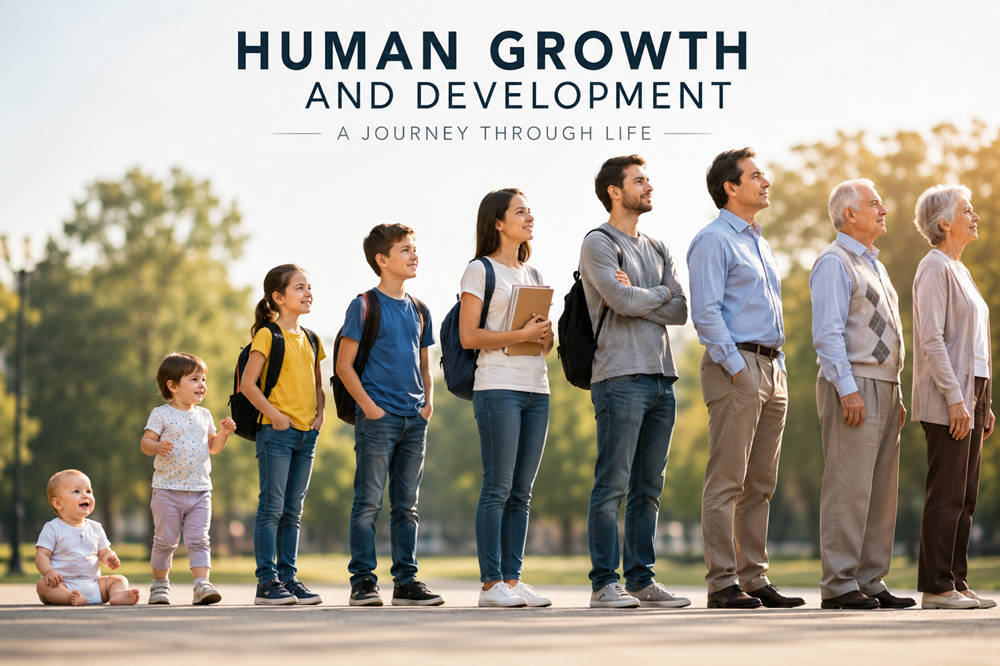
Human growth and development is the process of change that begins before birth and continues across the lifespan. It includes visible changes such as increases in body size and puberty, but it also covers changes in thinking, language, emotions, relationships, identity, skills, and the ability to adapt to new situations.
People tend to move through recognizable developmental periods, but there is no single timetable that fits everyone. Biology provides part of the foundation, while health, relationships, education, culture, opportunities, and life experiences all help shape how development unfolds.
What Is Human Growth and Development?
Growth and development are closely connected, but the terms are not completely interchangeable.
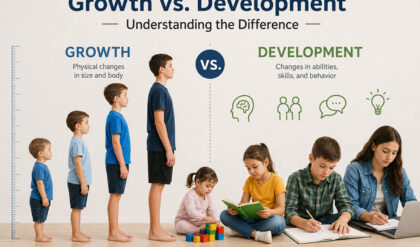
Growth often refers to biological maturation and measurable physical changes such as height, weight, body proportions, and the development of organ systems. Development is broader. It includes changes in physical functioning as well as thinking, language, behavior, emotional regulation, relationships, and other abilities.
A child gaining height is an example of growth. Learning to speak in sentences, control impulses, solve problems, or cooperate with other people reflects development. Both processes interact, especially during childhood and adolescence.
Development also extends well beyond childhood. The lifespan perspective on human development examines change from conception through older adulthood. Adults continue learning, adjusting to new responsibilities, building expertise, changing relationships, and adapting to physical and social changes.
Three Broad Domains of Human Development
Human development is often organized into three broad, overlapping domains: physical, cognitive, and social-emotional development. The categories are useful for studying development, but they rarely operate independently in everyday life.
Physical Development
Physical development involves changes in the body and biological systems. It includes brain development, sensory abilities, movement, coordination, hormones, puberty, physical maturation, and changes associated with aging.
Early physical development allows infants to gain greater control over movement and explore their surroundings. Puberty brings major biological changes during adolescence. In adulthood, the body continues to change as people mature and age.
Physical health can influence other areas of development as well. Sleep, nutrition, illness, sensory abilities, and opportunities for physical activity can affect learning, participation, independence, and social experiences.
Cognitive Development
Cognitive development concerns how people learn, remember, reason, communicate, solve problems, and make decisions.
It begins with basic processes such as recognizing familiar people and exploring objects. Over time, children develop language, memory strategies, logical reasoning, and increasingly complex ways of understanding the world. Adolescents become more capable of considering abstract ideas and future possibilities, while adults can continue gaining knowledge and expertise through education and experience.
Cognitive development is therefore broader than school achievement. It includes the changing mental tools people use to understand information and respond to problems.
Social and Emotional Development
Social and emotional development includes relationships, emotions, identity, personality, attachment, self-concept, communication, and the ability to function with other people.
An infant forming relationships with caregivers, a child learning to cooperate, an adolescent exploring identity, and an adult adapting to changing family or workplace roles are all examples.
These changes are closely connected with physical and cognitive development. A person’s ability to communicate, understand another perspective, regulate emotions, or make decisions can influence how relationships develop.
Major Stages of Human Growth and Development
Researchers use developmental periods to organize the lifespan. Their exact boundaries can vary between frameworks, so the stages are better understood as broad guides than rigid age divisions.
| Stage | Common Areas of Development |
|---|---|
| Prenatal development | Formation, biological growth, and development before birth |
| Infancy and toddlerhood | Movement, attachment, communication, exploration, and rapid physical growth |
| Early childhood | Language, play, independence, imagination, and emotional regulation |
| Middle childhood | Learning, reasoning, friendships, competence, and skill building |
| Adolescence | Puberty, identity, more complex thinking, and increasing independence |
| Early adulthood | Work, relationships, adult responsibilities, and life direction |
| Middle adulthood | Changing responsibilities, adaptation, relationships, and physical change |
| Late adulthood | Aging, continued adaptation, relationships, independence, and meaning |
Prenatal Development
Human development begins at conception. During the prenatal period, a single fertilized cell develops into an increasingly complex organism, with major changes occurring in the brain, nervous system, organs, and body structure.
Genes influence this process, but prenatal conditions matter too. Nutrition, maternal health, infections, harmful exposures, and other environmental factors can affect development before birth. The prenatal stage therefore shows from the beginning that biological and environmental influences work together.
Infancy and Toddlerhood
The first years of life involve rapid development in movement, communication, learning, and relationships. Infants gradually gain greater control over their bodies, respond to familiar people, explore their surroundings, and begin communicating through sounds, gestures, and eventually words.
Toddlerhood brings expanding mobility and independence. Walking and growing language abilities give children more ways to explore, express preferences, imitate others, and solve simple problems.
Relationships are especially important during these early years. A 2025 National Academies review of early relational health describes responsive, supportive relationships as important to healthy development, learning, resilience, and social-emotional growth.
Early Childhood
Early childhood brings major advances in language, imagination, independence, self-control, and social understanding.
Play is an important part of this period because it creates opportunities to use language, experiment with ideas, practice social behavior, solve problems, and manage emotions. Children also become increasingly capable of following routines, cooperating, communicating their needs, and understanding that other people can have thoughts and feelings different from their own.
Children do not develop every ability at the same speed. A child may be advanced in language while developing motor or social skills at a different pace.
Middle Childhood
During the school-age years, children typically build more organized academic, social, and practical skills. Reading, mathematics, attention, planning, memory strategies, and logical reasoning become increasingly important as learning demands grow.
Friendships and peer groups also become more influential. Children gain experience with cooperation, competition, belonging, disagreement, fairness, and social expectations. Successes and setbacks in school, hobbies, sports, friendships, and other activities can contribute to their developing sense of competence.
Adolescence
The World Health Organization defines adolescence as ages 10 to 19, although other developmental frameworks may use somewhat different boundaries.
Adolescence involves rapid physical, cognitive, social, and emotional change. Puberty transforms the body, while thinking becomes increasingly capable of dealing with abstract ideas, possibilities, and longer-term consequences.
Identity and independence also become more prominent. Adolescents may explore values, friendships, interests, education, work goals, and different ways of seeing themselves. Greater autonomy develops gradually, and supportive relationships with adults remain important during this transition.
Early Adulthood
Early adulthood often involves greater responsibility for education, employment, finances, relationships, and independent decision-making. The exact sequence differs widely. Some people pursue higher education, others begin full-time work, some form long-term partnerships or families, and many combine several paths.
This period can also involve considerable skill development. Experience in work, relationships, financial decisions, and everyday responsibilities creates new opportunities to improve judgment, communication, problem-solving, and specialized knowledge.
Middle Adulthood
Middle adulthood often brings changes in both responsibilities and priorities. Careers may develop or shift, family relationships change, children may become more independent, and some adults take on greater responsibility for aging relatives.
Physical changes can become more noticeable as well, although their timing and effects differ greatly between individuals. Health, lifestyle, environment, economic circumstances, and earlier experiences all influence how this period is experienced.
Adaptation becomes particularly important as people balance established skills and relationships with changing demands.
Late Adulthood
Older adulthood is highly diverse. Two people of the same chronological age can differ substantially in physical ability, health, independence, cognitive performance, relationships, and daily activities.
Some changes in memory, learning speed, sensory abilities, mobility, or physical strength can accompany normal aging. However, significant cognitive impairment is not an inevitable part of getting older. The National Institute on Aging notes that older adults remain capable of learning new skills, forming new memories, and improving some language abilities even as certain cognitive processes change.
Social connection, environment, health, accessibility, financial resources, and opportunities to participate in meaningful activities can strongly affect later life. This is why age alone provides an incomplete picture of a person’s abilities.
What Shapes Human Growth and Development?
No single factor determines how a person develops. Human development emerges from continuous interaction among biological characteristics, relationships, health, learning opportunities, culture, and the wider environment.
Genetics and Biology
Genes influence physical traits and many aspects of biological development. Hormones, brain development, nervous-system maturation, and other biological processes also contribute to changes across the lifespan.
Biology does not operate in isolation, however. Genetic tendencies develop within particular environments, and people with similar biological characteristics can have very different experiences and outcomes.
Nutrition and Health
Nutrition provides the energy and nutrients needed for physical growth and normal body function, particularly during periods of rapid development.
Health can also influence opportunities to learn, attend school or work, move independently, form relationships, and participate in everyday activities. Sleep, illness, disability, health care, physical activity, and environmental conditions can therefore affect several areas of development at once.
Relationships
People develop through interaction with other people. Early caregivers provide opportunities for communication, emotional connection, learning, and regulation. Later, teachers, friends, partners, mentors, coworkers, family members, and community relationships can shape skills, beliefs, confidence, identity, and behavior.
The importance of relationships changes across the lifespan, but social environments remain part of human development rather than becoming irrelevant after childhood.
Education and Experience
Formal education can develop knowledge, language, reasoning, and specialized skills, but learning extends far beyond classrooms.
People learn through play, observation, conversations, practice, work, hobbies, reading, experimentation, mistakes, and interaction with others. The opportunities available in a person’s environment influence which abilities can be practiced and strengthened.
Culture and Social Environment
Culture helps shape expectations about family, independence, education, work, communication, aging, relationships, and appropriate behavior at different stages of life.
The broader social environment matters too. Access to safe housing, food, education, health care, transportation, supportive communities, and economic resources can expand or restrict developmental opportunities.
These influences are interconnected. A person’s biology can affect how they respond to an environment, while experiences can influence how biological tendencies are expressed. Development is therefore better understood as an interaction of influences than as a simple competition between “nature” and “nurture.”
Three Influential Theories of Human Development
Developmental theories provide different ways of explaining how and why people change. They are frameworks rather than complete descriptions of every person.
Piaget and Cognitive Development
Jean Piaget proposed that children actively build their understanding of the world and that their thinking changes in broad stages. His work helped establish the idea that children’s reasoning differs in important ways from adult reasoning rather than simply containing less information.
Modern research shows more flexibility and individual variation than a rigid reading of Piaget’s stages suggests, but his work remains influential in the study of cognitive development.
Erikson and Psychosocial Development
Erik Erikson described development across eight psychosocial stages spanning the lifespan. His framework focused on challenges involving trust, autonomy, identity, relationships, contribution, and reflection.
One of its most important contributions was treating adulthood and older age as meaningful developmental periods rather than viewing psychological development as something completed in childhood.
Vygotsky and the Social Side of Learning
Lev Vygotsky emphasized that cognitive development occurs within a social and cultural context. People learn through interaction with others and through cultural tools, especially language.
This approach highlights why development cannot be explained only by what happens inside an individual. Families, teachers, peers, communities, and cultures help create the environments in which learning takes place.
Development Does Not Follow One Exact Timeline
Age ranges, stages, and milestones can help us understand common developmental patterns, but they are not deadlines that every person must meet at exactly the same time.
This distinction is especially important in early childhood. Developmental milestones describe abilities that most children can perform by certain ages, such as particular ways of moving, communicating, playing, or interacting.
The CDC’s developmental milestone guidance makes clear that its milestone checklists are intended for developmental monitoring and communication. They are not developmental standards, screening tests, or diagnostic tools.
If a child repeatedly misses expected milestones, loses abilities they previously had, or raises other developmental concerns, discussing those concerns with a qualified health professional is more useful than trying to reach a diagnosis from an online checklist. Formal developmental screening uses validated tools and provides a more appropriate next step when concerns arise.
Variation also continues beyond childhood. People can develop different abilities at different rates because their health, experiences, environments, responsibilities, opportunities, and individual characteristics differ.
Why Understanding Human Development Matters
Knowledge of human development can improve the way we interpret behavior and set expectations.
Parents and caregivers can use developmental knowledge to better understand children’s changing abilities and needs. Teachers can adjust learning and communication to match students’ developing cognitive and social skills. Health and support professionals can consider how age, environment, relationships, and life circumstances interact.
A lifespan perspective is useful for adults too. It shows that learning, adaptation, and skill development remain relevant when careers change, relationships evolve, responsibilities increase, or aging creates new challenges.
It also provides a reason to be careful about comparisons. Two people can be the same age while having very different developmental histories, resources, strengths, health conditions, opportunities, and responsibilities.
Human Development Is a Lifelong Interaction
Human growth and development includes far more than getting taller or moving from childhood into adulthood. It is the combined process of physical maturation, learning, thinking, emotional change, relationship building, and adaptation across life.
Common developmental patterns help us understand the lifespan, but they do not create one correct path for everyone. Genes, health, relationships, education, culture, environment, and experience continually interact to shape individual development.
Understanding that interaction gives us a more realistic view of human growth: people share many developmental needs and transitions, yet each person moves through life with a distinct combination of abilities, experiences, challenges, and opportunities for continued learning.