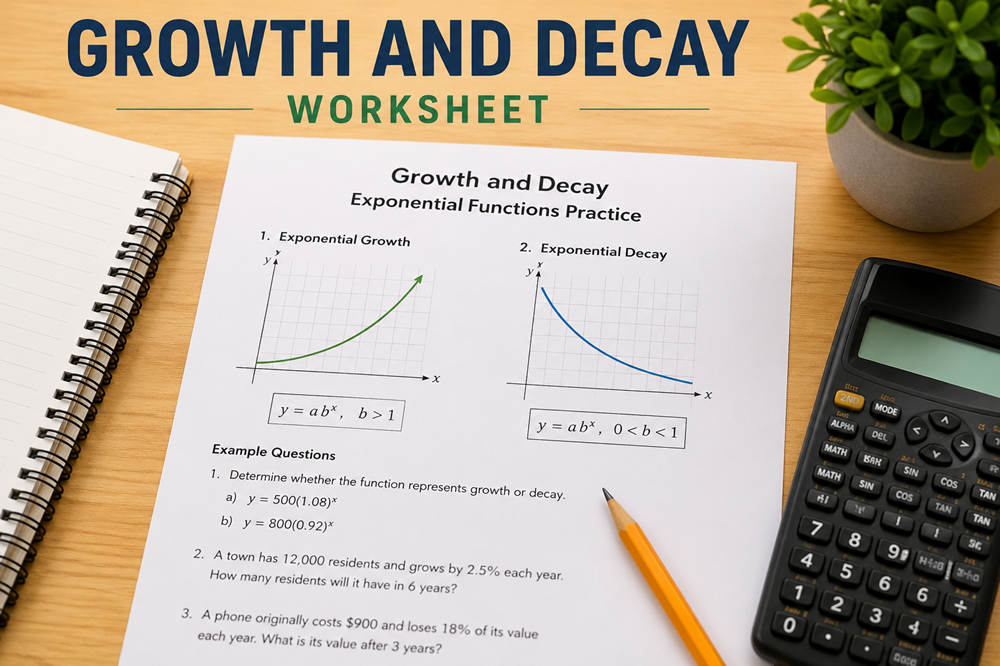
Exponential growth and decay problems are easier when you can identify four things: the starting value, the percentage rate, the growth or decay factor, and the number of time periods. This growth and decay worksheet gives you practice with each of those skills before moving into tables, word problems, and comparisons between linear and exponential change.
The worksheet is designed primarily for Algebra 1 students. A calculator is useful for the later problems, and a complete answer key is included below.
Growth and Decay Quick Reference
A common exponential model is:
y = abx
- a is the value when x = 0, which is usually the starting value in a growth or decay problem.
- b is the growth or decay factor.
- x tells how many equal periods have passed.
- y is the resulting value.
The factor and percentage rate are related, but they are not the same thing.
| Type of Change | Factor | Example |
|---|---|---|
| Growth | 1 + r | 8% growth → 1.08 |
| Decay | 1 – r | 8% decay → 0.92 |
Here, r is the percentage rate written as a decimal. A factor greater than 1 indicates growth, while a positive factor below 1 indicates decay.
This worksheet focuses on situations where the same percentage change is applied once during each equal period. The basic structure of exponential functions also explains why repeated multiplication, rather than repeated addition, produces exponential change.
Common Percentage Conversions
| Change | Decimal Rate | Factor |
|---|---|---|
| 5% growth | 0.05 | 1.05 |
| 12% growth | 0.12 | 1.12 |
| 5% decay | 0.05 | 0.95 |
| 12% decay | 0.12 | 0.88 |
Two Worked Examples
Example 1: Find the Type of Change and Rate
Consider the function:
y = 500(1.06)x
The initial value is 500. The factor is 1.06, which is greater than 1, so the function represents growth.
To find the rate:
1.06 – 1 = 0.06 = 6%
The model represents 6% growth per period.
Example 2: Write a Decay Model
A computer is worth $2,000 and loses 18% of its value each year.
The amount remaining each year is:
1 – 0.18 = 0.82
The model is:
V(t) = 2000(0.82)t
The 2,000 is the starting value, 0.82 is the decay factor, and t represents years.
Growth and Decay Worksheet
Complete the problems before checking the answer key. Round decimal answers to the nearest hundredth unless a problem calls for a whole-number answer.
Part A: Identify Growth or Decay
For each function, identify whether it represents growth or decay. Then give the initial value, factor, and percentage rate.
- y = 40(1.12)x
- y = 900(0.93)x
- y = 125(1.045)t
- y = 2000(0.82)n
- y = 7.5(1.30)m
- y = 640(0.975)t
Part B: Convert Rates to Factors
Write the correct exponential factor for each percentage change.
- 7% growth
- 16% decay
- 2.5% growth
- 35% decay
- 12.5% growth
- 4% decay
Part C: Write an Exponential Function
Write an exponential model for each situation.
- A town starts with 1,500 residents and grows by 6% each year.
- A car is worth $28,000 and depreciates by 14% each year.
- A bacteria culture begins with 450 bacteria and increases by 25% each hour.
- A laptop is worth $1,800 and loses 20% of its value each year.
- A savings balance starts at $3,200 and increases by 3.2% each year.
- Under a simplified mathematical model, 120 milligrams of a substance is present initially and the amount remaining decreases by 15% each hour.
Part D: Read Tables and Graph Information
Exponential relationships have the same multiplicative factor over equal intervals. This is different from a linear relationship, which has the same additive difference over equal intervals. That distinction is central to Algebra 1 work with exponential functions.
19. Determine whether the table represents growth or decay. Find the factor, rate, and exponential function.
| x | y |
|---|---|
| 0 | 80 |
| 1 | 100 |
| 2 | 125 |
| 3 | 156.25 |
20. Determine whether the table represents growth or decay. Find the factor, rate, and exponential function.
| x | y |
|---|---|
| 0 | 500 |
| 1 | 400 |
| 2 | 320 |
| 3 | 256 |
21. An exponential graph passes through the points (0, 250), (1, 200), and (2, 160). Determine whether it shows growth or decay. Find the initial value, factor, rate, and equation.
22. An exponential graph passes through the points (0, 60), (1, 90), and (2, 135). Determine whether it shows growth or decay. Find the initial value, factor, rate, and equation.
Part E: Evaluate Exponential Models
Evaluate each function at the given value of t.
- y = 500(1.08)t when t = 4
- y = 2400(0.90)t when t = 3
- y = 120(1.15)t when t = 5
- y = 7500(0.94)t when t = 6
Part F: Growth and Decay Word Problems
- A town has 18,000 residents. Its population grows by 2.5% each year. Approximately how many residents will it have after 8 years?
- A new phone costs $950 and loses 22% of its value each year. What is its modeled value after 3 years?
- A social media account has 12,000 followers and grows by 18% each month. If that rate continued unchanged, approximately how many followers would it have after 6 months?
- Under a simplified mathematical model, 200 milligrams of a substance is initially present and 30% disappears each hour. How much remains after 4 hours?
- A wildlife population begins at 6,400 animals and grows by 4% each year. If the model continues, approximately how many animals will there be after 5 years?
- A machine originally costs $65,000 and depreciates by 9% annually. What is its modeled value after 7 years?
Part G: Linear or Exponential?
Not every increasing quantity represents exponential growth. Use these problems to distinguish repeated addition from repeated multiplication.
33. Two accounts each start with $500.
- Account A gains $50 every month.
- Account B grows by 8% every month.
Find the value of each account after 12 months. Which account is larger at that point?
34. Compare the two tables. Identify which is linear and which is exponential. For the exponential table, give the percentage growth rate.
| x | Table A | Table B |
|---|---|---|
| 0 | 200 | 200 |
| 1 | 230 | 230 |
| 2 | 260 | 264.50 |
| 3 | 290 | 304.175 |
Challenge Problems
- A quantity grows from 500 to 605 in two years at a constant annual percentage rate. Find the annual growth rate.
- An exponential decay model has a factor of 0.90. After three periods, its value is 729. Find the initial value.
Growth and Decay Worksheet Answer Key
Part A Answers
- Growth: initial value 40; factor 1.12; rate 12%.
- Decay: initial value 900; factor 0.93; rate 7%.
- Growth: initial value 125; factor 1.045; rate 4.5%.
- Decay: initial value 2,000; factor 0.82; rate 18%.
- Growth: initial value 7.5; factor 1.30; rate 30%.
- Decay: initial value 640; factor 0.975; rate 2.5%.
Part B Answers
- 1.07
- 0.84
- 1.025
- 0.65
- 1.125
- 0.96
Part C Answers
- P(t) = 1500(1.06)t
- V(t) = 28000(0.86)t
- B(h) = 450(1.25)h
- V(t) = 1800(0.80)t
- A(t) = 3200(1.032)t
- M(h) = 120(0.85)h
Part D Answers
19. Growth. Each output is multiplied by 1.25, so the growth rate is 25%. y = 80(1.25)x
20. Decay. Each output is multiplied by 0.80, so the decay rate is 20%. y = 500(0.80)x
21. Decay. The initial value is 250 and the factor is 0.80, giving a 20% decay rate. y = 250(0.80)x
22. Growth. The initial value is 60 and the factor is 1.50, giving a 50% growth rate. y = 60(1.50)x
Part E Answers
- 500(1.08)4 ≈ 680.24
- 2400(0.90)3 = 1,749.60
- 120(1.15)5 ≈ 241.36
- 7500(0.94)6 ≈ 5,174.02
Part F Answers
- 18,000(1.025)8 ≈ 21,931. Approximately 21,931 residents.
- 950(0.78)3 ≈ $450.82.
- 12,000(1.18)6 ≈ 32,395. Approximately 32,395 followers.
- 200(0.70)4 ≈ 48.02. About 48.02 milligrams remain under the simplified model.
- 6,400(1.04)5 ≈ 7,787. Approximately 7,787 animals.
- 65,000(0.91)7 ≈ $33,589.47.
Part G Answers
33. Account A changes by a constant amount, so it is linear:
500 + 50(12) = $1,100
Account B changes by a constant percentage, so it is exponential:
500(1.08)12 ≈ $1,259.09
After 12 months, Account B is approximately $159.09 larger.
34. Table A is linear because it increases by 30 each time. Table B is exponential because each output is multiplied by 1.15. Its growth rate is 15%.
Challenge Answers
35. Start with:
605 = 500b2
Dividing by 500 gives b2 = 1.21, so b = 1.10. The annual growth rate is 10%.
36. Use:
729 = a(0.90)3
Because 0.903 = 0.729:
a = 729 ÷ 0.729 = 1,000
The initial value is 1,000.
Common Growth and Decay Mistakes
Confusing the Rate With the Factor
If a quantity grows by 15%, the number 0.15 is the rate, not the factor. The factor must include the original 100%:
100% + 15% = 115% = 1.15
Using the Amount Lost Instead of the Amount Remaining
Suppose an object depreciates by 20%. The model needs the 80% that remains after each period, so the decay factor is 0.80.
Looking for a Constant Difference in an Exponential Table
A constant difference signals a linear pattern. For an exponential pattern, divide consecutive output values and look for a constant factor.
Counting the Time Periods Incorrectly
The exponent records how many times the factor is applied. Check the units carefully. Six months and six years produce very different models when the stated rate is annual.
Rounding During Intermediate Steps
Keep the calculator value through the calculation and round at the end. Repeated early rounding can make the final answer less accurate.
Quick Checklist for Solving Growth and Decay Problems
- Find the starting value.
- Identify the percentage rate.
- Convert the percentage to a decimal.
- Decide whether the situation shows growth or decay.
- Convert the rate into the correct factor.
- Write the exponential model.
- Check the unit of each time period.
- Substitute the number of periods.
- Calculate before rounding.
- Check whether the result is reasonable for the situation.
Getting Better at Exponential Growth and Decay
The key is learning to see the pattern behind the numbers. Linear change repeatedly adds or subtracts an amount, while exponential change repeatedly multiplies by a factor. Once you can identify the starting value and that factor, writing and evaluating most introductory growth and decay models becomes much more straightforward.
If a problem feels difficult, begin with a simpler question: What percentage of the previous amount remains or is carried forward to the next period? That usually reveals the factor you need.