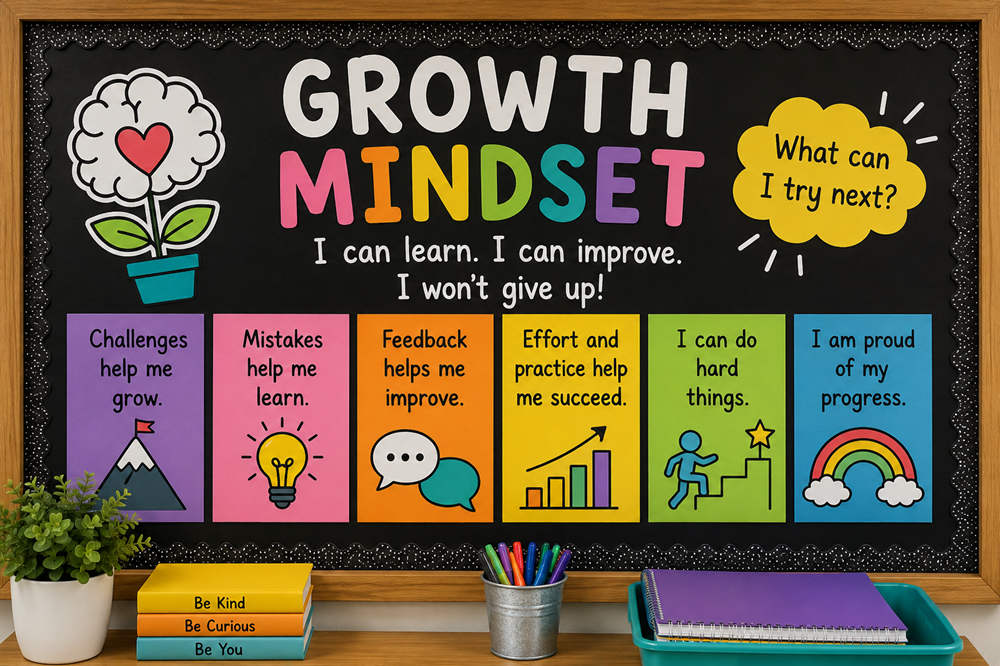
A growth mindset bulletin board can be more than colorful classroom decoration. At its best, it gives students useful reminders for the moments when learning becomes difficult: try another strategy, use feedback, break the problem into smaller steps, or recognize how much you have already improved.
The idea behind a growth mindset is not simply to tell students to work harder. Skills and understanding can develop through learning, effective strategies, practice, feedback, reflection, and revision. A good bulletin board makes those behaviors visible and gives teachers language they can refer to during everyday lessons.
Here are 15 growth mindset bulletin board ideas that can become practical classroom tools rather than posters students stop noticing after the first week.
What Is a Growth Mindset Bulletin Board?
A growth mindset bulletin board is a classroom display that reinforces the idea that students can develop their knowledge and abilities rather than treating their current performance as permanent.
Stanford’s growth mindset guidance highlights approaches such as taking on challenges, trying new strategies, reframing setbacks as opportunities to learn, responding to feedback, and continuing to work toward difficult goals.
A classroom board can reinforce those ideas with simple reminders such as:
- Challenges are part of learning.
- Mistakes can show you what to work on next.
- Not knowing something yet does not mean you cannot learn it.
- Feedback can improve the next attempt.
- A different strategy may work when the first one does not.
- Progress can be more useful to notice than perfection.
A bulletin board is best treated as a classroom reminder, not a growth mindset intervention by itself. Its value comes from the conversations, teaching practices, feedback, strategies, and learning routines connected to it.
15 Growth Mindset Bulletin Board Ideas
1. The Power of Yet
Build the board around one small but useful word: yet.
Display unfinished-learning statements such as:
- I don’t understand fractions yet.
- I can’t solve this kind of problem yet.
- I haven’t finished a chapter book on my own yet.
- I don’t feel confident presenting to the class yet.
The point is not to promise that everything will become easy. “Yet” simply turns a permanent-sounding conclusion into something still in progress.
Make the display interactive by letting students write one “not yet” statement at the beginning of a unit and revisit it later.
2. Change Your Words, Change Your Approach
This board focuses specifically on self-talk. Divide it into two columns: Instead of… and Try…
For example:
Instead of: “I’m bad at math.”
Try: “Which part of this problem do I need help understanding?”
Instead of: “This is impossible.”
Try: “What’s one part I can start with?”
Instead of: “Everyone else gets it.”
Try: “What question could help me understand it?”
Avoid replacing every negative statement with empty positivity. The alternative should point students toward an action they can take.
3. Mistakes Help Us Learn
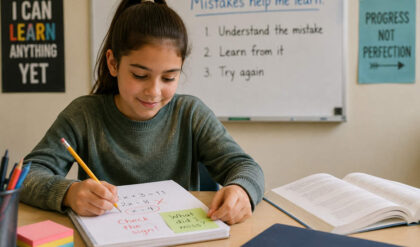
Turn this display into a reflection space with three prompts:
What happened?
What did I learn?
What will I try next?
Students can respond on index cards or sticky notes.
For example:
I missed part of the question because I read too quickly. Next time, I’m going to underline what the question is asking before I solve it.
The point is not that mistakes are automatically good. Their value comes from noticing what happened and using that information to improve the next attempt.
4. Our Learning Journey
Use a road, staircase, mountain trail, stepping stones, or another visual path to show the stages of learning.
A simple sequence could be:
Try → Check → Get Feedback → Adjust → Practice → Improve
This board teaches something different from a progress chart. Instead of measuring how far each student has advanced, it shows what the learning process can look like.
Avoid turning the path into a race. Students may move through the stages at different speeds or return to an earlier step when they need a new strategy.
5. Watch Our Skills Grow
A tree, garden, or plant theme works well when the board is used to record specific skills students have developed.
Students might add a leaf or flower when they can say something concrete such as:
- I can divide two-digit numbers.
- I can write a clearer topic sentence.
- I can identify the main idea without help.
- I can cite evidence from a text.
- I can organize my notes before a test.
This keeps the focus on observable learning rather than vague statements about becoming “smarter.”
6. Fixed Response or Growth Response?
Make this one an activity rather than another collection of replacement phrases.
Place response cards on the board and ask students to sort or discuss them.
Examples might include:
- “I’m just not good at this.”
- “Which strategy could I try next?”
- “I don’t want feedback because I might have to change my work.”
- “I haven’t figured this out yet.”
- “I’ll look at the example and compare it with my answer.”
The discussion matters more than the labels. Students can also talk about how the same person might respond confidently in one subject and feel much more fixed or discouraged in another.
7. Strategies I Can Try When I’m Stuck
This may be the most practical board on the list because students can use it while they are actually working.
Fill it with strategies such as:
- Reread the directions.
- Identify what you already know.
- Break the task into smaller steps.
- Look at an example.
- Draw or diagram the problem.
- Check your notes.
- Explain your thinking aloud.
- Try another method.
- Use feedback from your last attempt.
- Ask a specific question.
This reflects an important part of growth-oriented learning: persistence can matter, but students also need strategies and opportunities to adjust their approach.
8. What Can I Try Next?
Unlike the self-talk board in idea #2, this display is designed specifically for moments when a student reaches an obstacle.
Create speech bubbles containing common problems and pair each one with a next-step question.
“I can’t write this introduction.”
Could I write the main point first and come back to the introduction?
“I don’t understand this chapter.”
Where did I first become confused?
“My answer keeps coming out wrong.”
Which step can I check separately?
The board helps students turn a broad feeling of “I can’t do this” into a smaller problem they can investigate.
9. Challenge Accepted
Give students a place to name something they are currently working to improve.
Each challenge card can contain three parts:
My challenge:
My next strategy:
What happened:
A student might identify public speaking, multiplication facts, essay organization, reading fluency, time management, or another skill appropriate to the class.
The purpose is to make challenges specific enough that students can choose an action and later reflect on the result.
10. Progress, Not Perfection
Use this board for actual before-and-after examples.
You might display:
- a first draft beside a revision
- an early math solution beside a corrected method
- an initial science diagram beside an improved version
- early handwriting beside later handwriting
- a first attempt at a project beside a later attempt
The physical evidence makes improvement visible in a way a slogan cannot.
Respect student privacy and confidence when displaying unfinished work. Participation can be voluntary, and anonymous examples can work just as well.
11. Our Classroom Learning Toolbox
Design the display as a toolbox in which every paper tool represents something students can use to learn.
Possible tools include:
- Practice: Build familiarity and fluency.
- Feedback: Find out what to improve.
- Questions: Clarify what you do not understand.
- Revision: Strengthen an earlier attempt.
- Planning: Decide how to approach a task.
- Collaboration: Learn through explaining and discussing ideas.
- Reflection: Notice what worked and what could change.
The toolbox metaphor makes the message clear: there is no single response that works for every learning problem.
12. Question of the Week
Instead of filling this board with answers, give students one useful reflection question at a time.
Rotate prompts such as:
- What was difficult for you this week?
- Which strategy helped you?
- What would you change if you tried again?
- What became easier with practice?
- When did feedback change your work?
- What are you still learning?
Students can add brief responses to the board or discuss the question as a class.
Giving students meaningful opportunities to reflect and contribute also supports student voice, which can help students become more active participants in their learning environment.
13. Small Wins
This board focuses on learning behaviors and improvements that might not appear on an honor roll or high-score chart.
Examples include:
- I asked for help when I needed it.
- I revised instead of submitting my first draft.
- I studied over several days instead of one night.
- I finished a book that challenged me.
- I used feedback from my previous assignment.
- I explained my reasoning to my group.
The emphasis should stay on individual progress rather than comparing students with one another.
14. Goal → Strategy → Evidence
This board connects a desired improvement with the action used to pursue it and evidence that something changed.
For example:
Goal: Improve spelling accuracy.
Strategy: Practice five difficult words each evening and group them by spelling pattern.
Evidence: I spelled 17 out of 20 correctly this week instead of 12.
This format teaches students that a goal becomes more useful when it is paired with a plan and a way to notice progress.
15. Quote or Thought of the Month
A motivational statement can still have a place on a growth mindset bulletin board, but give students something to do with it.
For example:
Try. Learn. Adjust.
When did changing your strategy help you this month?
Or:
Learning in progress.
What can you do now that was difficult at the beginning of the term?
Changing one statement periodically is often more useful than covering an entire wall with slogans. If you use a quotation attributed to a real person, verify the wording and attribution first. Original classroom phrases avoid that problem entirely.
Growth Mindset Sayings and Bulletin Board Titles
If you want short wording that can be read across the classroom, keep it concrete and action-oriented.
For Challenges
- Hard does not mean impossible.
- Start with what you know.
- Break the challenge into smaller steps.
- You don’t know it yet.
- What can you try next?
For Mistakes and Progress
- Mistakes give us information.
- Check it. Learn from it. Try again.
- Notice how far you’ve come.
- Small improvements add up.
- Revision is part of learning.
For Strategies
- Try another way.
- Use the feedback.
- Ask a better question.
- Break it into steps.
- Change the strategy when you need to.
Short Bulletin Board Titles
- The Power of Yet
- Learning in Progress
- Watch Our Skills Grow
- Our Learning Toolbox
- Try, Learn, Adjust
- Progress Happens Here
- What’s Your Next Step?
- Goal. Strategy. Progress.
A Simple Growth Mindset Bulletin Board You Can Copy
If you want something quick to build, try a board titled:
WHAT CAN I TRY NEXT?
Create six large cards underneath:
- Reread — Read the directions one more time.
- Break It Down — Choose one smaller part to work on first.
- Look Back — Check your notes or an example.
- Ask — Ask one specific question about what is confusing you.
- Use Feedback — Look at what you were told to improve last time.
- Try Another Way — Change your method rather than repeating something that is not working.
Leave a section at the bottom labeled:
This week I tried…
Students can add sticky notes describing a strategy they used.
This setup is inexpensive, easy to understand, and flexible enough for many subjects. More importantly, it gives students an actual response to “I’m stuck” rather than simply telling them to stay positive.
Growth Mindset Bulletin Boards by Grade Level
| Grade Level | What Works Best |
|---|---|
| Elementary | Simple language, pictures, “yet” statements, visual metaphors, and concrete examples of skills improving |
| Middle School | Realistic self-talk, reflection questions, learning strategies, feedback, goals, and student contributions |
| High School | Academic strategies, study habits, revision, feedback, goal tracking, and evidence of progress |
For elementary students, visual themes such as gardens, stepping stones, mountains, and toolboxes can make abstract ideas easier to understand.
Middle school students often respond better when the language feels natural rather than overly cute. Give them chances to contribute their own strategies and reflections.
For high school, the display can look more like an academic resource than traditional classroom decor. A board devoted to revision strategies, test reflection, feedback, or study approaches may be more useful than motivational characters or slogans.
How to Make the Board Useful All Year
You do not need to rebuild the bulletin board every month. A simple structure can last for much of the school year if the content changes with what students are learning.
Choose One Main Purpose
Decide what the board is supposed to help students do. It might focus on handling mistakes, choosing strategies, using feedback, recognizing progress, or setting goals.
A board trying to communicate every growth mindset idea at once will usually become cluttered.
Leave Room for Student Contributions
Reserve part of the display for reflections, questions, challenges, examples, progress notes, or revised work.
A finished-looking board with no space for change may quickly fade into the background.
Teach Students How to Use It
Introduce the board instead of assuming students will understand its purpose.
If it includes a list of strategies, demonstrate how to choose one. If it contains reflection prompts, use one after an assignment. If it tracks goals, show what a specific, workable goal looks like.
Refer to It During Real Challenges
The display becomes more meaningful when its language appears during everyday instruction.
When someone is stuck, you might ask, “Which strategy on the board could help?” After students receive feedback, ask them to identify one change they will make. After completing a difficult unit, invite them to notice what improved.
Rotate the Content, Not Necessarily the Whole Design
Keep the basic board but periodically change:
- reflection questions
- student examples
- current goals
- strategy cards
- challenges
- before-and-after work
During a difficult unit, the board might emphasize what to do when students are stuck. Before a revision project, it can focus on using feedback. Near the end of a term, it can highlight evidence of progress.
Growth Mindset Bulletin Board Mistakes to Avoid
Turning Growth Mindset Into “Just Try Harder”
Effort matters, but repeating an ineffective approach is not always productive.
Students may need a new strategy, clearer instruction, feedback, more practice, additional support, or help identifying what they misunderstand. Formative feedback can help students recognize gaps in understanding and identify approaches that need to change.
Instead of only saying, “Keep trying,” ask:
- What have you tried so far?
- Where did you get stuck?
- What does the feedback tell you?
- Could another strategy work better?
Making Every Message Unrealistically Positive
Students do not have to enjoy every challenge.
Learning can be frustrating, and disappointment after a poor result is normal. A growth-oriented response does not deny those feelings. It helps the student identify what can happen next.
Celebrating Mistakes Without Learning From Them
“Mistakes are great!” can become another empty slogan.
A more useful message is: Mistakes give us information.
Ask what the mistake revealed, what needs to change, or what the student will try differently.
Labeling Students
Avoid identifying children as “fixed mindset students” or “growth mindset students.”
People can respond differently depending on the task and situation. A student who welcomes feedback in art may become discouraged during math, while another student may show the opposite pattern.
Focus on changeable responses and strategies rather than attaching a mindset label to the person.
Making the Board Decorative but Unusable
Before finishing the display, ask one question:
What can a student actually do with this board?
If the answer is only “read it,” consider adding strategy cards, reflection prompts, student examples, movable pieces, or another element that connects it to real classroom work.
Final Thoughts
The most useful growth mindset bulletin board is not necessarily the one with the most decorations. It is the one students and teachers can refer to when learning becomes difficult.
A simple reminder to ask “What can I try next?”, use feedback, recognize progress, or reconsider an unsuccessful strategy can give the board a genuine purpose.
Choose one idea that fits your students, leave room for their contributions, and connect the display to the challenges they encounter in class. That is what turns a growth mindset bulletin board from wall decor into a practical learning tool.