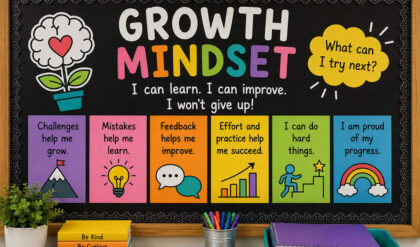
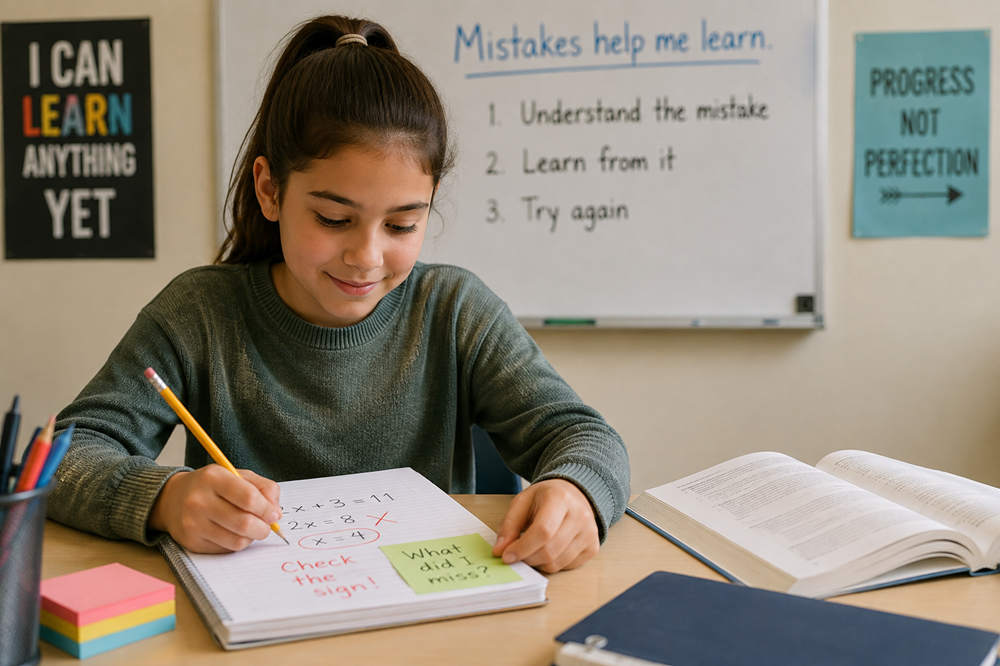
Students with a growth mindset tend to see mistakes as feedback, not proof that they lack ability. A mistake can show them what they have not mastered yet and help them decide what to practice, change, or ask for help with next.
That does not mean they enjoy getting things wrong. The difference is that an error becomes something to investigate rather than a final judgment about intelligence or potential.
What a Growth Mindset Means When a Student Makes a Mistake
A growth mindset is the belief that abilities can develop through learning, practice, useful strategies, feedback, and support. In school, that belief becomes especially important when a student struggles.
A fixed-mindset reaction may turn one difficult experience into a broad conclusion: “I’m bad at math” or “I’m not a good writer.” A growth-minded response is more specific: “I don’t understand this type of problem yet” or “I need to improve how I support my argument.”
The word yet is useful because it leaves room for development without pretending success is guaranteed. Stanford’s Center for Teaching and Learning describes growth mindset in similar terms, encouraging students to reframe setbacks as opportunities for learning and improvement.
Students also do not have to approach every subject with the same mindset. Someone may believe strongly that writing improves with practice while still thinking mathematical ability is something people either have or do not have. Growth and fixed beliefs can vary by situation.
Mistakes Become Information About What to Learn Next
The central change is the meaning attached to the mistake.
Imagine that two students get the same question wrong. One thinks, “This proves I’m not smart enough.” The other asks, “Which part did I misunderstand?”
The second student is treating the error as information. It might reveal that a concept was misunderstood, an important step was skipped, instructions were misread, or the current study strategy was ineffective.
This makes the problem more manageable. “I’m terrible at science” gives a student little direction. “I keep confusing mitosis and meiosis” identifies something that can actually be reviewed and practiced.
A growth mindset therefore does not make a wrong answer correct. It changes what the student believes the wrong answer says about them and what they choose to do next.
What Research Shows About Growth Mindset and Mistakes
Research provides some support for the idea that growth-minded students respond differently to errors, although the findings should not be exaggerated.
A 2017 study involving 123 school-aged children examined brain activity while the children completed a task that required them to respond to mistakes. Children with stronger growth-mindset beliefs showed greater attention to their errors and higher accuracy after making mistakes. The researchers also found that greater attention to errors predicted better post-error accuracy.
This builds on earlier work with adults suggesting that how closely learners attend to a mistake may matter for what happens on the next attempt.
More recent research has examined what students actually do after errors. A 2024 study of 345 biology undergraduates found that stronger growth-mindset beliefs were associated with more adaptive reactions to mistakes. Those adaptive reactions were also associated with behaviors such as spacing study sessions and using effective study strategies.
Because that study examined associations, it does not prove that growth mindset directly caused the students to study differently. It does, however, reinforce an important distinction: simply believing mistakes are acceptable is not enough. What matters is responding to them in a useful way.
What Students Can Do After Making a Mistake
A growth mindset becomes practical when it leads to a better next step. Students can use a simple process after an error.
1. Find the specific problem
Replace a broad judgment such as “I don’t understand this” with a more precise question. Which step went wrong? Which concept is unclear? Was the problem knowledge, attention, interpretation, or technique?
2. Understand why it happened
Seeing the correct answer is not the same as understanding the error. A student should compare the two and identify what caused the wrong turn.
3. Choose an appropriate response
The next step may be more practice, but it may also be a different explanation, a worked example, feedback from a teacher, reviewing an earlier concept, or changing the study method.
4. Apply the correction
Students need another opportunity to use what they learned. That could mean solving a similar problem, revising a paragraph, correcting a test question, or trying the skill again with a different technique.
This turns a mistake into a short learning cycle: identify, understand, adjust, and retry.
Growth Mindset vs. Fixed Mindset After the Same Setback
Consider a student who earns a low score on a math quiz.
A fixed-mindset interpretation might be:
“I knew I wasn’t a math person.”
That conclusion treats the score as evidence of a permanent limitation and offers no obvious next action.
A growth-minded interpretation might be:
“Most of the questions I missed involved fractions. I need to figure out which part of that method I don’t understand before the next quiz.”
The student may still be disappointed with the grade. What has changed is the diagnosis. Instead of judging overall ability, the student has identified a particular skill that needs attention.
A Growth Mindset Does Not Mean “Just Try Harder”
One common misunderstanding is that growth mindset means effort always solves the problem. It does not.
A student could spend hours repeating an ineffective study method and make little progress. More effort is helpful only when the effort is connected to learning.
Stanford’s Teaching Commons cautions against reducing growth mindset to hard work alone. Students also need constructive feedback and useful learning strategies.
Sometimes growth means working harder. Other times it means:
- trying a different method;
- slowing down and checking each step;
- reviewing a prerequisite skill;
- asking a teacher or tutor for clarification;
- using practice questions instead of rereading notes; or
- taking feedback and revising the work.
A more useful growth-mindset question is therefore not simply “How can I try harder?” but “What should I change on my next attempt?”
Examples of Turning Mistakes Into Learning
Math
A student solves an algebra problem incorrectly. Instead of copying the correct answer, they compare their work with the solution and discover that they changed a sign incorrectly. On the next problems, they deliberately check that step before moving on.
Writing
A teacher says an essay makes claims without enough evidence. The student does not have to conclude that they are a poor writer. They can review each body paragraph, identify unsupported claims, and revise the essay with stronger evidence.
Test preparation
A student reviews the questions missed on an exam and notices that most errors came from one topic. Several other mistakes came from reading questions too quickly. The test now provides two useful pieces of information: what content needs review and what test-taking habit needs adjustment.
Learning a practical skill
A student writing computer code receives an error message. Rather than repeatedly running the same code, they test individual sections, locate the source of the problem, make a change, and run it again. Troubleshooting becomes part of developing the skill.
How Teachers and Parents Can Encourage a Healthy Response to Mistakes
Students do not develop their attitudes toward mistakes in isolation. The way adults respond to errors can influence whether a student investigates a mistake or tries to hide it.
Ask process-focused questions
Instead of immediately supplying the correct answer, an adult might ask, “Where do you think things went off track?” or “What could you try differently?” The goal is to help the student examine the process that produced the answer.
Allow meaningful correction
When appropriate, revisions and corrections give students a reason to use feedback. Stanford’s teaching guidance recommends learning activities that provide opportunities for reflection, feedback, and improvement rather than treating every first attempt as the end of the process.
Praise useful actions, not labels
Classic research by Claudia Mueller and Carol Dweck found that fifth graders praised for intelligence responded less adaptively after failure than children praised for effort. Later work has also shown that praise itself needs to be used thoughtfully.
Instead of relying on “You’re so smart” or automatically praising any amount of effort, adults can be more specific: “Changing your approach helped you solve that problem,” or “You used the feedback from the first draft to make your argument clearer.”
This focuses attention on strategies, progress, revision, and behaviors the student can act on again.
Model correction without embarrassment
An adult who makes a mistake can acknowledge it, correct it, and continue. That models an important idea: being capable does not require being correct on every attempt.
What Growth Mindset Can—and Cannot—Do
Growth mindset is useful, but it should not be treated as a formula that automatically raises grades.
Research on growth-mindset interventions has produced mixed conclusions. One 2023 systematic review and meta-analysis found no significant overall effect on academic achievement when examining the highest-quality evidence. Another meta-analysis published in the same journal found small positive effects when interventions were delivered with high fidelity to groups expected to benefit most, while also reporting substantial variation across studies.
A major U.S. experiment illustrates why context matters. The study included 12,490 ninth graders across 65 public schools. Among the 6,320 relatively lower-achieving students targeted in the primary analysis, a brief growth-mindset intervention was associated with an average 0.10-point improvement in core-course GPA compared with the control group. The effects also differed across school environments.
These findings suggest that mindset is only one part of learning. Students still need good instruction, effective strategies, useful feedback, opportunities to practice, and appropriate support.
Growth mindset is most useful when it helps a student stay engaged long enough to make use of those resources.
Final Takeaway
Students with a growth mindset are more likely to see mistakes as clues about what they need to learn next rather than as proof that they lack ability.
The goal is not to celebrate being wrong or pretend disappointment does not matter. It is to turn an error into a useful next action.
A student can do that by asking one simple question:
“What does this mistake show me, and what should I change on my next attempt?”
That question shifts attention away from judging ability and toward learning—the place where improvement can actually happen.