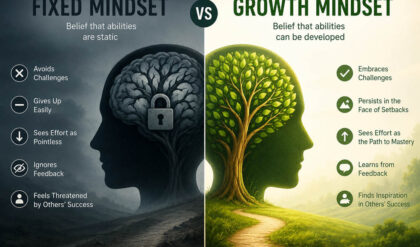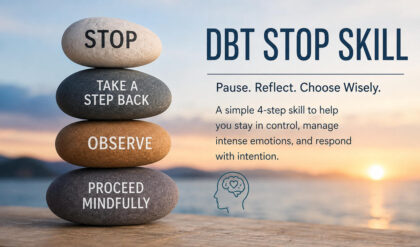
Growth mindset quotes are most useful when they change what you do next. A growth mindset is built around the idea that abilities can develop rather than being permanently fixed. That does not mean every goal is guaranteed. It means difficulty, feedback, practice, new strategies, and help from others can all be part of getting better.
This collection brings together carefully attributed quotes about learning, mistakes, persistence, and challenge, followed by a small set of original Mindset & Skills reminders you can put into practice.
Best Growth Mindset Quotes
These quotes capture the broader spirit of growth: your present ability, difficulty, or setback does not have to be the final word.
- “You may encounter many defeats, but you must not be defeated.” — Maya Angelou
- “You are not born with a fixed amount of resilience.” — Sheryl Sandberg
- “Every failed experiment is one step closer to success.” — Denzel Washington
- “Hard problems really teach you what you’re capable of.” — Lisa Su
- “Some failure in life is inevitable.” — J.K. Rowling
- “Sometimes life’s gonna hit you in the head with a brick. Don’t lose faith.” — Steve Jobs
- “The learn-it-all does better than the know-it-all.” — Satya Nadella
- “Everyone’s on a growth journey.” — Jo Boaler
The common thread is not blind optimism. Each quote leaves room for difficulty while refusing to treat difficulty as a permanent definition of your ability.
Carol Dweck Quotes About Growth Mindset
Psychologist Carol Dweck helped develop and popularize the distinction between fixed and growth mindsets. Her work is especially useful because it shows that growth mindset is more nuanced than simply telling yourself to try harder.
- “Are you not smart enough to solve it … or have you just not solved it yet?” — Carol Dweck
- “A growth mindset is when people believe that their basic abilities, their basic human qualities can be developed.” — Carol Dweck
- “These qualities can be developed through effort, perseverance, good strategies, lots of great input from others.” — Carol Dweck
- “Everyone—through effort, dedication, schooling, experience—can grow.” — Carol Dweck
The word yet is useful because it separates current performance from future possibility. “I cannot do this” sounds like a verdict. “I cannot do this yet” leaves room to learn.
Dweck’s well-known TED talk on believing you can improve also helps clarify why growth mindset is about the response to difficulty, not pretending that difficulty does not exist.
Growth Mindset Quotes About Learning and Getting Better
Learning requires being willing to spend time not knowing. These quotes focus on curiosity, education, practice, and the process of becoming more capable.
- “There’s no better use of a day than learning something new.” — Hank Green
- “My wonderful teachers … inspired me to believe in myself and be brave.” — Malala Yousafzai
- “As much as talent counts, effort counts twice.” — Angela Duckworth
- “Play is another word for experimentation, which is another word for learning.” — Patrick Jagoda
- “Being wrong, revising assumptions, testing new ideas, and rethinking the past.” — Carolyn Zola
- “To learn how to learn — throughout a lifetime.” — Martha E. Pollack
- “Lives of exploration and learning — the keys to a fulfilling life and rewarding career.” — Richard Saller
Learning is easier to continue when you stop treating confusion as evidence that you do not belong. Not understanding something can simply identify the next thing you need to investigate, practice, or ask about.
Growth Mindset Quotes About Mistakes and Failure
Failure does not automatically make a person stronger. Its value depends on whether you examine what happened and use that information afterward. These quotes emphasize that distinction.
- “Failure taught me things about myself that I could have learned no other way.” — J.K. Rowling
- “My mistakes have been necessary.” — Conan O’Brien
- “Fall down. Make a mess. Break something occasionally.” — Conan O’Brien
- “We all stumble. We all have setbacks.” — Oprah Winfrey
- “What is this here to teach me?” — Oprah Winfrey
- “Failure is not the end of the world, or even the end of the road!” — Robert Iger
- “Failure is a better teacher than success.” — Kay Bailey Hutchison
- “This isn’t a failure; it’s just a course correction.” — George Hatsopoulos
The practical question after a setback is not simply, “How do I stay positive?” A better question is, “What does this result tell me to change?” Perhaps the method was wrong, preparation was incomplete, feedback was ignored, or more practice is needed. Sometimes the goal itself needs reconsidering.
Growth Mindset Quotes About Effort and Persistence
Persistence becomes productive when effort is combined with adjustment. Working longer is not always the answer; learning how to work differently can matter just as much.
- “It’s a muscle. You can build it up.” — Sheryl Sandberg, on resilience
- “You’ve got to take risks.” — Denzel Washington
- “Stay hungry. Stay foolish.” — Steve Jobs
- “Character is created in the sum of all the little choices we make.” — Maria Ressa
- “What we do the next day is what makes us who we are.” — Melinda French Gates
- “I was a judge who worked as hard as she could to be the best of her ability to do the job right.” — Ruth Bader Ginsburg
Effort matters, but effective effort has direction. If the same approach repeatedly produces the same poor result, growth may require feedback, instruction, a different strategy, additional resources, or a more realistic intermediate goal.
Growth Mindset Quotes About Challenges
A challenging task puts you at the edge of your current ability. That is uncomfortable precisely because you cannot rely entirely on what you already know.
- “We choose to go to the Moon … not because they are easy, but because they are hard.” — John F. Kennedy
- “Even when I didn’t know the answer, I could figure it out.” — Lisa Su
- “You don’t know who you are until you’re tested.” — Maria Ressa
- “The thing that motivates you to keep going in difficult or trying circumstances.” — Jacinda Ardern
- “People who get comfortable of mind and intellect get dull.” — Cory Booker
You do not have to choose the hardest possible task to develop a growth mindset. A better approach is to choose challenges that stretch your current skills enough to require learning without making meaningful practice impossible.
Growth Mindset Quotes for Students
Growth mindset can be particularly useful in school because grades and test results can easily feel like labels. A result can describe one performance without defining everything a student could eventually learn.
- “You can improve certain skills or attributes through effort and persistence.” — Sreya Guha
- “Whatever difficulties were posed to us, we were able to meet them, adapt and exhibit a resilience that allowed us to thrive.” — Nelson Lopez
For students, the practical application is straightforward: use feedback, ask questions, revise work, experiment with study methods, practice difficult material, and look for evidence of improvement over time.
10 Short Growth Mindset Reminders from Mindset & Skills
The following lines are original editorial quotes from Mindset & Skills, not quotations attributed to historical figures or public personalities. They are designed as simple reminders for journals, planners, classrooms, or difficult moments.
- “Your current ability is a starting point, not a permanent limit.”
- “Not knowing is where learning gets its next assignment.”
- “A mistake becomes useful when it changes your next attempt.”
- “Keep the goal when it still matters; change the method when it does not work.”
- “Progress can be real before it becomes obvious.”
- “Being a beginner is part of becoming skilled.”
- “Feedback is information, not an identity.”
- “A hard problem can expose what you need to learn next.”
- “Practice with purpose, not just repetition.”
- “Your next attempt does not have to look like your last one.”
How to Use Growth Mindset Quotes in Everyday Life
Reading an encouraging sentence can improve your mood temporarily, but a growth mindset becomes useful when the thought leads to a behavior.
Choose a quote that matches the situation
If you made a mistake, choose a quote about learning from failure. If you are avoiding a difficult task, choose one about challenge. If progress feels slow, focus on learning and persistence.
The right quote should help you see the specific problem more clearly, not simply make you feel positive for a few minutes.
Turn the quote into a question
Suppose you choose the reminder, “A mistake becomes useful when it changes your next attempt.” Turn it into questions such as:
- What went wrong?
- What did I learn from the result?
- What will I change next time?
- What information am I missing?
- Who could give me useful feedback?
Now the quote has become a decision-making tool.
Pair the thought with one action
“I can improve” is encouraging but vague. Give it a next step: revise the paragraph, solve five more problems, ask the instructor a question, rehearse the presentation, review the feedback, or study the part you keep getting wrong.
Growth becomes easier to observe when intention turns into behavior.
Keep evidence of improvement
Day-to-day progress can be difficult to notice. Compare an early draft with a recent one. Save practice scores. Record how long a task takes. Revisit a problem that once confused you.
Looking backward occasionally can reveal improvement that is almost invisible while it is happening.
Growth Mindset Is More Than “Try Harder”
One of the most important misconceptions about growth mindset is that effort alone solves every problem. It does not. Stanford’s growth-mindset guidance emphasizes strategies, feedback, persistence, and support alongside effort.
The research on formal growth-mindset interventions is also more complicated than motivational slogans sometimes suggest. Recent systematic reviews have differed in how they interpret the size and reliability of intervention effects, with context, target populations, implementation, and study quality playing important roles.
That does not make the underlying idea useless. It makes the practical lesson more realistic: believing improvement is possible can encourage a different response to difficulty, but progress still depends on what you actually do, the strategies available to you, the quality of instruction or feedback, and the circumstances in which you are trying to learn.