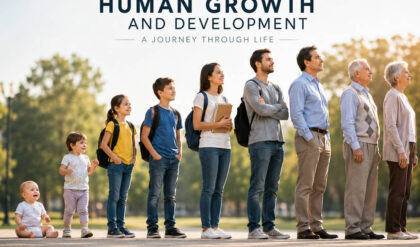
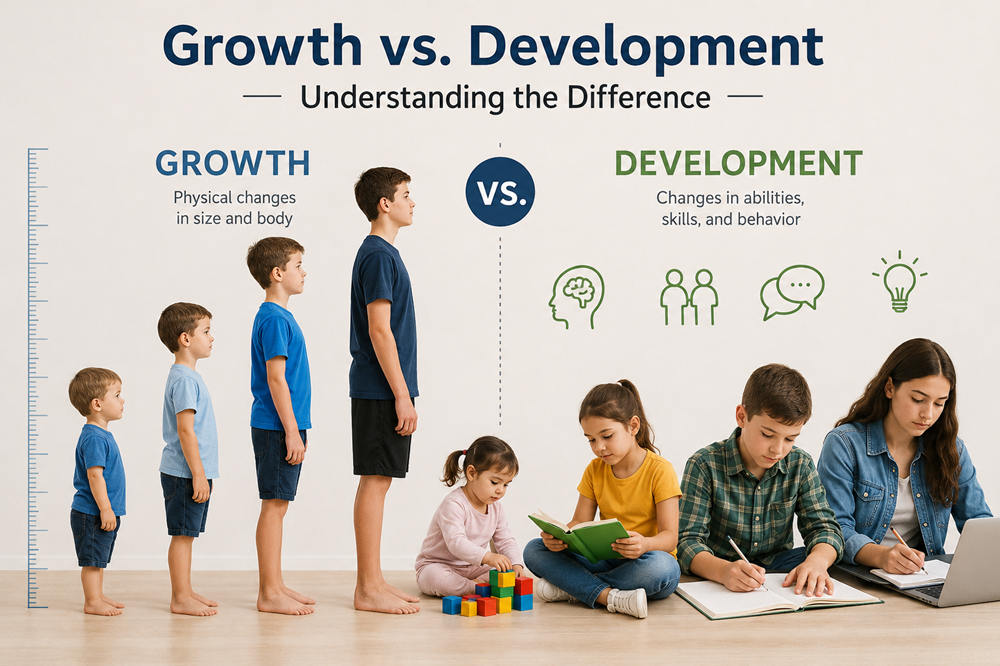
Growth and development are closely related, but they are not the same thing. Growth mainly refers to measurable physical changes in the body, while development describes broader changes in a person’s abilities and functioning over time.
A child becoming taller is an example of growth. The same child learning to speak, solve a problem, manage emotions, or cooperate with other people is experiencing development.
In the context of human development, physical growth is one part of the broader developmental process.
What Is Growth?
Growth generally refers to changes in the body’s physical size and structure. Because many of these changes can be measured directly, growth is often described in quantitative terms.
Height and weight are common examples. The World Health Organization’s child growth standards include measures such as length or height for age, weight for age, and weight for length or height to help assess physical growth in young children.
Examples of growth include:
- Becoming taller
- Changes in body weight as the body matures
- Increases in bone and muscle size
- Changes in body proportions
- Physical changes associated with puberty
Growth does not occur at exactly the same rate throughout life. It is especially noticeable during childhood and adolescence, when changes in height, weight, and body structure can happen relatively quickly.
What Is Development?
Development is a broader concept. It describes changes in how a person moves, thinks, communicates, behaves, manages emotions, relates to others, and functions in everyday life.
Development can take place across several connected areas. UNICEF describes early childhood development as multidimensional, involving physical, social, emotional, mental, and learning-related aspects of a child’s well-being.
Examples of development include:
- Learning to walk
- Learning to speak and communicate
- Improving memory and problem-solving
- Developing coordination and motor skills
- Learning to manage emotions
- Building friendships and social skills
- Becoming more independent
- Learning new skills later in life
This is why physical size alone cannot tell us how developed someone is. Two children of the same height may have different language abilities, motor skills, reasoning abilities, emotional skills, or levels of independence.
Growth vs. Development: Key Differences
| Growth | Development |
|---|---|
| Mainly concerns physical size and body structure | Concerns broader changes in abilities and functioning |
| Includes changes such as height, weight, and body proportions | Includes physical, cognitive, language, emotional, motor, and social changes |
| Often tracked using physical measurements | Can be observed through abilities, behavior, milestones, performance, and formal assessments |
| Rapid physical growth is especially noticeable during childhood and adolescence | Development can continue throughout the lifespan |
| Usually describes quantitative physical change | Can involve both quantitative and qualitative change |
The simplest distinction is that growth tells us how the body is changing physically, while development tells us how the person is changing more broadly.
Examples of Growth and Development
Everyday situations make the distinction easier to see.
A Child Becomes Taller
If a child’s height increases over the course of a year, that is growth. The physical change can be measured in inches or centimeters.
A Child Learns to Walk
Learning to walk is development. It involves balance, coordination, motor control, physical maturation, and the ability to move independently.
A Toddler Begins Speaking in Sentences
This is an example of language development. The child is becoming better able to understand words, organize language, and communicate ideas.
An Adolescent Goes Through Puberty
Adolescence shows how growth and development can occur together. Increases in height and changes in body structure are examples of physical growth. Changes in reasoning, independence, emotional regulation, identity, and relationships are part of development.
An Adult Learns a New Skill
An adult who learns another language, improves communication skills, or becomes better at solving complex problems is still developing even though that person is no longer growing taller.
How Are Growth and Development Connected?
Growth and development are different processes, but they can influence each other.
Physical maturation can provide the foundation for new abilities. Changes in the brain, nervous system, muscles, and senses can make increasingly complex activities possible. Experience, learning, practice, and interaction with other people then help those abilities develop.
Language is a good example. Biological maturation supports a child’s increasing capacity to communicate, while conversations and other language experiences help the child expand vocabulary, understand meaning, and express ideas.
Growth and development therefore should not be viewed as completely separate. Physical change can support development, while experience helps shape how emerging abilities are used.
Can Development Continue After Physical Growth Slows?
Yes. This is one of the clearest differences between the two concepts.
The rapid increases in height associated with childhood and adolescence eventually end. The body continues to change during adulthood and later life, but those changes are different from the physical growth that characterizes childhood.
Development can continue throughout life. The study of lifespan development considers physical, cognitive, and psychosocial changes from the beginning of life through adulthood and later years.
Adults can continue developing knowledge, communication abilities, professional skills, relationships, emotional regulation, and ways of adapting to new situations. Development does not mean that every ability continually improves; different abilities may show growth, stability, or decline at different stages of life.
Reaching adult height, therefore, does not mean human development has ended.
Common Misunderstandings About Growth and Development
Growth and Development Mean the Same Thing
The terms are often mentioned together because they are connected, but they describe different kinds of change. Growth mainly concerns physical size and structure, while development covers a much wider range of abilities and functioning.
A Bigger Child Is Necessarily More Developed
Physical size is not a measure of overall development. A child’s height or weight alone cannot show how well that child communicates, reasons, coordinates movement, regulates emotions, or interacts socially.
Development Ends After Childhood
Many highly visible developmental changes occur during childhood, but development is not confined to the early years. People continue learning, adapting, forming relationships, taking on new roles, and building skills throughout adulthood.
Everyone Develops at Exactly the Same Rate
Development often follows recognizable patterns, but people do not necessarily reach every developmental change at precisely the same age or pace.
Developmental milestones can provide useful reference points during childhood. The CDC distinguishes ongoing developmental monitoring from developmental screening: monitoring involves observing progress over time, while screening uses formal tools to look more closely at areas such as language, movement, thinking, behavior, and emotions.
When parents or caregivers have concerns about a child’s development, discussing those concerns with an appropriate healthcare professional is more useful than drawing conclusions from physical growth or a milestone checklist alone.
Why Does the Difference Matter?
Understanding the difference helps prevent physical growth from being mistaken for overall development.
A child can be growing physically while progressing at a different pace in language, motor, cognitive, social, or emotional abilities. Likewise, someone whose physical growth has largely finished can continue developing in meaningful ways.
For students studying human development, the key is to remember that growth describes a relatively specific type of physical change, while development provides a broader picture of how human abilities and functioning change over time.
What Is the Difference Between Growth and Development?
Growth mainly refers to measurable physical changes such as changes in height, weight, body size, and structure. Development is the broader process of change in physical abilities, thinking, language, emotions, behavior, relationships, and other areas of functioning.
A child becoming taller is an example of growth. That child learning to speak, reason, coordinate movements, manage emotions, or interact with others is experiencing development.
The two processes are closely connected, but development is the broader concept. Physical growth is especially visible during childhood and adolescence, while human development can continue throughout the lifespan.