Bo Burnham’s “Welcome to the Internet” is funny, theatrical, and deeply uncomfortable. The song begins like a cheerful tour of the online world, but the friendly welcome soon turns into something darker. You can read the full “Welcome to the Internet” lyrics before exploring the meaning behind them.
The song appears in Burnham’s 2021 Netflix special Inside, a musical comedy special he shot and performed largely by himself. It explores information overload, endless entertainment, lost privacy, and the pressure to remain connected. Burnham presents the internet as a charming host offering anything you could possibly want—but demanding your attention in return.
What Is “Welcome to the Internet” About?
“Welcome to the Internet” is about the overwhelming nature of modern online life.
The internet gives us access to education, entertainment, news, communities, and creative opportunities. At the same time, it exposes us to misinformation, harassment, disturbing content, pointless arguments, and constant advertising.
Everything appears together.
A serious news report may sit beside a joke, a personal tragedy, a product ad, and a meaningless quiz. Before we can process one emotion, the screen gives us something else to watch, fear, judge, or share.
Burnham’s point is not simply that bad things exist online. He is criticizing a system that keeps presenting new material before we have time to think about what we have already seen.
The Internet as a Character
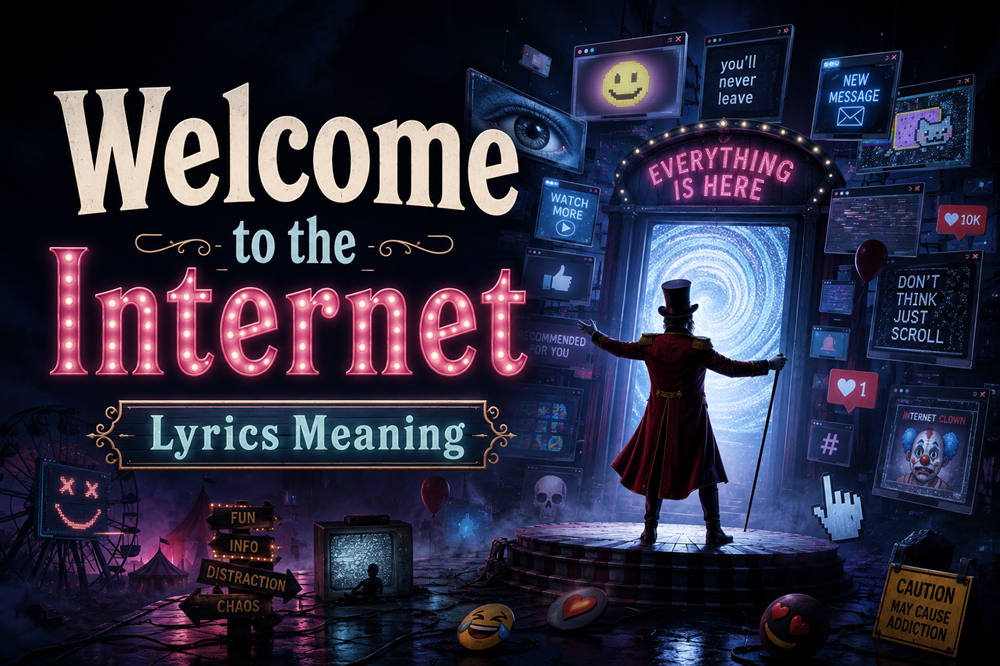
One of the song’s smartest choices is Burnham’s decision to perform as the internet itself.
His character feels like a mixture of a circus host, a salesman, and a villain. He smiles, laughs, and promises an exciting experience, but his energy soon becomes threatening.
The internet character claims to give people unlimited choice. In reality, it floods them with so many options that meaningful choice becomes harder.
It does not care whether users feel happy, angry, afraid, jealous, lonely, or shocked. Every strong reaction is useful because it keeps people looking at the screen.
This character can also represent the larger digital system surrounding us: social platforms, advertisers, algorithms, influencers, news outlets, and anyone else competing for attention.
The internet appears to serve the user, but the relationship works both ways. Users provide their time, personal information, emotional reactions, and content.
Information Overload and Endless Scrolling
The song moves rapidly between unrelated subjects. Burnham jumps from helpful information to political conflict, sexual material, violence, personal opinions, and absurd entertainment.
The structure feels like scrolling through a social media feed.
Within a few seconds, someone might see a cooking video, a war update, a vacation photo, a cruel comment, and an advertisement. Each post asks for a different emotional response, yet there is almost no time to pause.
The song’s speed recreates that experience. As Burnham talks faster and the music becomes more intense, the listener starts to feel overwhelmed.
This effect becomes even clearer in Burnham’s official performance of the song, where the lighting, camera angles, facial expressions, and frantic movements make the internet feel like a stage show spiraling out of control.
The performance shows what it feels like to live in a space where silence and boredom are treated as problems. The internet always has another video, argument, headline, or notification ready. Even when the experience stops being enjoyable, leaving can feel strangely difficult.
How the Internet Uses Emotion
The internet described in the song does not need people to enjoy everything they see. It only needs them to react.
Anger can lead to comments. Fear can lead to repeated checking. Curiosity can lead to more clicks. Outrage can lead to sharing. Insecurity can lead to comparison and spending.
Positive emotions work too. Funny videos, supportive communities, and inspiring stories can also keep people online for hours.
Burnham shows how these different feelings become part of the same attention-driven system. The content changes, but the goal remains the same: keep the user engaged.
That is why the cheerful host becomes increasingly disturbing. He is not concerned about anyone’s emotional health. He simply wants the show to continue.
Privacy Becomes Public Content
The song also looks at how easily private life becomes public online.
People are encouraged to share photographs, relationships, opinions, arguments, fears, achievements, and personal struggles. Posting becomes so normal that keeping something private can feel unusual.
Once information is online, people lose some control over it. A photograph can be copied. A comment can be misunderstood. A private mistake can be shared with thousands of strangers.
The internet turns users into both the audience and the entertainment.
We watch other people’s lives while offering pieces of our own lives in return. Platforms can then use that information to recommend content, personalize advertisements, and learn what keeps us interested.
Children Growing Up Online
The slower section of the song is one of its darkest moments.
Burnham looks back at a time when the internet played a smaller role in everyday life. He then turns his attention to children who have grown up surrounded by screens, social platforms, and online entertainment.
The song is not simply blaming younger people for being too attached to technology. Children did not create this digital environment. Adults and technology companies built it, promoted it, and placed it in their hands.
For many young people, the internet is connected to almost every part of life:
- Friendship
- Education
- Entertainment
- Popularity
- Identity
- Shopping
- News
- Self-expression
Their mistakes, interests, appearances, and emotions can all become visible to others.
Concerns about this environment extend beyond Burnham’s satire. The U.S. Surgeon General’s advisory on social media and youth mental health calls for families, technology companies, researchers, and policymakers to help reduce the risks young people face online.
Burnham’s internet character sounds almost proud of how deeply connected children have become. It speaks like a caring parent, but it is celebrating how successfully it has shaped the child’s habits.
That false affection makes the section especially unsettling.
What “It Was Always the Plan” Means
Near the end of the song, Burnham suggests that this level of connection was not entirely accidental.
The line does not have to describe a literal secret plan. It points toward the business incentives and design choices behind many online platforms.
Social media services often benefit when people spend more time scrolling, watching, clicking, and sharing. That gives platforms a reason to develop feeds, recommendations, autoplay features, and notifications that encourage repeated checking.
Some websites and apps also use manipulative design choices known as dark patterns. The Federal Trade Commission describes these as designs that can trick or steer people into choices they might not otherwise make.
A user who feels satisfied may close the app. A user who remains curious, angry, anxious, or excited may continue scrolling.
The internet’s chaos can therefore be profitable. Constant stimulation is not always an accidental side effect of online life. In some cases, it supports the way a platform makes money.
Burnham questions whether people are truly choosing how to spend their attention or being guided by systems designed to hold it.
Why Burnham’s Performance Matters
The meaning of the song comes from more than its words.
Burnham’s exaggerated smile, dramatic gestures, changing voice, and wild laughter turn the performance into a strange stage show. At first, he seems playful. As the song continues, he looks more controlling and unstable.
The shift mirrors the way the internet can feel.
It may begin as a useful tool or a harmless source of entertainment. Over time, it can become exhausting, distracting, and difficult to escape.
The performance is also effective because Burnham does not pretend to be separate from internet culture. His career grew through online videos, and Inside repeatedly examines his relationship with audiences, screens, and digital performance.
He understands the internet’s creative possibilities as well as its harmful side. That keeps the song from becoming a simple lecture about putting down our phones.
Is the Song Saying the Internet Is Bad?
The song is not arguing that the internet has no value.
Online spaces can help people learn, work, communicate, create art, organize communities, and find support. The problem is that helpful content exists beside manipulation, cruelty, misinformation, and distraction.
The same tool that connects people can also make them feel isolated. The same platform that encourages self-expression can create pressure to perform for strangers.
Burnham is criticizing the way the internet has developed into an environment that tries to fill every quiet moment.
The question is not whether the internet is completely good or bad. It is whether we still control our relationship with it.
Why the Song Feels So Familiar
“Welcome to the Internet” works because many listeners recognize their own habits in it.
We open an app to check one thing and remain there much longer than planned. We read arguments between people we do not know. We compare ordinary moments from our lives with polished photographs from someone else’s.
Sometimes we keep scrolling even when the content makes us tired, angry, or unhappy.
Burnham turns those familiar habits into a musical nightmare. His version of the internet is exaggerated, but it does not feel imaginary.
The song captures one of the biggest contradictions of online life: the internet can be useful, entertaining, and connecting while also making us distracted, anxious, and overwhelmed.
Final Meaning
“Welcome to the Internet” is a dark comedy about a digital world that offers unlimited possibilities while constantly competing for our attention.
Bo Burnham presents the internet as a friendly host who slowly reveals himself to be controlling. He offers knowledge, entertainment, outrage, desire, and connection, but never gives the audience time to stop and think.
The song’s warning is simple: the internet does not have to make us happy to keep us online. It only has to make us feel something strong enough to stay.