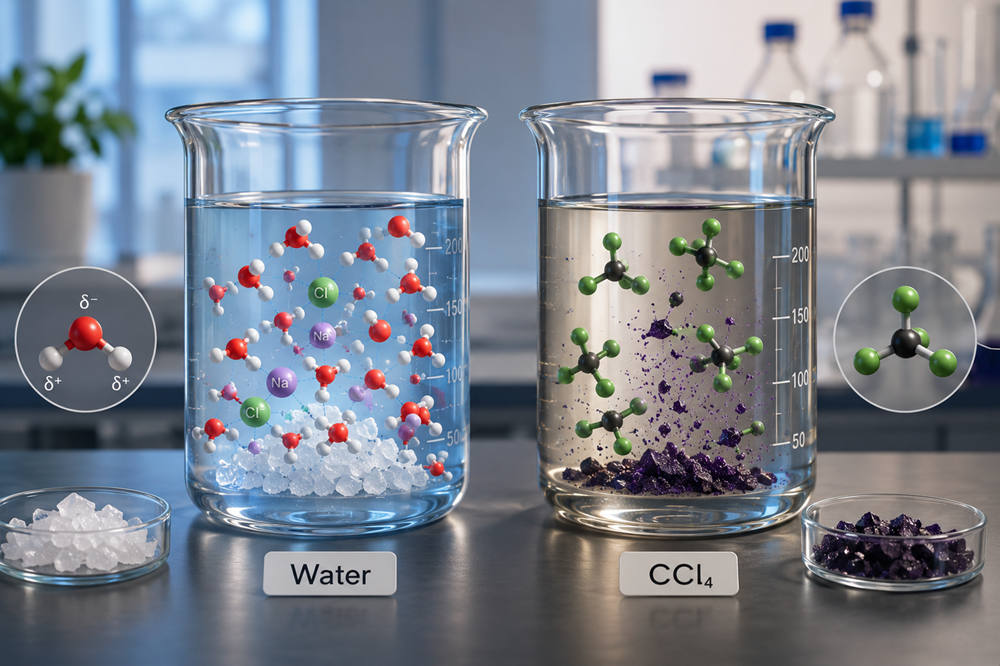
To decide whether a solute dissolves better in water or carbon tetrachloride, use the chemistry rule “like dissolves like”.
- Water is polar, so it usually dissolves ionic and polar substances.
- Carbon tetrachloride, CCl₄, is nonpolar, so it usually dissolves nonpolar substances.
The correct choice depends on the solute, but this rule works for most introductory chemistry problems.
Water vs. Carbon Tetrachloride
Water has an uneven distribution of electrical charge, making it a polar molecule. This allows water to interact strongly with ions and other polar molecules.
Water is usually the better solvent for:
- Ionic compounds
- Polar molecules
- Substances that can form hydrogen bonds
Carbon tetrachloride contains polar carbon-chlorine bonds, but its symmetrical shape causes the individual bond dipoles to cancel. This makes the complete molecule nonpolar. You can learn more about how molecular shape affects molecular polarity.
Carbon tetrachloride is usually the better solvent for:
- Nonpolar molecules
- Hydrocarbons
- Oils and waxes
Common Examples
| Solute | Better Solvent | Why |
|---|---|---|
| Sodium chloride, NaCl | Water | Ionic compound |
| Potassium nitrate, KNO₃ | Water | Made of positive and negative ions |
| Glucose, C₆H₁₂O₆ | Water | Polar and able to form hydrogen bonds |
| Methanol, CH₃OH | Water | Contains a polar hydroxyl group |
| Ammonia, NH₃ | Water | Polar molecule |
| Iodine, I₂ | Carbon tetrachloride | Nonpolar molecule |
| Bromine, Br₂ | Carbon tetrachloride | Nonpolar molecule |
| Hexane, C₆H₁₄ | Carbon tetrachloride | Nonpolar hydrocarbon |
| Benzene, C₆H₆ | Carbon tetrachloride | Mostly nonpolar |
| Vegetable oil | Carbon tetrachloride | Made mainly of nonpolar molecules |
| Paraffin wax | Carbon tetrachloride | Nonpolar hydrocarbon mixture |
| Sulfur, S₈ | Carbon tetrachloride | Nonpolar molecular substance |
These are examples. A worksheet may provide a different set of solutes.
How to Choose the Better Solvent
1. Check Whether the Solute Is Ionic
An ionic compound usually contains a metal combined with a nonmetal or a polyatomic ion.
Examples include:
- NaCl
- KBr
- MgCl₂
- Ca(NO₃)₂
For most introductory chemistry questions, choose water for an ionic solute. Polar water molecules can surround the positive and negative ions, helping separate them from the solid.
However, choosing water does not mean the compound will dissolve completely. Some ionic compounds, including silver chloride, have very low water solubility. Water is simply the better choice compared with nonpolar carbon tetrachloride.
2. Decide Whether a Molecular Solute Is Polar
Polar molecules have an uneven distribution of charge. They often contain oxygen or nitrogen in functional groups such as:
- Hydroxyl, –OH
- Amino, –NH₂
- Carbonyl, C=O
- Carboxyl, –COOH
These groups can interact strongly with water. Molecules containing –OH or –NH groups may also form hydrogen bonds, which often improves their water solubility.
Glucose, for example, contains several hydroxyl groups, so water is the better solvent.
3. Look for a Mostly Nonpolar Structure
Molecules made mainly of carbon and hydrogen are usually nonpolar.
Common examples include:
- Hexane
- Benzene
- Naphthalene
- Paraffin
- Many oils
These substances generally dissolve better in carbon tetrachloride because both the solute and solvent are nonpolar.
What About Molecules With Polar and Nonpolar Parts?
Some molecules contain both polar and nonpolar regions.
Ethanol, for example, has a polar –OH group and a short nonpolar carbon chain. The polar group has a strong enough influence that ethanol mixes well with water.
As a carbon chain becomes longer, the nonpolar portion becomes more important. Long-chain alcohols are therefore less soluble in water than short-chain alcohols.
When a molecule has both types of regions, consider whether the polar group or nonpolar carbon structure makes up most of the molecule.
Quick Decision Rule
Use this four-step method:
- If the solute is ionic, choose water.
- If it is polar, choose water.
- If it is nonpolar, choose carbon tetrachloride.
- If it has both polar and nonpolar parts, determine which part dominates.
Safety Note
Carbon tetrachloride is not an ordinary household solvent. Exposure can harm the liver, kidneys, and nervous system, and the EPA regulates its use because of its health risks. The CDC’s carbon tetrachloride fact sheet provides additional safety information.
In classroom problems, remember the basic rule: water is better for ionic and polar solutes, while carbon tetrachloride is better for nonpolar solutes.