
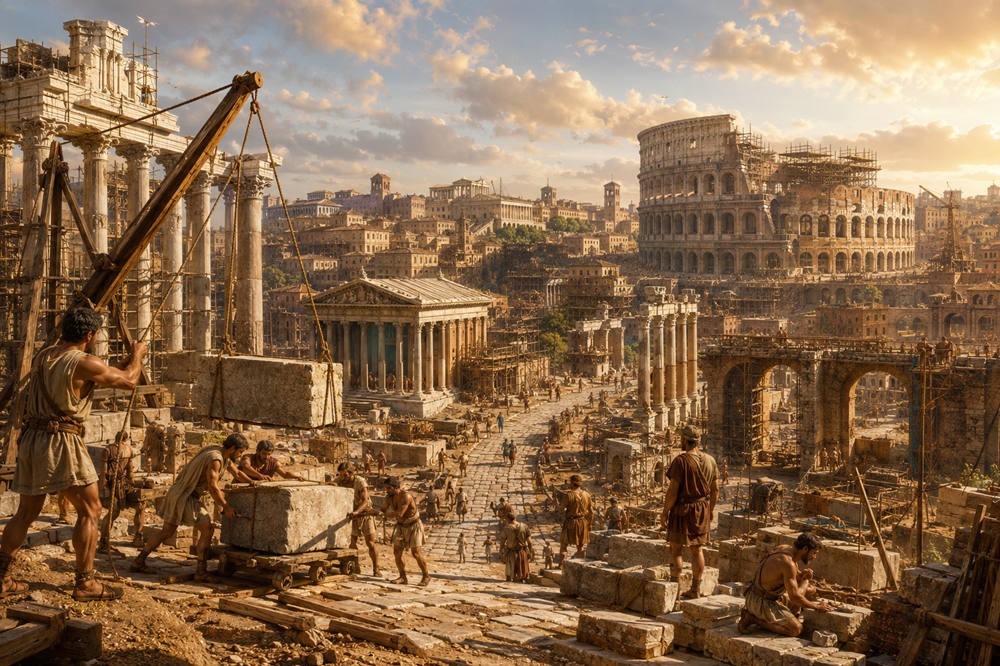
Rome was not built in a day — and it was not built in a single lifetime either.
If we answer the question literally, Rome took hundreds of years to grow from a small settlement into the powerful ancient city we remember today. If we count its full development from early village life to imperial capital, the process stretches across more than 1,000 years.
There is no exact moment when Rome was “finished.” It kept expanding, rebuilding, and changing with every generation.
Rome Started as a Small Settlement
Roman tradition says the city was founded in 753 BCE by Romulus. Historians treat that story as partly legendary, but the date is still commonly used as Rome’s starting point.
Early Rome was nothing like the grand city of temples, arenas, marble buildings, and stone roads we picture now. It began as a small settlement near the Tiber River, where the hills offered protection and the river helped with trade.
Over time, nearby villages grew together. Simple homes, defensive walls, religious spaces, and public gathering areas slowly formed. This early stage alone took many generations.
Rome Grew Through the Kingdom and Republic
Rome’s early monarchy lasted until around 509 BCE, when the Roman Republic began. During the Republic, Rome became more organized, more powerful, and much larger.
This period shaped many parts of the city’s identity. The Roman Forum became the center of political, religious, and social life. Roads helped connect Rome with other parts of Italy. Stronger walls protected the city. Temples, markets, government buildings, and public spaces gave Rome a more permanent shape.
The Republic lasted nearly 500 years, so Rome’s growth was slow and layered. It was not one construction project. It was a city being built while history was happening around it.
The Empire Made Rome Monumental
Rome became an empire in 27 BCE, when Augustus became its first emperor. This period changed the look and scale of the city.
Augustus and later emperors used architecture to show power. They built forums, temples, theaters, baths, aqueducts, arches, palaces, and arenas. Rome became more crowded, more impressive, and more symbolic.
This is when many people’s image of “ancient Rome” really begins to take shape. The city was no longer just the center of government. It became a display of wealth, engineering, and imperial ambition.
Famous Roman Landmarks Took Years to Build
Even Rome’s individual landmarks were major projects.
The Colosseum was started around 70 CE and opened around 80 CE, so it took about 10 years to complete. That was only one building, but it required huge amounts of labor, planning, stone, engineering, and money.
The Pantheon also shows how Rome was built in layers. Earlier versions were damaged, and the structure we know today was rebuilt under Emperor Hadrian in the 2nd century CE.
Other buildings were repaired, expanded, reused, or changed over time. Rome was always under construction in some form.
So, How Long Did It Take to Build Rome?
The best answer depends on what you mean by “Rome.”
If you mean the first settlement, Rome began around 753 BCE.
If you mean Rome as a major city, it took several centuries to develop through the Kingdom and Republic.
If you mean the famous imperial city with monuments, arenas, aqueducts, baths, and marble buildings, much of that took shape from the 1st century BCE through the 2nd century CE.
If you mean Rome’s full ancient development, the answer is more than 1,000 years.
A simple way to say it is this: Rome took centuries to build, and every era added something new.
Why Do People Say “Rome Wasn’t Built in a Day”?
The saying means that great things take time. It is used for goals, careers, habits, relationships, businesses, creative work, and personal growth.
Rome works as a symbol because it was not created quickly or easily. It grew through planning, labor, mistakes, rebuilding, and ambition.
That is why the phrase still feels useful today. Big results usually come from steady progress, not one perfect day of effort.
Rome’s Growth in Simple Stages
Here is an easy way to understand the timeline:
- Early settlement: Rome begins around 753 BCE
- Roman Kingdom: the city forms its early structure
- Roman Republic: roads, walls, forums, temples, and public life expand
- Roman Empire: major monuments, arenas, baths, aqueducts, and palaces reshape the city
- Later Rome: repairs, Christian buildings, medieval changes, and modern development continue
Rome was built in stages, not all at once.
Final Answer
Rome took hundreds of years to become a major ancient city and more than 1,000 years to develop into the layered city known through history.
The famous phrase is true because Rome was built piece by piece. Its story reminds us that anything lasting usually takes patience, effort, and time.