
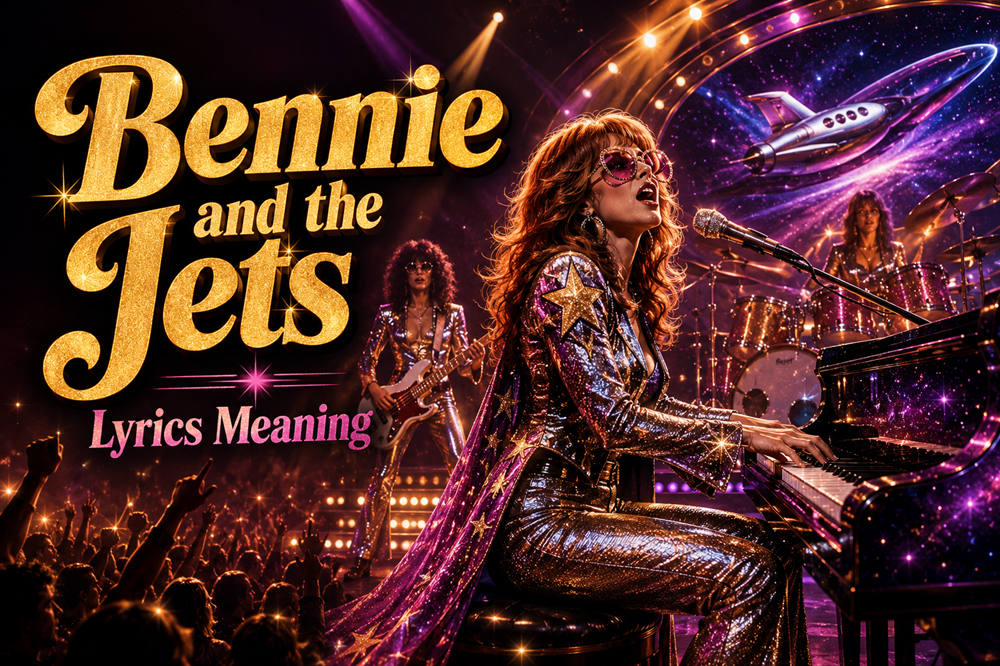
“Bennie and the Jets” sounds like it was recorded during a wild concert. A crowd cheers and whistles while Elton John plays the song’s slow, heavy piano rhythm. Yet the performance was created in a studio, and Bennie and her band are fictional.
You can read the complete “Bennie and the Jets” lyrics before exploring the song’s meaning.
Written by Bernie Taupin and performed by Elton John, the song appeared on the 1973 album Goodbye Yellow Brick Road. It introduces a strange, stylish rock group that captures the attention of young fans. Beneath the playful imagery, the song explores celebrity culture, youth rebellion, fashion, and the way the music industry turns performers into larger-than-life figures.
What Is “Bennie and the Jets” About?
The song is about a fictional band called Bennie and the Jets. Bennie is the group’s glamorous and unconventional leader.
The narrator encourages young listeners to watch the band perform. Bennie and her musicians are presented as loud, futuristic, fashionable, and unlike anything their parents would understand.
There is no traditional storyline with a clear beginning and ending. Instead, the lyrics capture the excitement surrounding a mysterious new act. Bennie’s fans know her through her music, appearance, and media image rather than through personal details.
That mystery is part of her appeal. She feels less like an ordinary musician and more like a pop-culture creation designed to fascinate an audience.
Is Bennie a Real Person?
Bennie is not a real singer or bandleader. Bernie Taupin created her as a fictional character.
Taupin imagined Bennie and the Jets as a futuristic rock group led by a powerful female performer. Bennie is fashionable, theatrical, and difficult to place within traditional ideas about gender or rock stardom. He has described the group as a science-fiction-style band fronted by an androgynous woman.
Rather than representing one specific artist, she reflects the bold style of early-1970s glam rock. Performers such as David Bowie, Marc Bolan, and Elton John used dramatic clothing, makeup, theatrical characters, and unusual stage designs to stand apart from more conventional musicians.
The glam-rock movement frequently challenged traditional ideas about gender and stage fashion. Bennie belongs to that world, but she is exaggerated enough to feel as if she has arrived from the future.
Fame, Fashion, and Public Image
Bennie’s appearance is one of the most memorable parts of the song. Her futuristic boots and mohair suit make her sound glamorous, strange, and carefully styled.
The narrator appears to have learned about her clothing from a magazine. That detail shows how celebrity images are often built through photographs, interviews, publicity, and fashion.
Fans do not necessarily know the person behind the performance. They know the version presented to them.
Bennie’s clothing is not simply decoration. It helps establish her identity as someone who rejects ordinary expectations. Her unusual style tells young fans that she belongs to a different world—one that feels more exciting than the one created by their parents.
The song also gently jokes about the way the music industry markets performers. A new act is often presented as revolutionary through dramatic clothes, bold claims, media attention, and carefully created mystery.
Bennie may be genuinely talented, but her image clearly contributes to her popularity.
Youth Rebellion and Generational Conflict
The song speaks directly to young people and creates a clear divide between them and the adult world.
Bennie and the Jets offer their fans something that feels new and personal. Older people may see the band as strange or excessive, but that makes the group even more attractive to younger listeners.
Music has often given teenagers a way to form identities outside their families. A favorite artist can influence clothing, language, friendships, and personal beliefs. Following an unusual band can also make fans feel like members of a private community.
In the song, the disagreement between parents and children becomes part of the excitement. The band represents change, while the older generation represents familiar rules and expectations.
The conflict is playful rather than threatening. Bennie is not leading a political revolution. She is creating the kind of cultural rebellion that happens through music, style, and attitude.
Why the Song Sounds Like a Live Performance
Many listeners assume “Bennie and the Jets” was recorded in front of a concert audience. It was actually recorded in a studio, with crowd sounds added later.
Producer Gus Dudgeon decided to create the fake concert atmosphere after hearing the opening piano chord. He felt it sounded like something a musician might play onstage before beginning a song, so he added applause, whistles, and cheering to the finished recording.
The story behind the studio production explains how the artificial crowd became one of the track’s most recognizable features.
This choice fits the song perfectly. Bennie and the Jets are an imaginary band, and the recording surrounds them with an imaginary audience.
The cheering makes Bennie’s popularity feel real before listeners know anything about her. It creates the impression that everyone else is already excited, encouraging the listener to join in.
The effect also adds humor. The song is pretending to document a major concert for a band that never existed.
Why Elton John Repeats Bennie’s Name
Elton John’s drawn-out pronunciation of Bennie’s name is one of the most recognizable moments in the song.
The repetition works mainly as a musical hook. It follows the stop-and-start rhythm, gives the chorus its playful character, and turns Bennie’s name into something the audience can easily chant.
His vocal delivery adds to the theatrical mood. He moves between smooth singing, sharp accents, high notes, and exaggerated sounds. The performance feels unusual because Bennie and her band are supposed to be unusual.
The chorus does not tell us much more about Bennie. Instead, it repeats her name until she feels important, famous, and unforgettable.
What Do the Most Confusing Lyrics Mean?
Some lines in “Bennie and the Jets” are intentionally strange. They create an atmosphere rather than explain a detailed story.
“Electric Boots”
The electric boots strengthen Bennie’s futuristic image. They suggest technology, spectacle, and fashion that seems ahead of its time.
The phrase does not need to refer to a real invention. It helps listeners picture a performer who looks as dramatic as her music sounds.
“Mohair Suit”
A mohair suit would have been stylish and eye-catching during the glam-rock era. Combined with the boots, it gives Bennie a carefully constructed stage appearance.
Her outfit mixes elegance with science-fiction imagery, making her seem both fashionable and strange.
“Plug Into the Faithless”
This is one of the song’s most debated phrases. It may suggest that young listeners are being invited to reject traditional beliefs and connect with people who do not follow the usual rules.
The line fits the song’s broader theme of young fans moving away from older expectations. However, Taupin’s lyrics often use unusual images for sound and atmosphere, so the phrase may not have one exact meaning.
“We Shall Survive”
This line gives the young fans a sense of unity. Through the band, they feel connected to something larger than themselves.
The language sounds dramatic, but that exaggeration matches the song’s playful portrayal of fandom. Discovering a new artist can feel life-changing, especially when the music becomes part of a person’s identity.
Is the Song Making Fun of Celebrity Culture?
The song both celebrates and questions celebrity culture.
Bennie is exciting. Her confidence, appearance, and music bring young people together. The song understands why fans would be attracted to someone who seems bold and completely different.
At the same time, nearly everything we know about her comes through publicity. We hear about her clothes, magazine image, stage show, and devoted audience, but we learn very little about her as a person.
Even the cheering crowd is artificial.
This suggests that fame is partly a performance. Audiences are not only responding to music; they are responding to an image created through fashion, media coverage, marketing, and spectacle.
The song does not condemn that process. It has fun with it. Elton John and Bernie Taupin understood that theatricality was part of rock music’s appeal, especially during the glam-rock era.
Why “Bennie and the Jets” Still Connects With Listeners
The song’s ideas remain familiar because musicians are still introduced through carefully planned public images.
Today, those images spread through social media, music videos, interviews, viral clips, fashion campaigns, and fan communities. A performer can become famous not only because of a song but also because of a distinctive personality or visual style.
Young listeners also continue to connect with artists their parents may not understand. Music still provides a sense of identity, freedom, and belonging.
The song itself has also aged well. Its pounding piano, unusual rhythm, theatrical vocals, and fake crowd noises make it instantly recognizable. The later official music video continued its futuristic style by presenting Bennie and her band through a strange talent-show setting inspired partly by Metropolis.
Final Meaning of “Bennie and the Jets”
“Bennie and the Jets” is about the excitement surrounding a fictional futuristic rock band and its mysterious female leader.
Bennie represents glamour, individuality, youth rebellion, and the power of a carefully created celebrity image. Her young fans are drawn to her because she offers something bold that the adult world does not fully understand.
The song celebrates the thrill of discovering a new artist while gently making fun of the publicity and spectacle surrounding fame. That combination of admiration and humor is what gives “Bennie and the Jets” its lasting charm.