Efficiency vs productivity is a simple idea, but it can change the way you work.
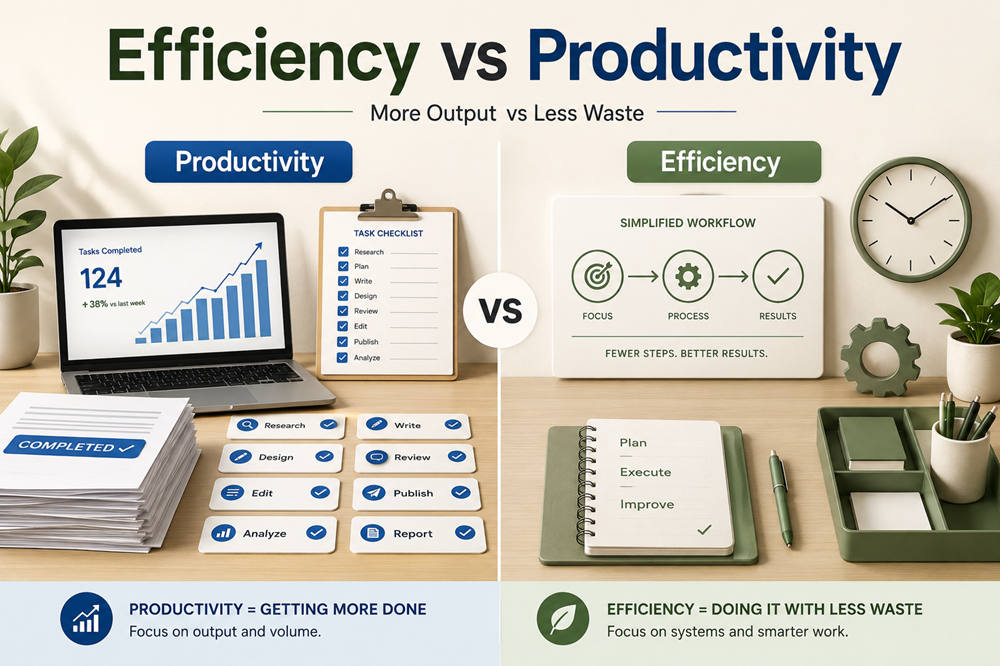
Productivity is about getting meaningful work done. Efficiency is about getting that work done with less wasted time, energy, money, or effort.
You need both. If you focus only on productivity, you may do more but feel drained. If you focus only on efficiency, you may polish your systems without making real progress. The goal is not to be busy every minute. The goal is to do useful work in a smarter, more sustainable way.
What Is Productivity?
Productivity means creating useful output within a certain amount of time.
In daily life, that might mean finishing a work project, writing a report, studying for an exam, cleaning your home, or completing an important task you have been avoiding.
The key word is useful.
A packed schedule does not always mean you are productive. You can answer emails, organize files, check notifications, and update your calendar all day without moving your most important goal forward.
Real productivity asks:
Did this effort create progress?
For example, a productive day might look like:
- Finishing the first draft of a proposal
- Completing three important client calls
- Studying one difficult chapter and understanding it well
- Publishing one useful article
- Solving a problem that was slowing down your team
Productivity is not about doing everything. It is about doing the right things with enough focus to create a result.
What Is Efficiency?
Efficiency means getting a result with less waste.
That waste may be extra time, repeated mistakes, unnecessary steps, unclear communication, poor tools, or mental energy spent on things that should be simple.
For example, you are becoming more efficient when:
- A report that used to take four hours now takes two
- A weekly meeting becomes a clear 15-minute check-in
- A checklist prevents the same mistake from happening again
- A template saves you from rewriting the same email
- A better system helps a team finish work with fewer delays
Efficiency is not the same as rushing. Rushing often lowers quality. Efficiency improves the way work is done so the same result becomes easier, cleaner, or faster.
Good efficiency feels less like panic and more like flow.
Efficiency vs Productivity: The Key Difference
The easiest way to separate them is this:
Productivity measures output. Efficiency improves the process.
| Point | Productivity | Efficiency |
|---|---|---|
| Main focus | Meaningful work completed | Waste reduced while doing the work |
| Main question | What got done? | How well was it done? |
| Best for | Goals, progress, growth, output | Time, energy, cost, workflow, quality |
| Common risk | Doing more until you burn out | Optimizing systems instead of acting |
| Ideal result | Important work gets finished | Work becomes smoother and less wasteful |
A person can be productive but not efficient. They may finish a lot, but it takes too much stress, overtime, or effort.
A person can also be efficient but not productive. They may have a perfect planner, clean folders, and a beautiful workflow, but still avoid the main task.
The best work happens when you combine both.
Simple Examples of Efficiency vs Productivity
1. Workplace Example
A team completes 30 tasks in a week. That is productivity.
If the team completes those tasks with fewer meetings, fewer errors, and less overtime, that is efficiency.
The output is strong, but the process is also healthier.
2. Student Example
A student studies for four hours and covers six chapters. That may be productive.
If the student uses practice questions, short review sessions, and active recall to understand the same material in two focused hours, that is more efficient.
The goal is not to stare at the book longer. The goal is to learn better.
3. Business Example
A business ships 800 orders this month instead of 600. That is higher productivity.
If the business also reduces packaging mistakes, delivery delays, and wasted materials, it becomes more efficient.
More output helps growth. Better systems make that growth easier to handle.
4. Personal Life Example
Cleaning the entire house in one afternoon is productive.
Creating a simple weekly routine that keeps the house manageable with less stress is efficient.
Both are useful, but they solve different problems.
Why Productivity Alone Can Become a Problem
Productivity sounds positive, but “more” is not always better.
When you focus only on output, you may start chasing numbers instead of results. More tasks checked off. More emails answered. More hours worked. More things squeezed into the day.
That can look impressive, but it can also create problems:
- You finish more work but make more mistakes.
- You choose easy tasks because they are quick to complete.
- You avoid deeper work because it takes more focus.
- You feel busy but not actually closer to your goal.
- You push yourself too hard and lose energy over time.
This is how people end up exhausted even when they are “getting things done.” Over time, that pressure can contribute to burnout, especially when stress keeps building without enough recovery.
For example, answering 40 emails may feel productive. But if your most important task was to prepare a presentation, write a proposal, or study for a test, the day may still feel unfinished.
Productivity should create progress, not just motion.
Why Efficiency Alone Can Also Hold You Back
Efficiency has its own trap: over-optimizing.
This happens when you spend more time improving the system than doing the work. You test new apps, redesign your schedule, organize your notes, rebuild your to-do list, and search for the perfect method.
Some of that can help. But after a point, it becomes another way to delay action.
Efficiency only matters when it supports meaningful output.
It is also possible to become efficient at the wrong thing. You might make a low-value task faster when it should be removed completely. You might automate a report nobody uses. You might shorten a meeting that should not exist at all.
Before improving a process, ask:
Is this task actually worth doing?
If the answer is no, the best efficiency move is not to do it faster. It is to stop doing it.
How to Improve Productivity
To improve productivity, start with clarity. You need to know what matters before you can make real progress.
Here are practical ways to become more productive:
- Pick one main priority each day. Decide what would make the day feel successful, even if other smaller tasks remain.
- Break large goals into smaller actions. “Work on my business” is too vague. “Write the service page intro” is clear.
- Use focused work blocks. Set 25 to 45 minutes for one task and keep messages, tabs, and notifications away during that time.
- Do important work early when possible. Your best energy should not always go to emails and admin tasks.
- Measure finished work, not just time spent. Five focused hours can be more valuable than ten distracted ones.
- Limit task switching. Jumping between tasks makes work feel busy but often slows real progress.
- End the day with a quick review. Ask what moved forward, what got in the way, and what should come first tomorrow.
Better productivity does not mean filling every empty space with work. It means using your attention where it counts.
How to Improve Efficiency
To improve efficiency, look for friction. Friction is anything that makes work slower, harder, messier, or more confusing than it needs to be.
Here are simple ways to become more efficient:
- Create templates for repeated work. Use saved replies, content outlines, invoice formats, planning sheets, or checklists.
- Batch similar tasks. Handle emails, calls, errands, or admin work together instead of returning to them all day.
- Remove unnecessary steps. If a process has five steps but only three are useful, simplify it.
- Make instructions clearer. A few extra minutes of clarity can prevent hours of confusion later.
- Reduce meetings when possible. Some updates can be handled with a short message or shared document.
- Fix repeated mistakes. If the same issue keeps happening, do not just correct it again. Find the cause.
- Use tools with purpose. A tool should save time or improve quality. If it creates more work, it is not helping.
Efficiency is often built through small improvements. A better checklist, a cleaner routine, or a clearer handoff can make daily work feel much lighter.
How to Balance Efficiency and Productivity
The best question is not, “Should I be more efficient or more productive?”
The better question is:
What problem am I trying to solve?
If you are not getting enough important work done, focus on productivity. You may need clearer priorities, fewer distractions, or better focus.
If you are getting work done but it takes too much time or energy, focus on efficiency. You may need better systems, simpler tools, or fewer unnecessary steps.
If quality is slipping, slow down and improve the process. More speed will not help if the work keeps coming back with errors.
If you feel busy but stuck, check whether your tasks match your real goals.
A simple rule:
- Low output means you need better productivity.
- High effort means you need better efficiency.
- Repeated mistakes mean the process needs attention.
- Constant busyness means your priorities may need a reset.
Productivity gives you movement. Efficiency helps you keep that movement sustainable.
Common Mistakes to Avoid
Many people struggle because they focus on the wrong thing at the wrong time.
Watch out for these mistakes:
- Confusing busyness with progress. A full calendar does not always mean a meaningful day.
- Trying to speed up tasks that should be removed. Not every task deserves a better system.
- Measuring only quantity. More work is not useful if the quality is poor.
- Over-planning. A neat plan is helpful only if it leads to action.
- Using too many productivity tools. Apps can become distractions when you spend more time managing them than working.
- Ignoring rest. A tired brain works slower and makes more mistakes.
- Treating everything as urgent. When everything is urgent, it becomes harder to see what is truly important.
Small changes in these areas can make your work feel calmer, sharper, and more useful.
Efficiency vs Productivity: Which One Matters More?
Neither one wins every time. The right focus depends on your situation.
A startup may need more productivity when it is trying to launch, test ideas, or reach customers. Later, it may need more efficiency to reduce waste and improve systems.
A student may need productivity when assignments are piling up. But if they study for hours and remember very little, efficiency becomes more important.
A worker may need productivity if they keep avoiding deep work. But if they are buried in meetings, unclear requests, and repeated admin tasks, efficiency may be the better place to start.
A busy parent may not need to do more. They may need simpler routines and better time management habits that make daily life less stressful.
So instead of asking which one is better, ask what your current problem is:
Do I need to create more meaningful output, or do I need to reduce the waste around the work I already do?
That answer will show you where to focus first.
Summary
Efficiency and productivity work best together.
Productivity helps you get meaningful work done. Efficiency helps you do that work with less wasted time, energy, money, and effort.
If you only chase productivity, you may end up busy, tired, and rushed. If you only chase efficiency, you may spend too much time improving systems without making real progress.
The goal is not to do more for the sake of doing more. The goal is to do what matters and make the process easier to repeat.
When you understand the difference between efficiency vs productivity, you can stop guessing and start improving the right part of your work.