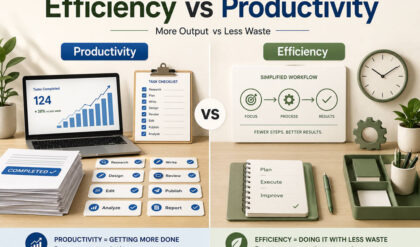

Productivity is not just about doing more. It is about making useful progress with the time, energy, and resources you have.
Many people measure productivity by counting hours worked or tasks completed. But those numbers can be misleading. A long workday does not always mean better results, and a full to-do list does not always mean meaningful progress.
To measure productivity well, look at output, quality, time, goals, and consistency.
What Does Productivity Really Mean?
Productivity is the relationship between output and input.
Output is what you create, complete, or improve. Input is what you use to get it done.
Output may include finished projects, completed tasks, sales, reports, solved problems, or customer issues resolved. Input may include time, energy, money, tools, materials, or team effort.
For example, if you write four reports in eight hours, your output is four reports and your input is eight hours. But the number alone is not enough. If the reports are rushed and full of errors, the real value is lower.
Good productivity means useful output, not just more activity.
Why Measuring Productivity Matters
Measuring productivity helps you understand what is working and what needs to change. It gives you a clearer picture of how your time and effort are being used.
It can help you:
- Find where time is being wasted
- Focus on high-value work
- Set realistic goals
- Improve results without burning out
- Notice problems in your workflow
- Make better decisions about priorities
For teams, productivity measurement can also reveal problems in the system, such as unclear goals, too many meetings, poor tools, or slow communication.
How to Measure Productivity
1. Define What Productive Work Looks Like
Before you measure productivity, decide what result matters most.
For a writer, it may be published articles. For a sales team, it may be closed deals. For a student, it may be completed assignments or stronger exam preparation.
Ask yourself: What result am I trying to create?
Once you know the answer, you can measure the work that actually supports that result.
2. Track Output, Not Just Activity
Activity is what you do. Output is what your work produces.
Answering emails, organizing files, and sitting in meetings may be necessary, but they do not always create important results.
A better question is: What did I finish, improve, solve, or move forward?
This helps you measure progress instead of just motion.
3. Measure Time Spent on Important Work
Time tracking can be helpful when it shows where your attention is going.
You do not need to track every second. Instead, look at how much time goes into:
- Focused work
- Meetings
- Messages
- Planning
- Admin tasks
- Breaks
- Distractions
If most of your time goes to low-value tasks, your productivity may feel low even when your day feels full.
4. Look at Quality, Not Only Quantity
Doing more is not always better. Quality matters too.
A team may finish many tasks, but if the work leads to errors, complaints, or rework, productivity is weaker than it appears.
You can measure quality through:
- Error rates
- Customer feedback
- Revision requests
- Accuracy
- Review scores
- Rework needed
The goal is not perfection. The goal is useful, reliable work that does not create more problems later.
5. Compare Results Against Goals
Productivity is easier to measure when you have clear goals.
Examples include:
- Finish three workouts this week
- Write four blog posts this month
- Close ten sales calls this quarter
- Complete a project draft by Friday
- Reduce customer response time
When you compare your results with your goals, you can see whether your effort is moving in the right direction.
6. Review Consistency Over Time
One good day does not prove your system is working. One slow day does not mean you failed.
Look at your productivity across a week or month. You may notice that you work better in the morning, lose focus after too many meetings, or get more done when you plan ahead.
The point is to find patterns you can improve, not judge yourself for every off day.
Common Productivity Metrics to Use
The right metrics depend on your work, but common examples include:
- Tasks completed
- Projects finished
- Deadlines met
- Revenue generated
- Sales closed
- Customer issues resolved
- Response time
- Error rates
- Quality scores
- Time spent on deep work
- Goal completion rate
- Rework needed
Choose a few metrics that match your real goals. Tracking too many numbers can make productivity harder to understand.
Simple Productivity Formula
A basic productivity formula is:
Productivity = Output ÷ Input
For example, if you complete four reports in eight hours, you complete 0.5 reports per hour.
This formula is useful for simple work, but it does not tell the full story. For a better view, also consider quality, goal progress, consistency, and the value of the work.
Personal Productivity vs Team Productivity
Personal productivity focuses on how one person uses time, energy, and attention. It may include daily priorities, focused work time, habits, and progress toward personal goals.
Team productivity looks at shared results. It may include project progress, deadlines, collaboration, customer outcomes, bottlenecks, and rework.
A team can be busy and still struggle if the workflow is unclear. That is why team productivity should measure both results and the process behind those results.
Mistakes to Avoid When Measuring Productivity
Avoid these common mistakes:
- Measuring hours instead of results
- Counting every task as equally important
- Ignoring quality
- Tracking too many metrics
- Comparing different roles unfairly
- Rewarding speed while ignoring mistakes
- Treating meetings as automatic productivity
- Using data to pressure people
- Ignoring burnout and energy levels
Productivity measurement should help people work better. It should not make work feel heavier, rushed, or overly controlled.
Summary
Measuring productivity is about understanding whether your effort is creating meaningful results.
Start by defining what productive work looks like. Then track output, time, quality, goal progress, and consistency. Use simple metrics, but do not rely on numbers alone.
Real productivity is not about filling every hour. It is about making steady progress on work that actually matters.