
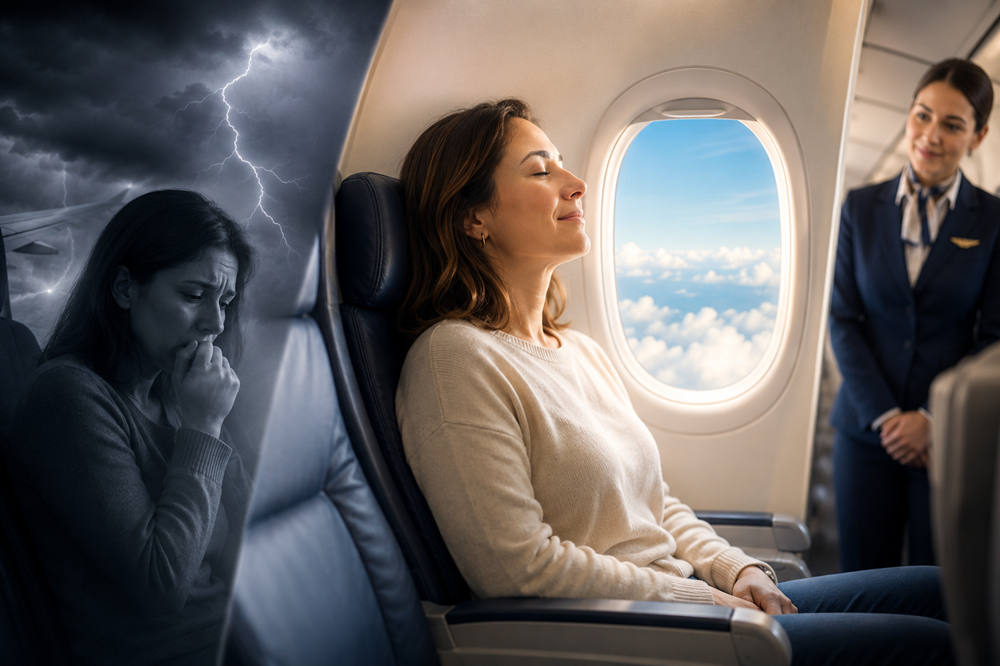
Fear of flying can make travel feel stressful even when part of you knows the plane is safe. Your body may react with tension, panic, or worst-case thoughts before your mind has a chance to catch up.
Learning how to overcome fear of flying starts with understanding what your fear is really about. Once you know your triggers, you can calm your body, challenge anxious thoughts, and build more trust in flying one step at a time.
What Fear of Flying Really Means
Fear of flying is often a mix of smaller fears, not just fear of the plane itself. You may feel scared of turbulence, heights, enclosed spaces, takeoff, landing, losing control, or having a panic attack where you cannot easily leave.
That is why the fear can feel so intense. Your brain treats flying as uncertain or unsafe, even when you are not in immediate danger. The goal is not to shame yourself for feeling afraid. It is to understand the fear clearly so it becomes easier to manage.
Why Flying Feels So Uncomfortable When You Are Anxious
Anxiety makes normal flight sensations feel more threatening. A small bump, engine sound, pressure change, or movement can seem alarming when your body is already on high alert.
Your heart may race, your breathing may get shallow, your chest may feel tight, and your thoughts may speed up. These reactions are uncomfortable, but they are common anxiety symptoms. The National Institute of Mental Health explains that anxiety can affect both thoughts and physical reactions, which is why fear can feel so convincing in the moment.
Instead of telling yourself to “just relax,” focus on giving your body steady signals of safety through slow breathing, relaxed muscles, and calmer self-talk.
How to Overcome Fear of Flying
There is no single trick that removes fear of flying instantly. The most helpful approach is to work with both your body and your thoughts.
Your body needs calming signals. Your mind needs clearer information. Your confidence needs practice. When those three things work together, flying can start to feel less overwhelming.
Understand What Triggers Your Fear
Start by naming the exact part of flying that scares you most.
Is it turbulence? Feeling trapped? Being high in the air? Not knowing what the sounds mean? Losing control? Having a panic attack? Worrying that something could go wrong?
This matters because “I am afraid of flying” is broad. A specific fear is easier to handle.
If turbulence is your biggest trigger, learning what turbulence actually is may help. If panic is your biggest fear, breathing and grounding tools may matter more. If feeling trapped bothers you, you may need strategies that help you feel more settled in your body.
You do not need to judge your fear. Just identify it. Naming the fear makes it less vague and less powerful.
Learn How Flying Works
A lot of flight anxiety comes from misreading normal airplane sounds and movements.
Planes make noise. Engines change tone. Wheels retract. Wings flex. The cabin pressure shifts. Landings can include bumps, braking, and loud sounds. These things can feel scary if you do not know they are normal.
Learning a few basic facts about flying can help your brain stop treating every sound as a warning sign. The Federal Aviation Administration has aviation safety information that can help nervous flyers better understand how air travel works.
You do not need to become an expert. Even simple knowledge can make flying feel less mysterious. When your mind asks, “What was that sound?” you can answer, “That is a normal part of the flight,” instead of letting fear fill in the blank.
Calm Your Body First
When fear rises, do not start by arguing with every thought in your head. Start with your body.
An anxious body sends danger signals to the brain. A calmer body sends safer signals back.
Try this simple breathing pattern: breathe in slowly for four counts, then breathe out for six counts. Repeat it several times. The longer exhale helps your nervous system slow down.
Then relax your body in small steps. Drop your shoulders. Unclench your jaw. Loosen your hands. Place your feet flat on the floor. Let your back rest against the seat.
You are not trying to force instant peace. You are showing your body that it does not need to stay in emergency mode.
Challenge Scary Thoughts
Fear of flying often feeds on “what if” thoughts.
What if something goes wrong? What if turbulence gets worse? What if I panic? What if I cannot handle it?
These thoughts feel urgent, but they are not facts. They are anxiety predictions.
A helpful response is to replace them with steadier thoughts.
Instead of “Something bad is going to happen,” try, “My anxiety is imagining danger right now.”
Instead of “I cannot handle this,” try, “This is uncomfortable, but I can take it one minute at a time.”
Instead of “Every movement means something is wrong,” try, “Planes move, make sounds, and shift during normal flights.”
The point is not to pretend you feel fearless. The point is to stop letting fear be the only voice in the room.
Use Grounding Techniques
Grounding helps bring your attention back to the present moment.
Anxiety pulls your mind into imagined danger. Grounding brings your focus back to what you can see, feel, hear, and touch right now.
Try naming five things you can see, four things you can feel, three things you can hear, two things you can smell, and one thing you can taste.
You can also focus on simple physical details. Notice your feet on the floor. Notice your hands in your lap. Notice the seat supporting your body. Notice the texture of your sleeve or the coolness of a water bottle.
The American Psychological Association notes that anxiety can involve worry, tension, and physical changes. Grounding gives your brain something steady to focus on when those symptoms feel loud.
Stop Fighting the Fear
Trying to force fear away can sometimes make it stronger.
When you think, “I must calm down right now,” your brain may treat the fear itself like an emergency. Then you become anxious about being anxious.
A better approach is to notice the fear without battling it.
You can say, “This is fear. I do not like it, but I know what it is.”
Or, “My body is anxious right now, but this feeling can pass.”
Or, “I do not need to feel perfectly calm to get through this.”
This creates space between you and the fear. You are no longer letting anxiety control the whole story. You are naming it, allowing it, and choosing your next steady action.
Build Confidence Slowly
Fear of flying usually improves through repeated safe experiences.
Your brain needs evidence that flying does not have to mean danger. That evidence can come from learning about flight, practicing calming skills, watching calm flight videos, talking with people who fly often, or taking manageable flights when you are ready.
You do not have to love flying right away. You only need to prove to yourself that fear can show up and you can still handle the moment.
Progress may be slow. That does not mean you are failing. It means your nervous system is learning a new response.
When Fear of Flying Needs Extra Support
Some fear of flying can improve with education, breathing, grounding, and practice. But if the fear causes you to cancel trips, avoid important events, or panic often, extra support may help.
Cognitive behavioral therapy, often called CBT, can help you identify anxious thoughts and respond to them differently. Exposure-based therapy can also help by gradually reducing avoidance in a safe, supported way. The Anxiety and Depression Association of America offers helpful information about anxiety and treatment options.
Getting help does not mean your fear is strange or hopeless. It means you are giving yourself better tools.
Some people also benefit from fear-of-flying courses, especially when they combine aviation education with anxiety-management skills.
Summary
Overcoming fear of flying does not mean you have to become fearless. It means you learn what your fear is really about and practice responding to it in a calmer way.
Start by naming your main trigger. Learn what normal flight sounds and sensations mean. Calm your body with slow breathing and relaxed muscles. Use grounding when panic rises. Replace scary “what if” thoughts with steadier reminders.
Most of all, be patient with yourself. Fear of flying is not weakness. It is an anxiety response, and anxiety can be retrained with practice, support, and repeated safe experiences.
You do not need to love flying overnight. You only need to take the next steady step toward feeling more capable in the air.