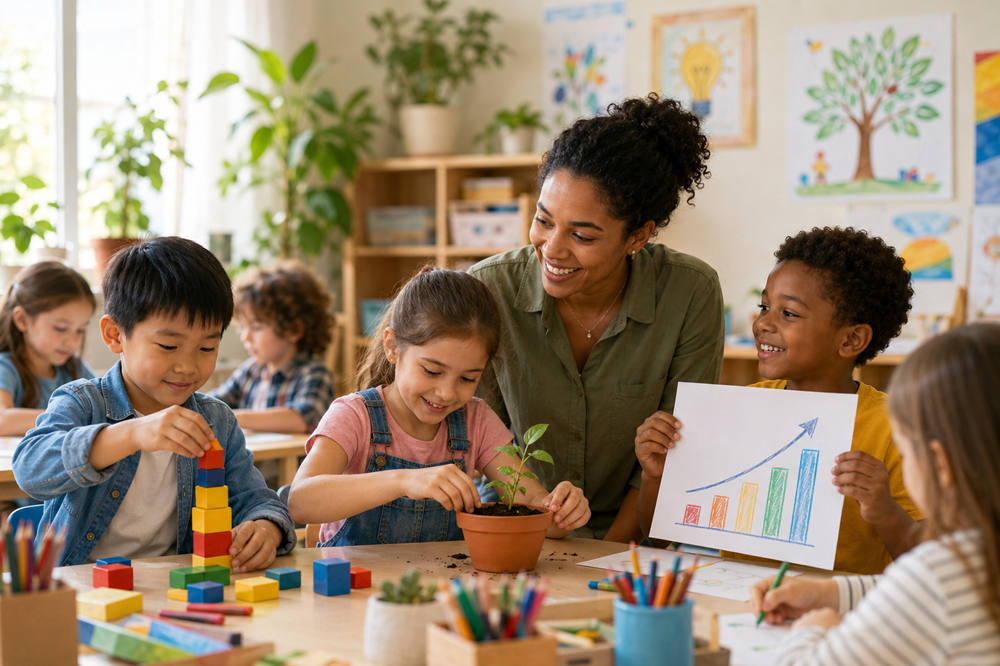
Helping kids develop a growth mindset starts with the way you respond to effort, mistakes, frustration, and progress. Children need to know that being confused, slow, or imperfect does not mean they are failing.
A growth mindset teaches kids that skills can improve with practice, feedback, patience, and better strategies. It is not about fake positivity. It is about helping children believe they can learn, adjust, and keep going when something feels hard.
What Is a Growth Mindset for Kids?
A growth mindset is the belief that abilities can grow over time. For kids, that means they can get better at reading, math, sports, music, problem-solving, friendships, and everyday responsibilities through practice and support.
A child with this mindset may still feel upset after a mistake. They may still cry over homework, feel embarrassed after losing a game, or get frustrated when a new skill takes longer than expected. The difference is that they slowly learn not to treat struggle as proof that they are incapable.
Instead of thinking, “I’m bad at this,” they learn to think, “I’m still learning how to do this.”
That small shift matters because it keeps the door open. Kids begin to see learning as something active. They can try a new strategy, ask a question, practice one part again, or take a break and return with a clearer mind.
The goal is not to make children believe everything is easy. The goal is to help them understand that hard things can be worked through.
Why This Mindset Matters for Children
Kids meet challenges in ordinary moments: spelling homework, reading practice, soccer drills, piano lessons, art projects, chores, friendships, and classroom discussions.
Without the right support, those moments can turn into fixed beliefs.
A child may say:
“I’m not a math person.”
“I’ll never be good at reading.”
“I always mess things up.”
“I’m not as smart as everyone else.”
“I can’t do this.”
Those statements may sound like temporary frustration, but repeated often enough, they can shape how children see themselves. A child who believes ability is fixed may avoid harder work because they do not want to feel embarrassed. They may choose easy tasks, give up quickly, or stop trying new things.
A learning-focused mindset gives them another way to respond. It helps them see challenge as part of improvement, not as a sign to quit.
This matters far beyond school. Children who learn how to handle mistakes and frustration are better prepared for friendships, hobbies, responsibilities, and future goals.
Praise Effort, Strategy, and Progress
One of the most practical ways to help kids is to praise the process, not just the outcome.
That means you notice what the child did to improve. You point out effort, focus, patience, problem-solving, and smart strategy.
Instead of saying:
“You’re so smart.”
Try saying:
“You worked through that problem step by step.”
Instead of saying:
“You’re a natural.”
Try saying:
“Your practice is starting to show.”
Instead of saying:
“You got an A, so you must be good at this.”
Try saying:
“You studied in a focused way, and it helped you understand the material.”
This kind of praise teaches kids that success is connected to action. They begin to understand that improvement comes from practice, attention, and better approaches.
The American Psychological Association explains the value of focusing on a child’s work, effort, and persistence instead of only praising talent.
This does not mean you can never tell a child they are smart or talented. The problem happens when praise focuses only on natural ability. A child who is always praised for being “smart” may become afraid of difficult work because struggling feels like losing that identity.
Process-based praise gives a healthier message: “You are capable of learning, and your choices matter.”
Teach Kids to Use the Word “Yet”
“Yet” is simple, but it can change how children talk to themselves.
When your child says, “I can’t do this,” you can gently say, “You can’t do it yet.”
That one word reminds them that the story is not finished.
For example:
“I can’t tie my shoes” becomes “I can’t tie my shoes yet.”
“I don’t understand fractions” becomes “I don’t understand fractions yet.”
“I’m not good at basketball” becomes “I’m still learning basketball.”
“I can’t read this book” becomes “This book is hard for me right now.”
The key is to avoid using “yet” like a correction that shuts down their feelings. If your child is upset, acknowledge that first.
You might say:
“I know this feels frustrating. You have not figured it out yet, but we can look at the part that feels confusing.”
That response does two things at once. It validates the feeling, and it keeps the child connected to the possibility of progress.
Turn Mistakes Into Useful Information
Mistakes are one of the best places to teach kids how learning works.
If every mistake leads to shame, anger, or panic, children may learn to hide failure. They may stop raising their hand, avoid hard books, or quit activities where they might not succeed right away.
But when mistakes are treated as information, kids learn to use them.
This does not mean ignoring poor choices or pretending mistakes do not matter. Children still need correction and responsibility. The goal is to respond in a way that helps them understand what to do next.
You can ask:
“What part was tricky?”
“What did this mistake show you?”
“What could you try differently next time?”
“What is one small thing you can fix?”
“What do you understand now that you did not understand before?”
If your child gets a spelling word wrong, avoid saying, “You should know this by now.” Try, “This word has a tricky pattern. Let’s look at the part that confused you.”
If your child loses a game, avoid blaming everyone else. Try, “That was disappointing. What is one skill you want to practice before the next game?”
Mistakes become less scary when kids know they can learn from them.
Model Learning in Your Own Life
Kids do not only learn from your advice. They learn from watching how you handle your own challenges.
If you call yourself “bad” at something, give up quickly, or react harshly to your own mistakes, your child notices. If you stay curious, try again, and talk through your process, they notice that too.
You do not have to act perfect. In fact, letting kids see you handle imperfection calmly can be powerful.
You can say:
“I made a mistake, so I’m going to fix it.”
“I don’t know how to do this yet, but I can learn.”
“This is harder than I expected, so I need a different strategy.”
“I got frustrated, so I’m going to take a short break and try again.”
“I practiced this a few times, and now I’m getting better.”
These moments show children that learning does not stop when you become an adult. Everyone has skills they are still building.
You can model this while trying a new recipe, using a new app, fixing something at home, learning a hobby, or improving a work skill. Let your child see the messy middle, not just the finished result.
Guide Instead of Rescuing Too Quickly
When kids struggle, it is natural to want to step in and fix the problem. You may want to finish the math question, clean up the project, solve the argument, or give the answer.
Support is helpful. But rescuing too quickly can teach children that they cannot handle hard things without someone taking over.
A better approach is to guide them toward the next step.
Ask:
“What have you tried so far?”
“Where did you get stuck?”
“What part do you understand?”
“What strategy could help here?”
“Do you want a hint or an example?”
For homework, you might say, “I won’t do it for you, but I can sit with you while you figure out the first step.”
For chores, you might say, “Let’s break this into smaller parts. What should you do first?”
For friendship problems, you might say, “What could you say to repair this?”
This teaches kids that asking for help is not the same as giving up. They can receive support and still take responsibility for learning.
Make Challenge Feel Normal
Children often think that if something is hard, something is wrong. They may believe other kids understand faster, perform better, or never feel nervous.
That is why it helps to normalize challenge before frustration turns into self-doubt.
You can remind your child that new skills often feel uncomfortable at first. Reading may feel slow before it feels smooth. Math may feel confusing before the pattern clicks. A sport may feel awkward before coordination improves.
A helpful phrase is:
“Hard does not mean impossible. Hard means you are learning something new.”
Children’s beliefs about learning and ability can shape how they respond to effort, challenge, and setbacks.
At home, you can make challenge part of normal conversation. Ask:
“What was something hard you worked through today?”
“What did you practice?”
“What are you getting better at?”
“What helped you keep going?”
These questions help kids notice effort and progress in everyday life.
Avoid Labels That Limit Your Child
Labels can stay in a child’s mind, even when adults mean well.
Some labels sound negative:
“She’s not a math person.”
“He’s too shy.”
“She’s not athletic.”
“He’s always careless.”
Other labels sound positive:
“She’s the smart one.”
“He’s naturally gifted.”
“She’s the artist.”
“He’s the athlete.”
Even positive labels can create pressure. A child who is always called “the smart one” may avoid hard work because they do not want to risk looking less smart. A child who is known as “the athlete” may feel nervous about trying art, music, or academic clubs.
Try describing actions instead of fixed identities.
Say:
“You practiced that skill.”
“You explained your idea clearly.”
“You showed patience.”
“You tried a new strategy.”
“You kept going even when it felt uncomfortable.”
This gives children room to grow. They do not have to stay inside one role. They can build many skills over time.
Build Small Learning Routines at Home
You do not need a formal lesson to build this mindset. Small daily routines can make the message feel natural.
At dinner, ask, “What did you learn today?” instead of only asking, “How was school?”
After homework, ask, “What strategy helped you most?”
After a mistake, ask, “What would you try differently next time?”
After practice, ask, “What felt easier than last week?”
You can also keep a simple “things I’m learning” list on the fridge or in a notebook. Add school skills, life skills, hobbies, and emotional skills. A child might write:
“I’m learning long division.”
“I’m learning to calm down when I’m mad.”
“I’m learning to read harder books.”
“I’m learning to pass the ball better.”
“I’m learning to clean my room without getting overwhelmed.”
This helps kids see that learning is not limited to grades. They are growing in many areas of life.
Use Helpful Language When Kids Feel Frustrated
The best time to teach this way of thinking is when kids are struggling.
Start by naming the feeling. Children often calm down faster when they feel understood.
You might say:
“I can see this is really frustrating.”
“That was disappointing.”
“You worked hard, and it still did not go the way you wanted.”
“It makes sense that you feel upset.”
Then guide them toward one next step.
Try:
“Let’s find the part that is confusing.”
“What is one small step we can try?”
“What strategy have you not tried yet?”
“This mistake is showing us what to practice.”
“You do not have to solve the whole thing right now. Let’s start with one piece.”
This approach helps kids connect emotional safety with learning. They do not have to pretend they are fine. They can feel upset and still move forward when they are ready.
Do Not Turn It Into “Just Try Harder”
One common mistake is using growth mindset language to pressure children.
A struggling child does not need to hear, “Just try harder.” That can feel dismissive, especially if they are already trying.
Effort matters, but effort alone is not always enough. Kids also need strategies, feedback, rest, encouragement, and sometimes extra support.
For example, if your child studies for a test and still does poorly, saying, “You should have tried harder” may not help. A better response would be:
“You did spend time studying. Let’s look at how you studied and see what might work better next time.”
Maybe they need practice questions, flashcards, shorter study sessions, help from a teacher, or a quieter place to focus.
The message should not be, “If you fail, it is because you did not try enough.”
The better message is, “Let’s learn from this and find a better way forward.”
Help Kids Focus on Their Own Progress
Comparison can damage confidence quickly.
Kids notice who reads faster, scores higher, runs quicker, draws better, or gets more attention. Some comparison is normal, but it becomes discouraging when children believe someone else’s strength means they are behind forever.
Help your child measure progress against their own starting point.
Instead of asking, “Did you get the highest score?” ask, “Did you improve from last time?”
Instead of saying, “Your sister learned this faster,” say, “Let’s look at what helps you learn best.”
Instead of focusing only on winning, ask, “What skill got stronger today?”
This is especially important with siblings. Avoid comparing children as motivation, even when you mean it kindly. Each child needs space to grow at their own pace.
Personal progress gives kids a healthier target. They can admire others without using someone else’s success as proof that they are not good enough.
Growth Mindset Phrases Parents and Teachers Can Use
Sometimes a simple phrase can help a child pause, breathe, and try again.
Here are useful phrases to keep nearby:
“You are learning something new, so it makes sense that it feels hard.”
“You do not understand it yet, but you can keep building the skill.”
“What is another strategy you could try?”
“Mistakes help us see what needs more practice.”
“You made progress, even if it is not perfect yet.”
“Let’s break this into smaller steps.”
“You worked through a tough moment.”
“What helped you improve this time?”
“You can ask for help and still be independent.”
“The goal is progress, not perfection.”
These phrases work best when they sound natural. You do not need to say them perfectly. The main goal is to help kids connect effort, strategy, patience, and learning.
What to Avoid When Teaching Growth Mindset
This approach works best when it is realistic and supportive.
Avoid praising effort that is not useful. If a child keeps using the same strategy and stays stuck, help them find a better one.
Avoid forcing positivity. Kids are allowed to feel sad, angry, nervous, or disappointed.
Avoid using growth mindset language to ignore real struggles. Some children need tutoring, accommodations, therapy, medical support, or extra help from school.
Avoid comparing siblings, classmates, or teammates.
Avoid turning every mistake into a lesson right away. Sometimes a child needs comfort before they are ready to reflect.
Avoid expecting instant confidence. Children build this slowly through repeated experiences of trying, adjusting, and improving.
The goal is not to raise kids who never feel discouraged. The goal is to help them recover from discouragement with more confidence and support.
Helping Kids Grow One Small Moment at a Time
Helping kids develop a growth mindset is less about one big speech and more about everyday responses. It shows up when you praise useful effort, stay calm around mistakes, guide instead of rescue, and model your own learning.
Children need to know they are loved while they are learning, not only after they succeed.
When you teach them to use the word “yet,” focus on progress, and look for better strategies, you give them tools they can use far beyond one assignment or one hard day.
A child with a growth mindset does not believe everything will be easy. They believe they can keep learning. That belief can shape how they face school, friendships, goals, and life.