
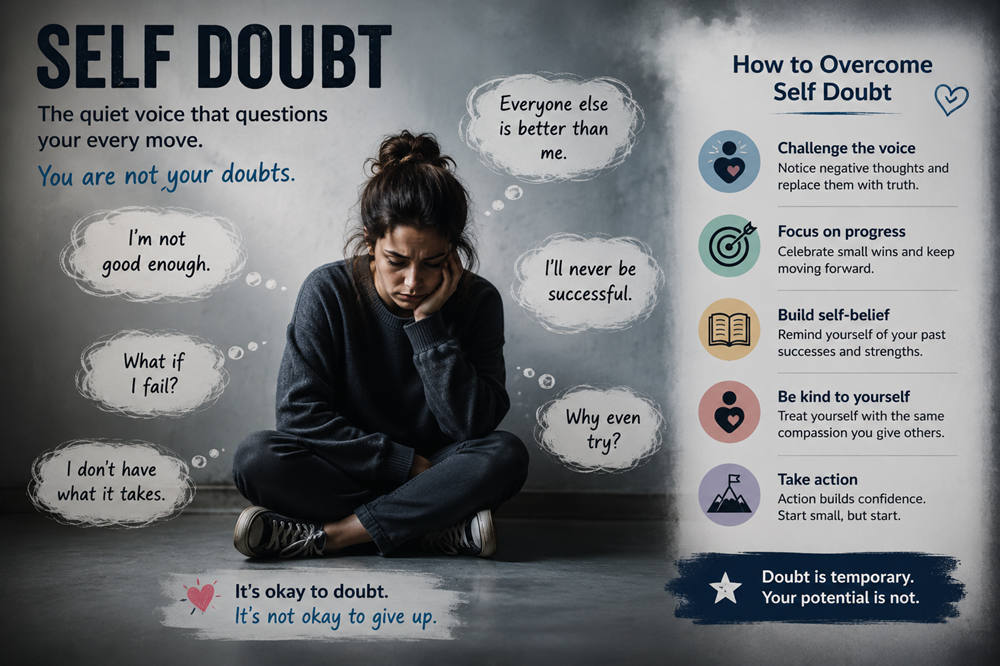
Self doubt can show up quietly. It may appear before a big decision, after a small mistake, or during a moment when someone else seems more confident than you. Suddenly, you are questioning your ability, your judgment, or whether you are ready for the next step.
The truth is simple: doubt is normal, but it should not run your life. You can learn to understand it, challenge it, and keep moving without waiting to feel perfectly confident first.
What Is Self Doubt?
Self doubt is the habit of questioning yourself, your abilities, your choices, or your worth. It often sounds like an inner voice asking, “What if I fail?” “What if I am not good enough?” or “What if everyone else is better than me?”
A little uncertainty can be useful. It can make you pause, prepare, ask better questions, or think more carefully before making a choice. That kind of reflection can help you grow.
The problem starts when doubt becomes your automatic response. Instead of helping you think clearly, it makes you freeze. You may avoid opportunities, delay decisions, or keep waiting for a level of confidence that never fully arrives.
Confidence often grows after you take action, not before. You learn to trust yourself by doing hard things, adjusting when needed, and seeing that you can handle more than your fear suggests.
Is Self Doubt Normal?
Yes, self doubt is normal. Everyone questions themselves sometimes, especially during change, stress, failure, or new challenges.
You may feel unsure when starting a new job, learning a skill, making an important decision, speaking in front of others, or comparing your progress to someone else’s. That does not mean you are weak. It means you are human.
The real question is not whether doubt appears. The real question is how much power it has over your choices.
If it helps you prepare, reflect, and improve, it can be useful. If it keeps you stuck, silent, or afraid to try, it needs to be challenged.
You do not need to become someone who never feels unsure. You only need to become someone who can keep going without letting that feeling make every decision.
Common Signs of Self Doubt
Self doubt does not always look obvious. Sometimes it hides inside everyday habits that feel normal.
You might second-guess decisions long after you have made them. You may ask for reassurance, then still feel uncertain after someone gives it. You might replay conversations in your mind, wondering if you sounded awkward, said too much, or made the wrong impression.
It can also show up in the way you respond to success. Instead of accepting a compliment, you explain it away. Instead of recognizing your effort, you call it luck. Instead of feeling proud of progress, you focus on what still is not perfect.
Common signs include:
- Avoiding challenges because you feel unprepared
- Comparing yourself to people who seem ahead
- Feeling afraid to speak up, even when you have something useful to say
- Procrastinating because you do not want to do something imperfectly
- Treating one mistake like proof that you are not capable
- Needing approval before making simple choices
- Thinking you must know everything before you begin
These patterns matter because they can slowly limit your life. The more you obey doubt without questioning it, the easier it becomes to stay in familiar places, even when you want something more.
Why Self Doubt Happens
Self doubt usually has roots. It often grows from past experiences, criticism, pressure, comparison, or fear of being judged.
Past failure is one common cause. If you tried something before and it did not go well, your mind may try to protect you from feeling that disappointment again. The next time you face something similar, the old memory comes back as a warning.
Criticism can also leave a lasting mark. Harsh words from parents, teachers, peers, bosses, or partners may stay with you long after the moment has passed. Over time, those voices can become part of your inner dialogue.
Perfectionism is another major cause. When you believe you must do everything perfectly, starting feels risky. You may avoid trying because you are afraid your effort will not meet your own impossible standard.
Comparison makes the feeling worse. Social media, school, work, and everyday conversations can make it seem like everyone else is moving faster or doing better. You may compare your private struggles to someone else’s polished results and assume you are behind.
Fear of failure also plays a big role. If you see failure as proof that you are not good enough, every new goal feels like a test of your worth. That makes even small risks feel heavy.
One of the most important things to remember is this: a feeling is not always a fact. Feeling unready does not always mean you are unready. Feeling behind does not always mean you are failing. Feeling unsure does not mean you are incapable.
Self Doubt vs. Healthy Self-Reflection
There is a difference between doubting yourself and reflecting honestly.
Healthy self-reflection helps you learn. It asks, “What can I improve?” “What did this teach me?” or “What would I do differently next time?”
Self doubt attacks your identity. It says, “Maybe I am not good enough.” “Maybe I should not try again.” or “Maybe everyone else can do this except me.”
Healthy reflection leads to growth. Doubt often leads to avoidance.
For example, after a difficult presentation, reflection may help you notice that you need to practice your opening. That is useful. But harsh inner criticism may tell you that you are terrible at speaking and should never present again. That is not growth. That is fear trying to protect you by making your world smaller.
You do not need to ignore feedback or pretend every mistake is fine. You simply need to stop turning every mistake into a judgment about who you are.
When Self Doubt Becomes a Problem
Self doubt becomes a problem when it starts making choices for you.
It may stop you from applying for a job, starting a project, sharing an idea, joining a class, setting a boundary, or trying something that matters to you. You may stay in familiar situations because they feel safer, even if they no longer help you grow.
It can also affect relationships. You might assume people are judging you when they are not. You may need constant reassurance. You may hold back your honest thoughts because you fear rejection or criticism.
Over time, this pattern can make your life feel smaller. You take fewer chances, so you have fewer chances to prove to yourself that you are capable. Then the lack of action becomes more evidence for the doubt.
That cycle can be frustrating, but it is not permanent. A doubtful thought is not a command. It is something you can notice, question, and respond to with more balance.
How to Overcome Self Doubt
You do not overcome self doubt by forcing yourself to feel confident all the time. A better approach is to build trust through small, steady actions.
1. Name the Doubt
Start by noticing the thought instead of immediately believing it.
Instead of saying, “I am going to fail,” try saying, “I am having a thought that says I might fail.”
That small shift creates distance. It reminds you that your mind is producing a fear-based thought, not delivering the final truth.
You can also name the pattern behind it. Maybe it is perfectionism. Maybe it is fear of judgment. Maybe it is an old critical voice from your past. When you can name what is happening, it becomes easier to respond instead of react.
2. Look for Real Evidence
Doubt often focuses only on what could go wrong. To balance it, look for facts.
Ask yourself:
- What have I handled before that proves I can do hard things?
- What skills do I already have?
- What have past mistakes taught me?
- What would I tell a friend in this same situation?
- Is this thought based on facts, fear, or old criticism?
This is not about pretending everything will be easy. It is about giving yourself a fairer picture.
You have likely solved problems, learned new skills, survived difficult days, and adjusted after setbacks. When your mind forgets that history, you need to remind it.
3. Take One Small Step
Overthinking keeps doubt alive. Small action interrupts it.
If you feel unsure about starting a project, work on it for ten minutes. If speaking up feels hard, ask one question. If exercise feels overwhelming, take a short walk. If writing feels intimidating, draft one messy paragraph.
The step does not need to be impressive. It only needs to be real.
Small action gives your brain new evidence. It shows you that discomfort is not danger and that imperfect effort still counts.
4. Stop Waiting Until You Feel Fully Ready
Many people treat readiness like a feeling. They wait to feel calm, certain, motivated, and fearless before beginning.
But readiness often looks much quieter than that. Sometimes it means you have enough information to start and enough willingness to learn as you go.
You can be nervous and ready. You can be unsure and still capable. You can be learning and still worthy of beginning.
Waiting for perfect confidence can become a form of avoidance. Give yourself permission to start before everything feels ideal.
5. Change the Way You Talk to Yourself
Your inner voice can either support your growth or make every challenge feel heavier.
You do not need fake positivity. You need honest, steady language. If you are used to negative self-talk, start by softening the way you speak to yourself instead of trying to force perfect confidence.
Instead of saying, “I always mess things up,” try, “This is difficult, but I can take one step.”
Instead of saying, “I am bad at this,” try, “I am still learning this.”
Instead of saying, “Everyone is ahead of me,” try, “I can focus on my own next move.”
Supportive self-talk is not pretending. It is choosing words that help you stay grounded enough to keep going.
6. Keep a Record of Your Wins
Doubt has a short memory. It forgets your progress quickly.
A simple win list can help. Write down moments when you handled something well, solved a problem, tried again, received kind feedback, finished a task, or acted with courage.
These wins do not have to be huge. Making a difficult phone call, asking for help, setting a boundary, or completing a small task all count.
Over time, this list becomes evidence. When your inner critic says, “You never do anything right,” you have proof that this is not true.
7. Reduce Comparison Triggers
Comparison can make anyone feel behind.
There will always be someone who seems more successful, confident, disciplined, attractive, or skilled. If you constantly measure your private struggle against someone else’s visible success, you will almost always feel like you are losing.
Pay attention to what triggers that feeling. It may be certain social media accounts, conversations, environments, or people who turn everything into a competition.
You do not have to judge them. You simply need to protect your focus.
Your path does not have to look like anyone else’s to be meaningful.
How to Turn Doubt Into Growth
Doubt does not always have to be treated as an enemy. Sometimes it can become useful information.
If it says, “I do not know enough,” you can choose to learn. If it says, “This matters to me,” you can prepare with care. If it says, “I am scared,” you can ask what support would help.
The key is to separate useful caution from fear-based avoidance.
Doubt before an interview might push you to practice your answers. That is helpful. But if it tells you not to apply at all, it is limiting you.
Uncertainty before a big decision might encourage you to think carefully. That can be wise. But if it traps you in endless overthinking, it is no longer helping.
A growth mindset does not mean you never question yourself. It means you believe you can learn, adjust, and improve even when you feel unsure.
Daily Habits That Build Self-Trust
Self-trust grows through small daily choices.
Start by making simple decisions without overchecking. Choose what to eat, what to wear, or which task to begin without asking for too many opinions. This teaches your brain that you can make choices and handle the outcome.
Another helpful habit is writing down one thing you did well each day. This trains your attention to notice progress instead of only scanning for mistakes.
You can also replace “I can’t” with “I’m learning.” That phrase keeps the door open. It reminds you that ability can grow with practice.
Try doing one slightly uncomfortable but meaningful thing each week. Speak up. Ask a question. Begin the task you have avoided. Try something new. Each small brave action gives you another reason to trust yourself.
Your environment matters too. Spend more time with people who encourage growth, honesty, and effort. Spend less time around people who constantly criticize, compete, or make you feel small.
What to Do When Doubt Feels Heavy
Sometimes doubt is more than a passing thought. It may feel constant, intense, or tied to anxiety, depression, trauma, or deep insecurity.
If it affects your daily life, relationships, sleep, work, or ability to make decisions, support can help. A trusted friend, mentor, coach, counselor, or mental health professional can give you space to understand what is happening and build healthier patterns.
You do not have to wait until things feel unbearable to ask for help. Support is not only for crisis moments. It can also help you understand yourself with more clarity and kindness.
Asking for help does not mean you are weak. It means you are taking your growth seriously.
Final Thoughts
Self doubt may visit you, but it does not have to lead you.
You can pause and listen without obeying every fearful thought. You can use uncertainty as a reason to prepare, not as a reason to disappear. You can take one small step before you feel fully ready.
Trusting yourself does not mean believing you will always get everything right. It means knowing you can learn, recover, adjust, and keep going.
That is where real confidence begins.