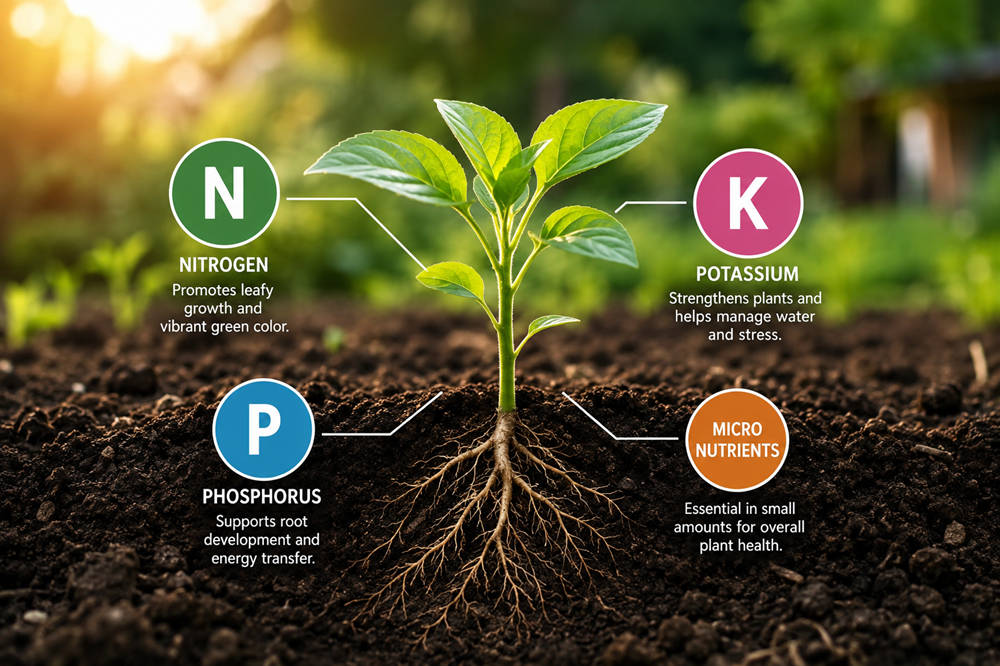
Nitrogen and phosphorus are major limiting nutrients for plant growth, particularly in natural terrestrial ecosystems. When plants cannot obtain enough of either nutrient, growth and productivity may decline. In gardens and agriculture, potassium can also become limiting, which is why nitrogen, phosphorus, and potassium are commonly grouped as the primary N-P-K macronutrients.
The actual limiting nutrient is not the same everywhere. It depends on the plant, soil, climate, nutrient availability, and growing conditions. Plants can also be limited by more than one nutrient at the same time.
Which Nutrients Limit Plant Growth?
For a general biology or ecology question, nitrogen (N) and phosphorus (P) are the nutrients most often discussed as major limits on plant productivity. Both are required for processes that plants cannot complete normally when supplies are inadequate.
In practical gardening and crop production, nitrogen, phosphorus, and potassium are known as the primary macronutrients because plants require relatively large amounts of them.
| Nutrient | Major Functions | Possible Effects of Deficiency |
|---|---|---|
| Nitrogen (N) | Chlorophyll, amino acids, proteins, and plant growth | Slow growth and yellowing that often begins on older leaves |
| Phosphorus (P) | Energy transfer, genetic material, membranes, and development | Stunted growth and poor development |
| Potassium (K) | Water regulation, enzyme activity, and movement of materials within plants | Reduced vigor and poorer stress tolerance |
What Does “Limiting Nutrient” Mean?
A limiting nutrient is an essential nutrient whose insufficient availability restricts plant growth. A plant can have an abundant supply of several nutrients and still grow poorly if it cannot obtain enough of another one that it needs.
This idea is often introduced through the Law of the Minimum. In its simplest form, the principle suggests that growth is constrained by the essential resource in shortest supply relative to a plant’s needs.
For example, suppose a plant has adequate phosphorus and potassium but not enough nitrogen. Adding more phosphorus would not solve the main problem because nitrogen remains the bottleneck.
Real ecosystems can be more complicated than this simple model. Research has shown that plant productivity may be co-limited by two or more nutrients. Nitrogen and phosphorus co-limitation, for example, occurs in some grasslands and other terrestrial ecosystems. In these situations, increasing one nutrient alone may produce a smaller response than supplying both.
Why Nitrogen Often Limits Plant Growth
Nitrogen is essential for many of the compounds plants use to grow. It is part of amino acids and proteins and is an important component of chlorophyll, the pigment central to photosynthesis.
Plants need relatively large amounts of nitrogen, but maintaining an adequate supply in soil can be difficult. Plant-available nitrogen can be lost through processes such as leaching, especially under conditions where water moves nitrate below the root zone. Nitrogen availability also changes with organic matter, soil biology, moisture, temperature, and other environmental conditions.
When nitrogen is deficient, plants may grow slowly and develop pale green or yellow foliage. Because plants can move nitrogen from older tissue to younger growth, yellowing frequently appears first on older leaves.
Those symptoms are useful clues, but they are not proof of nitrogen deficiency. Root damage, excessive water, drought, disease, and other stresses can produce similar changes.
Why Phosphorus Can Limit Plant Growth
Phosphorus performs different jobs from nitrogen. Plants use it in compounds involved in energy transfer, including ATP, and it is part of DNA, RNA, and cell membranes. Adequate phosphorus supports normal plant development and reproduction.
One challenge with phosphorus is that the amount present in soil is not necessarily the amount available to roots. Chemical reactions can bind phosphorus into forms that plants cannot readily absorb.
Soil pH plays an important role in this process. Under unfavorable pH conditions, phosphorus availability can decline even when the soil contains phosphorus. This is one reason fertilizer decisions should consider soil chemistry rather than simply the total quantity of a nutrient.
Phosphorus deficiency may cause slow or stunted growth. Some plants can also develop unusually dark green or purplish foliage, although appearance varies among species and growing conditions. Visual symptoms therefore should be treated as clues rather than a diagnosis.
When Does Potassium Become Limiting?
Potassium is another essential macronutrient that plants use in large quantities. It contributes to enzyme activation, movement of water and carbohydrates within plant tissue, and regulation of processes that help plants respond to their environment.
If the plant-available potassium supply becomes too low, growth and normal plant function can suffer. The risk varies with soil type, crop requirements, previous nutrient removal, and other management conditions.
Potassium also illustrates why nutrient limitation is about availability, not simply whether a nutrient exists in the soil. Soil minerals can contain substantial potassium while only part of that supply is immediately accessible to plants.
Can Micronutrients Limit Plant Growth?
Yes. Plants require micronutrients such as iron, manganese, zinc, copper, boron, molybdenum, chlorine, and nickel in much smaller quantities than macronutrients, but they are still essential.
If one of these nutrients becomes unavailable, it can restrict normal development even though the plant requires only a small amount. Soil pH is particularly important because it can greatly influence micronutrient availability.
For example, some micronutrients become less available as soils become more alkaline. A plant growing in such soil can therefore show signs of deficiency even when the element is physically present.
Adding more fertilizer is not automatically the solution. Excessive amounts of some nutrients can create imbalances, interfere with the availability of others, or cause environmental problems.
What Determines Which Nutrient Is Limiting?
Nutrient limitation results from the relationship between what a plant needs and what its roots can actually obtain. Several factors influence that balance.
- Soil pH: Changes the chemical availability of many nutrients.
- Soil texture: Influences nutrient retention and the risk of leaching.
- Organic matter: Stores nutrients and affects biological nutrient cycling.
- Moisture: Influences root activity and movement of nutrients through soil.
- Plant species: Different species have different nutritional requirements.
- Growth stage: Nutrient demand changes as plants develop.
- Root health: Compaction, waterlogging, disease, or root damage can reduce nutrient uptake.
- Previous management: Fertilizer, compost, crop removal, and other practices change nutrient levels over time.
Because these conditions vary from one site to another, a nutrient that limits growth in one field, garden, or ecosystem may be plentiful somewhere else.
How Can You Identify a Possible Nutrient Limitation?
Plant appearance can suggest a problem, but symptoms alone rarely identify the cause with certainty. Yellow leaves, poor growth, discoloration, or weak development can result from nutrient deficiencies, but they can also be caused by pests, diseases, temperature stress, root problems, poor drainage, or inadequate water.
A soil test is usually a better starting point than diagnosing a deficiency by appearance alone. Depending on the laboratory and test package, testing may provide information about pH, organic matter, phosphorus, potassium, and other indicators of soil fertility.
Not every nutrient is evaluated in the same way by a standard soil test. Nitrogen, for example, is highly dynamic in soil, and specialized testing or recommendations based on crop needs and soil conditions may be used instead. For persistent or commercially important problems, plant-tissue analysis can provide additional information about the nutrients actually being taken up by the plant.
Testing helps avoid unnecessary fertilizer applications. Applying a nutrient that is already plentiful may do little for plant growth while increasing the risk of nutrient imbalance, plant injury, or losses to the surrounding environment.
Nutrients Aren’t the Only Limits on Plant Growth
Poor growth does not always mean that a plant needs fertilizer. Plants depend on several resources and environmental conditions simultaneously.
Light can become limiting when there is not enough energy for adequate photosynthesis. Water shortage can restrict growth directly, while waterlogged soil can deprive roots of oxygen. Temperature extremes, compacted soil, pests, diseases, and physical root damage can also reduce growth.
These factors may interact with nutrient availability. A damaged or poorly developed root system, for example, may absorb nutrients inefficiently even when the soil contains adequate supplies.
For that reason, nutrient problems are best considered as one possible part of a broader plant-health diagnosis rather than the automatic explanation for weak growth.
The Bottom Line
Nitrogen and phosphorus are major nutrients that commonly limit plant growth, especially when discussing natural terrestrial ecosystems. Nitrogen supports chlorophyll, proteins, and plant tissue, while phosphorus is central to energy transfer, genetic material, and development.
Potassium and even micronutrients can become limiting under the right conditions, and more than one nutrient may restrict productivity at the same time. The key question is not simply which nutrients exist in the soil, but whether plants can obtain enough of each essential nutrient to meet their needs.
If a plant is growing poorly, avoid assuming that fertilizer is automatically the answer. Consider soil conditions, water, light, roots, pests, and disease, and use appropriate soil or plant testing when a nutrient problem is suspected.