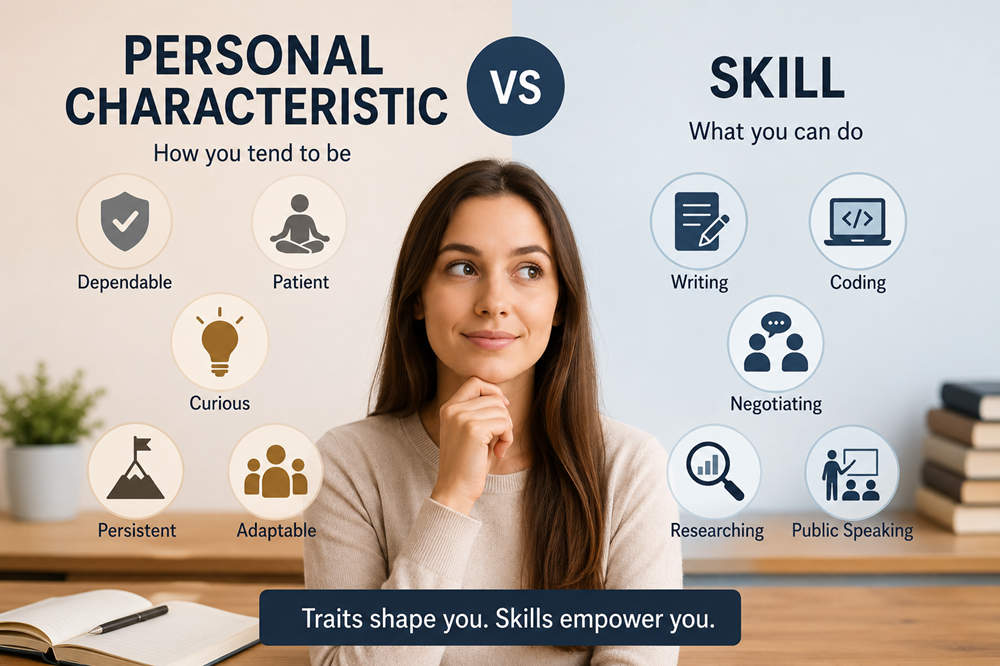
The main difference between a personal characteristic and a skill is that a personal characteristic describes how a person tends to think, behave, or approach situations, while a skill describes something a person has learned or developed the ability to do.
For a simple school or quiz answer, think of it this way: skills are generally learned and improved through practice, while personal characteristics describe a person’s qualities or behavioral tendencies. That does not mean characteristics are fixed at birth or unable to change.
Personal Characteristics vs. Skills at a Glance
| Personal Characteristic | Skill |
|---|---|
| Describes how someone tends to behave or approach situations | Describes something someone can perform |
| Often appears across many situations | Usually involves a particular task or type of performance |
| Develops through a combination of personality, experience, and environment | Develops mainly through learning, practice, feedback, and experience |
| Examples: dependable, patient, curious, persistent | Examples: writing, coding, negotiating, researching |
A useful shortcut is: characteristics describe how you tend to be; skills describe what you can do.
Different education and career frameworks may classify individual terms somewhat differently. In this article, “personal characteristic” refers mainly to personality traits and behavioral tendencies.
What Is a Personal Characteristic?
A personal characteristic is a relatively consistent quality or tendency that influences how someone behaves, responds, or approaches situations.
Examples include:
- Dependability
- Patience
- Curiosity
- Persistence
- Adaptability
- Integrity
- Self-confidence
- Attention to detail
For example, a dependable person tends to follow through on commitments. A curious person is more likely to ask questions and explore unfamiliar ideas. Someone who is persistent tends to keep working when progress is difficult.
These characteristics can affect many parts of life. Patience, for instance, may influence how someone studies, communicates with coworkers, handles delays, or responds to a difficult problem.
Personal characteristics should not be treated as permanently fixed qualities. The APA Dictionary of Psychology describes a personality trait as relatively stable and consistent, which is different from saying that a trait can never develop or change.
What Is a Skill?
A skill is a learned or developed proficiency that helps someone perform a task effectively. Skills can usually be strengthened through instruction, repetition, experience, and feedback.
The O*NET Content Model, used for occupational information in the United States, separates skills from worker characteristics. It describes skills and knowledge as requirements developed through education and experience.
Some skills are technical, such as:
- Programming
- Bookkeeping
- Using spreadsheet software
- Operating specialized equipment
- Video editing
Other skills transfer easily between jobs and situations:
- Writing
- Public speaking
- Negotiation
- Problem solving
- Active listening
- Research
The key difference is performance. A skill can usually be demonstrated through an activity. If someone says they can build a budget in spreadsheet software, for example, they can be given financial data and asked to create one.
A characteristic such as dependability is judged differently. Rather than being demonstrated through one isolated task, it is usually reflected in a pattern of behavior over time.
Examples of Characteristics and Skills Side by Side
Characteristics and skills often work together, which is why people sometimes confuse them. Comparing related examples makes the difference easier to see.
Patience vs. Conflict Resolution
Patience is a characteristic. It describes a tendency to stay composed when dealing with delays, difficulties, or frustration.
Conflict resolution is a skill. It involves behaviors such as listening to different viewpoints, identifying the source of disagreement, communicating clearly, and working toward a practical solution.
Patience can help someone manage conflict, but being patient does not automatically mean that person knows effective conflict-resolution techniques.
Self-Confidence vs. Public Speaking
Self-confidence is a personal tendency related to how someone views their capabilities.
Public speaking involves learnable techniques such as organizing a presentation, adapting to an audience, controlling pace, using vocal emphasis, and answering questions.
A confident person can still be an ineffective speaker. Someone who feels nervous can also become a strong speaker through preparation and practice.
Attention to Detail vs. Proofreading
Attention to detail describes a tendency to notice and carefully manage small details.
Proofreading is a skill involving the identification and correction of errors in spelling, grammar, punctuation, formatting, and consistency.
Attention to detail may support good proofreading, but proofreading also requires knowledge and technique.
Curiosity vs. Research
Curiosity can motivate someone to ask questions and seek information.
Research requires skills such as finding relevant information, evaluating sources, organizing evidence, and drawing reasonable conclusions.
Curiosity may encourage someone to investigate a topic, while research skills influence how well that investigation is carried out.
Do Personal Characteristics Turn Into Skills?
Personal characteristics do not usually turn directly into skills. Instead, they can make certain skills easier to develop or use.
- Curiosity can support research and learning.
- Persistence can help someone continue practicing a difficult skill.
- Empathy can support active listening and communication.
The distinction matters because having a helpful characteristic does not automatically provide the related skill. An empathetic person may care about other people’s perspectives but may still need to practice asking useful questions, listening without interrupting, and responding clearly.
The relationship can also work in the other direction. Practicing a skill repeatedly can influence behavior. Someone who gains experience speaking in front of groups, for example, may become more comfortable and confident doing it.
Why “Soft Skills” Can Be Confusing
The term soft skills often blurs the line between skills and personal characteristics.
In everyday workplace language, communication, teamwork, leadership, adaptability, dependability, and similar qualities may all be grouped under the soft-skills label. However, they are not exactly the same type of thing.
Communication, negotiation, active listening, and conflict resolution involve behaviors that can be deliberately learned and practiced. Dependability and similar work-style tendencies describe broader patterns in how a person approaches work.
O*NET handles this difference by separating work styles from essential and transferable skills. Its transferable-skills category includes areas such as communication, problem solving, and teamwork, while work styles describe personality tendencies shown at work.
Some concepts naturally involve both. Leadership, for example, may be supported by characteristics such as integrity and confidence while also requiring learnable skills such as communication, delegation, decision-making, and coaching.
Why the Difference Matters
Knowing whether you are dealing with a characteristic or a skill can make personal development, education, and career planning more practical.
Personal Development
If you struggle with a particular activity, describing the problem only as a personality weakness can make improvement feel vague.
Suppose you have difficulty giving presentations. Instead of deciding that you simply “lack confidence,” you can identify specific skills to improve, such as organizing your ideas, practicing your delivery, controlling your pace, or preparing for questions.
That turns a broad concern into something you can practice.
Education and Career Planning
Skills provide specific learning targets. If a job requires data analysis, writing, project management, or programming, you can seek courses, projects, practice exercises, internships, or work experience that develop those abilities.
Improving a personal characteristic may involve a broader change in habits. Becoming more dependable, for example, could involve better planning, clearer communication, stronger routines, and consistently following through on commitments.
Resumes and Job Interviews
The distinction is especially useful when describing your strengths to an employer.
Writing that you are “dependable” or “detail-oriented” does not provide much evidence by itself. It is more persuasive to show the characteristic through what you accomplished.
Instead of:
I am organized and dependable.
You could write:
Coordinated weekly project deadlines for a five-person team and completed all assigned deliverables on schedule.
The same principle applies to skills. Rather than simply claiming that you have strong communication skills, describe situations in which you presented information, trained others, worked with customers, or coordinated a project.
Berkeley Career Engagement’s resume guidance similarly emphasizes showing results and connecting your skills and experience to an employer’s needs.
How to Tell Whether Something Is a Skill or a Characteristic
If you are unsure how to classify something, use these questions:
- Does it mainly describe how someone tends to behave? It is probably a personal characteristic.
- Does it describe something someone can perform or demonstrate? It is probably a skill.
- Can someone deliberately practice the activity and improve their performance? It is more likely to be a skill.
- Does it describe a general pattern that appears across many situations? It is more likely to be a characteristic.
For example, “patient” describes a tendency in how someone responds to difficulty, so it is a personal characteristic. “Negotiating” describes something a person can learn, practice, and perform, so negotiation is a skill.
Some terms, including leadership, teamwork, communication, and adaptability, can sit near the boundary depending on how they are being used. When that happens, focus on the context: a repeatable capability is closer to a skill, while a general behavioral tendency is closer to a personal characteristic.
The Bottom Line
A personal characteristic describes a person’s relatively consistent qualities or behavioral tendencies, while a skill is a learned or developed proficiency used to perform a task.
Characteristics can support the development of skills, and practicing skills can sometimes influence how a person behaves over time. Understanding the difference makes it easier to identify strengths, choose what to improve, and describe your abilities more accurately at school or work.