
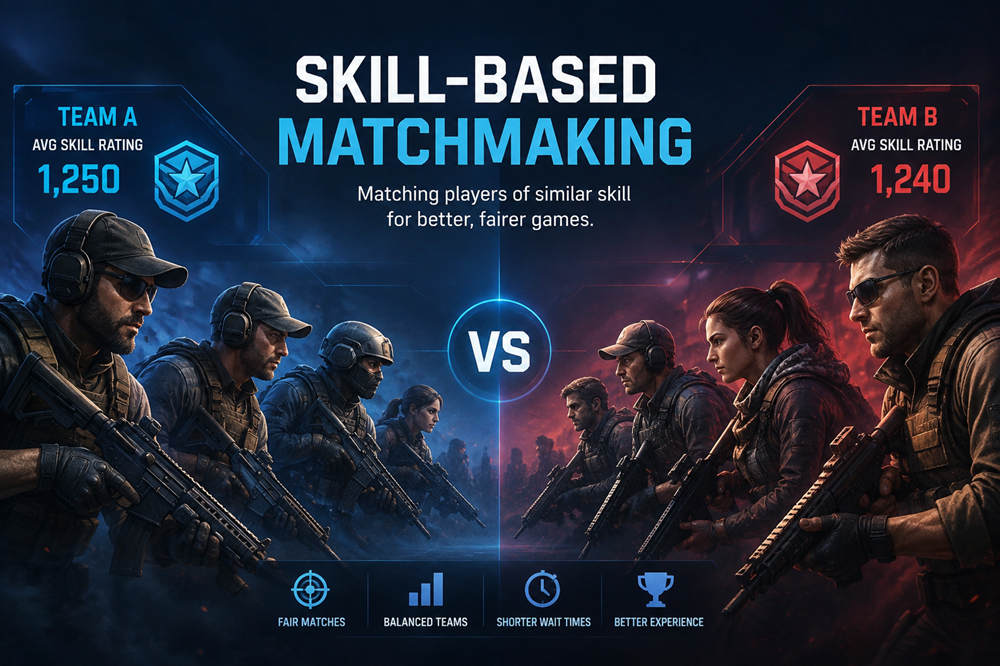
Skill-based matchmaking, usually shortened to SBMM, is a system that considers a player’s estimated ability when creating multiplayer matches. Its basic purpose is to reduce extreme skill mismatches, such as regularly placing beginners against highly experienced players.
Skill is rarely the only factor involved. Modern matchmaking systems may also consider connection quality, queue time, region, party composition, platform, game mode, and how many suitable players are currently searching.
| Term | What It Means |
|---|---|
| SBMM | A matchmaking approach that considers estimated player skill. |
| MMR | A rating or statistical estimate representing player ability. |
| Rank | A visible competitive tier or progression level, such as Gold or Platinum. |
| Team balancing | The process of dividing players in a lobby into reasonably balanced teams. |
What Is Skill-Based Matchmaking?
Skill-based matchmaking uses information about player ability to help decide who should compete together. Instead of selecting every opponent randomly, the system attempts to find players who are suitable competitive matches.
That does not mean everyone in a lobby must have exactly the same rating. Matchmaking is usually a compromise between competitive similarity and practical concerns such as latency and waiting time.
Microsoft Research’s TrueSkill ranking system provides a useful example of the underlying idea. It estimates player ability so that competitors with reasonably similar skill can be matched together.
Calling a system “skill-based” also does not necessarily mean skill is its highest priority. In standard Call of Duty multiplayer, for example, Activision says connection quality and time to match are higher matchmaking priorities than skill.
How Does Skill-Based Matchmaking Work?
The exact formulas are usually proprietary, and different games measure skill in different ways. Still, most skill-aware matchmaking systems follow a similar general process.
1. The Game Estimates Your Skill
The first step is determining roughly how strong a player is. The game may store this as MMR, a skill rating, a hidden matchmaking value, or another internal measurement.
Depending on the game, possible performance signals could include:
- Wins and losses
- Performance relative to opponents
- Eliminations and deaths
- Damage dealt
- Match placement
- Objective contribution
- Individual or team performance
These are examples rather than a universal formula. A fighting game, battle royale, racing game, and objective-based team shooter may need very different ways to define useful competitive skill.
As of August 2026, Apex Legends matchmaking illustrates that difference within a single game. EA says Unranked and Wildcard use MMR, Mixtape uses a damage-based skill value, and Ranked uses Ranked Points. MMR also helps with placement when a new Ranked season begins.
2. The Matchmaker Finds Compatible Players
Once a skill estimate exists, the matchmaking system looks through the available pool of people searching for a match.
Other requirements can narrow that pool. Depending on the game, these may involve region, latency, platform, party size, game mode, cross-play settings, input device, or other technical restrictions.
This is one reason matchmaking can behave differently at different times of day. A busy playlist in a populated region gives the system more possible combinations than a quiet mode with relatively few active players.
3. Matchmaking Rules May Become More Flexible
A system that demanded a nearly perfect match indefinitely could leave players waiting too long. Some matchmaking designs therefore widen acceptable conditions as a search continues.
Microsoft’s PlayFab matchmaking documentation provides a concrete example. Developers can configure matchmaking rules so a narrow skill requirement gradually expands while a player waits. A rule can even become optional after a specified period.
This is an example of how matchmaking can trade tighter skill similarity for faster matches. It should not be taken to mean that every multiplayer game uses PlayFab’s exact system or relaxes its rules in the same way.
4. Skill Estimates Change Over Time
A useful skill rating needs to adapt as players improve or decline. Match results therefore give the system additional information that can update its estimate.
Microsoft’s TrueSkill model tracks both estimated ability and uncertainty about that estimate. When a player is new and the system has little information, the rating can change more rapidly. After a longer sequence of consistent results, it can become more confident about where that player belongs.
This helps explain why matchmaking ratings are not necessarily permanent reflections of a player’s past performance.
What Does a Game Consider “Skill”?
There is no single statistic that defines skill in every multiplayer game.
A common misconception is that SBMM must be based entirely on kill/death ratio. That is not a universal rule. A useful matchmaking measurement needs to reflect what predicts success in the particular game or mode.
In a battle royale, placement and survival may matter. An objective shooter might need to account for contributions that do not appear in raw elimination totals. A fighting game may rely heavily on match outcomes and the strength of opponents.
The important point is that SBMM describes the use of estimated skill in matchmaking, not one standardized method of measuring that skill.
What Is the Difference Between SBMM and MMR?
SBMM and MMR are closely related, but they describe different things.
MMR, or matchmaking rating, is a value or estimate representing how skilled a system believes you are.
SBMM is the broader matchmaking process that can use that skill estimate when deciding which players should compete together.
A simple way to remember it is:
- MMR represents skill.
- SBMM uses skill information to help build matches.
Your MMR also does not have to be the same as the rank displayed on your account. A game can maintain hidden matchmaking information separately from visible ranks, divisions, or progression systems.
Skill-Based Matchmaking vs. Ranked Matchmaking
Ranked matchmaking and SBMM overlap, but they are not synonyms.
Ranked Matchmaking
Ranked modes normally include visible competitive progression. Players gain or lose points and move through named ranks or divisions based on their performance.
Because competitive integrity is the purpose of the mode, a developer may accept longer matchmaking searches to create a more suitable contest.
Activision’s Ranked Play matchmaking research describes this tradeoff directly. Call of Duty Ranked Play can tolerate longer searches than standard multiplayer because maintaining competitive match quality is more important in that environment.
SBMM in Unranked Modes
An unranked or casual playlist can still consider skill even when there is no visible competitive ladder.
Apex Legends, for example, currently uses a hidden MMR for Unranked play. Players cannot see that MMR, but it can still influence how they are grouped.
This means the absence of a displayed rank does not automatically mean matchmaking is random.
Why Do Multiplayer Games Use SBMM?
The main reason is to reduce situations where the competitive gap is so large that one side has little realistic opportunity to participate.
It Can Reduce Extreme Skill Mismatches
A beginner facing experienced veterans may struggle to learn basic mechanics before being eliminated. Meanwhile, a highly skilled player repeatedly facing beginners may encounter little meaningful competition.
Skill-aware matchmaking attempts to reduce these extremes without requiring every player to be identical in ability.
It Can Reduce One-Sided Matches
When teams are reasonably comparable, the outcome is harder to predict before play begins. That does not guarantee a close final score, but it can reduce the likelihood that the lobby was heavily tilted from the start.
It Can Give New Players More Room to Learn
Experience in multiplayer games involves more than mechanical ability. Veteran players often understand maps, positioning, weapons, objectives, movement systems, counters, and common strategies.
Keeping complete newcomers away from the strongest parts of the player population all the time can give them more opportunity to learn those systems.
It May Help Keep More Types of Players Engaged
Activision tested what happened when it reduced the importance of skill for a large group of Call of Duty players. Its matchmaking research reported reduced return rates for most skill groups, along with more quitting and more blowout matches. The highest-skilled group benefited on some measurements.
Those findings are specific to Call of Duty and should not be treated as proof that every SBMM implementation produces the same results. They do show why developers may view skill matching as a player-experience tool rather than simply a competitive ranking feature.
Why Is Skill-Based Matchmaking Controversial?
The same design choices that help one group of players can frustrate another.
Better Players May Face Consistently Stronger Opposition
As a player improves, the matchmaking system may identify stronger opponents as increasingly appropriate matches.
This can create an unusual experience: you may be getting noticeably better at the game without your average match becoming much easier.
Highly skilled players sometimes dislike this in casual modes because they want a different experience from the intensity of ranked competition.
Mixed-Skill Parties Are Hard to Balance
Groups of friends can contain players with dramatically different abilities. Matching the group entirely around the beginner could make the experienced player too dominant, while matching around the strongest member could create an overwhelming game for the beginner.
Games therefore have to choose their own compromises for premade groups.
EA currently says Apex Legends uses the average MMR or damage value for relevant premade squads, while Ranked matchmaking uses the highest Ranked Points value in the squad. It also applies a small adjustment to account for the coordination advantage of premade groups.
Skill Can Compete With Ping and Queue Time
A narrower skill range reduces the number of acceptable opponents. In lower-population regions, uncommon modes, or very high skill brackets, insisting on extremely close ratings could lead to long waits or poor connections.
This is why SBMM is best understood as part of a larger matchmaking system rather than an isolated switch.
Call of Duty offers a particularly useful example. Activision says connection quality is its most heavily weighted matchmaking factor in standard multiplayer, followed by time to match. Skill is considered, but its target can be relaxed faster than connection-quality targets while the lobby is being formed.
Hidden Ratings Can Make the System Feel Unpredictable
Players often cannot see the exact rating or rules influencing an unranked lobby. That makes matchmaking difficult to judge from a small sample of matches.
A sudden difficult lobby might reflect a changing skill estimate, but it could also result from who happens to be online, the selected mode, party members, region, queue population, or other matchmaking constraints.
Does SBMM Force a 50% Win Rate?
Balanced matchmaking is sometimes interpreted as the game deciding when a player should win or lose. Those are not the same thing.
A matchmaker can attempt to build teams with similar estimated ability without scripting the result of the match itself.
Even if two teams were perfectly equal on paper, one side could still dominate because of tactics, individual performance, mistakes, map conditions, coordination, disconnects, or ordinary variation.
Winning and losing streaks can also happen naturally among evenly matched players. A balanced probability does not mean results must alternate between wins and losses.
SBMM is therefore better understood as an attempt to influence the quality of the matchup before the game begins, not a guarantee of a particular outcome afterward.
Is Skill-Based Matchmaking Only Used in Ranked Games?
No. Skill-aware matchmaking can be used in any multiplayer environment where player-versus-player competition matters.
That includes shooters, battle royales, fighting games, racing games, sports games, strategy titles, and other competitive genres.
Microsoft says TrueSkill has been used across games ranging from Halo to Forza, showing that skill-estimation systems can work across very different types of multiplayer competition.
The measurements and matchmaking rules still need to fit the game. There is no single SBMM model that makes sense for every genre.
Can You Turn Off Skill-Based Matchmaking?
That depends on the game.
Many titles do not offer a direct setting for disabling SBMM because matchmaking rules are built into the game’s online infrastructure. Some instead provide different playlists or modes with different matchmaking priorities.
Techniques such as intentionally losing, creating low-level alternate accounts, or manipulating matchmaking conditions are not the same as an official SBMM toggle. They can also undermine fair play or conflict with a game’s rules.
Because matchmaking systems can change between seasons and updates, current developer documentation is the best place to check how a particular game handles skill.
So, Is SBMM Good or Bad?
There is no universal answer. SBMM can make multiplayer games more approachable by reducing extreme mismatches, but aggressive skill restrictions can also create tougher casual matches, complicate mixed-skill parties, or increase matchmaking pressure when the available player pool is small.
The most useful question is therefore not simply whether a game has SBMM. It is how strongly skill is weighted against connection quality, queue time, population, party composition, and the goals of the particular game mode.
Final Thoughts
Skill-based matchmaking is a system that uses an estimate of player ability as one factor when deciding who should play together. It does not require every opponent to have an identical rating, and it does not necessarily mean skill takes priority over connection or matchmaking speed.
MMR provides one way to represent ability, while SBMM is the broader process that can use that information. Ranked systems may apply additional competitive rules, and unranked modes can still use hidden skill ratings even when players never see them.
Ultimately, multiplayer matchmaking is a balancing problem. The better a system balances competitive similarity with ping, reasonable wait times, party differences, and the available player population, the less noticeable the matchmaking system itself is likely to feel.