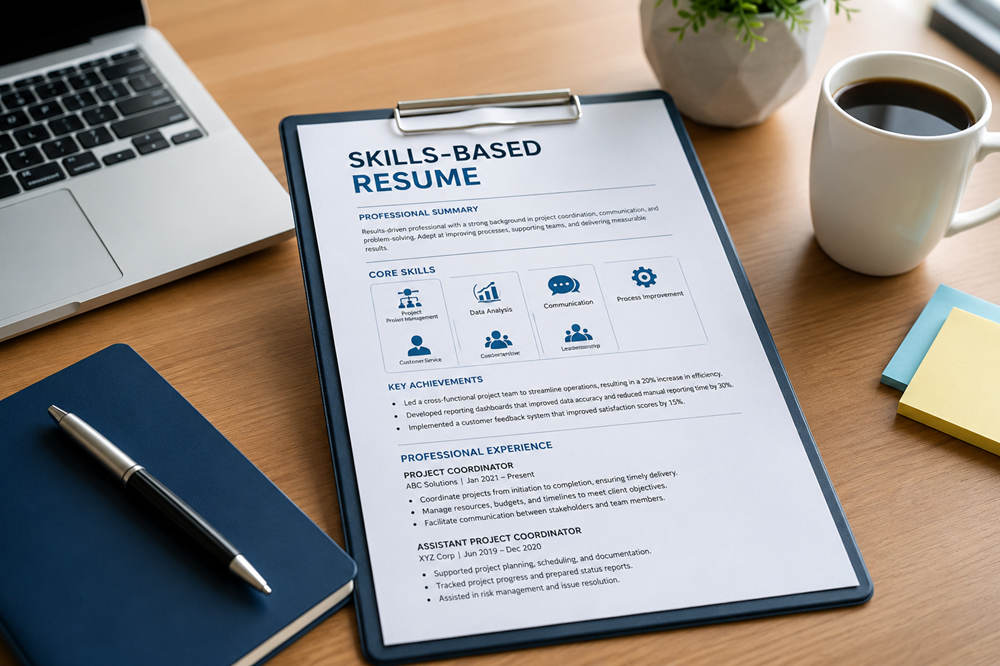
A skills-based resume puts your most relevant abilities and accomplishments near the center of the story instead of relying mainly on job titles and employment dates. Also commonly called a functional resume, this approach can be useful when you are changing careers, entering the workforce, or drawing on transferable experience from several different settings.
That does not mean you should hide your work history. For many applicants, a combination format works better: it gives important skills prominent placement while still showing employers where and when those skills were developed.
Quick answer: A skills-based resume is most useful when your abilities make a stronger case for the job than your previous titles do. The strongest version supports every important skill with evidence and still gives employers enough employment history to understand your background.
What Is a Skills-Based Resume?
A skills-based resume organizes much of the document around abilities that are relevant to the position you want.
Instead of allowing previous jobs to dominate the page, it may feature areas such as:
- Project coordination
- Customer communication
- Data analysis
- Sales
- Process improvement
- Technical support
Under each skill area, you provide examples showing how you used that ability and what you accomplished.
A skills-based resume is closely related to the functional resume format. By contrast, a chronological resume organizes experience primarily around jobs in reverse chronological order. A combination resume blends the two approaches by giving skills greater visibility while retaining a detailed employment history.
It is also worth distinguishing a skills-based resume from a conventional resume that simply contains a short Skills section. Almost any resume can list technical or professional skills. A true skills-based format gives demonstrated competencies a much larger role in the document’s structure.
Which Resume Format Should You Choose?
The best format depends on what you need an employer to notice first.
Choose a chronological resume when your work history tells the strongest story
A reverse-chronological format is often a natural choice when:
- Your recent positions are directly related to the new job
- Your career progression strengthens your application
- Your previous titles clearly communicate relevant experience
- You have a solid history in the same occupation or industry
For example, someone applying for an accounting manager position after progressing from staff accountant to senior accountant may benefit from putting that progression front and center.
Consider a skills-based resume when your transferable abilities matter more
A skills-focused approach can make sense when:
- You are moving into a different career
- You are a student or recent graduate with limited traditional experience
- Your experience comes from several unrelated roles
- You have relevant freelance, volunteer, military, or project experience
- Your previous job titles do not accurately show what you can do
The purpose is not to disguise your history. It is to make connections that may not be obvious from job titles alone.
Consider a combination resume when you want both
For many job seekers, the combination format offers a useful middle ground. You can place a professional summary and relevant skills near the top, then follow them with a clear employment history.
CareerOneStop’s current resume guidance describes combination resumes as useful for highlighting transferable skills, redirecting experience toward a career change, and maintaining detailed work history.
What Should a Skills-Based Resume Include?
The exact order depends on your circumstances, but a practical structure usually contains:
- Contact information
- Professional summary
- Key skills and supporting accomplishments
- Professional experience
- Education
- Relevant certifications, projects, or additional experience
The distinguishing feature is not the presence of unusual sections. It is the amount of attention given to skills that matter for the target job.
How to Write a Skills-Based Resume
1. Start With the Job Description
Before writing your skills section, study the position you want.
Look for recurring requirements involving:
- Technical abilities
- Software and tools
- Daily responsibilities
- Industry knowledge
- Communication
- Leadership or supervision
- Customer or client work
- Expected results
If a project coordinator posting repeatedly mentions schedules, deadlines, stakeholder communication, documentation, and task tracking, those themes tell you what the employer considers important.
Your goal is to identify genuine overlaps between those needs and your existing experience.
2. Choose Skills You Can Actually Prove
A skill belongs in a prominent position when three things are true: the employer needs it, you have demonstrated it, and it matters to the role.
Your evidence may come from several types of experience.
Technical skills can include:
- Microsoft Excel
- SQL
- Bookkeeping
- CRM software
- Graphic design tools
- Programming languages
Transferable skills can include:
- Project coordination
- Training
- Research
- Client communication
- Process improvement
- Problem-solving
Role-specific abilities will depend on the position. A sales applicant might emphasize prospecting and pipeline management, while an operations applicant might focus on scheduling and inventory planning.
A few well-supported skills are more useful than a long list of attractive words with no evidence behind them.
3. Write a Focused Professional Summary
Your summary should establish your direction and most relevant strengths in a few lines.
For example:
Operations professional transitioning into project coordination with experience managing schedules, training employees, documenting procedures, and coordinating daily workflows. Skilled at organizing competing priorities and communicating across teams.
Compare that with a summary such as “Hardworking, motivated team player seeking an exciting opportunity to grow.” The second version uses positive adjectives, but it tells an employer very little about what the applicant has actually done.
Keep the summary specific to the kind of position you are targeting.
4. Build Skill Sections Around Evidence
This is the most important part of the format.
A heading followed by another list of abilities is not enough:
Project Management
- Leadership
- Communication
- Organization
- Time management
Those are still just claims.
A stronger version demonstrates the skill:
Project Coordination
- Coordinated weekly schedules for a 14-person team while balancing staffing requirements, employee availability, and peak operating periods.
- Organized onboarding activities for new employees and created a checklist for recurring training tasks.
- Tracked supply needs and communicated potential shortages before they interrupted daily operations.
The employer can now see what the applicant means by project coordination.
Harvard’s resume guidance recommends specific, active, fact-based language and encourages applicants to quantify and qualify accomplishments where doing so adds useful context.
5. Quantify Results When the Numbers Mean Something
Numbers can help an employer understand scale and impact.
For example:
- Trained 12 new employees
- Coordinated schedules for 20 staff members
- Supported approximately 40 customer requests per day
- Reduced average response time from two days to one
- Increased newsletter subscriptions by 18%
Not every bullet needs a percentage or dollar figure. A statement such as “Created a standardized onboarding checklist used across three departments” still provides useful context.
Use numbers when they make the accomplishment clearer, and never invent a metric simply because a quantified bullet sounds more impressive.
6. Include a Clear Employment History
A skills-first structure does not require you to remove the jobs behind those skills.
A straightforward experience section could include:
Operations Supervisor — Northfield Services
May 2022–Present
Customer Service Associate — Northfield Services
January 2020–April 2022
You can add selected bullets beneath individual jobs when they provide useful context that does not already appear in the skills section.
Avoid copying the same accomplishment into several places. Each section should contribute something new.
7. Add Education, Projects, and Certifications When They Strengthen Your Case
The supporting sections should reflect your situation rather than a rigid template.
A recent graduate may want education to receive more attention. Someone moving into IT may benefit from a relevant certification. A person changing into design or development may have portfolio projects that demonstrate abilities their current job does not use.
Possible sections include:
- Education
- Certifications
- Relevant Projects
- Volunteer Experience
- Technical Skills
- Professional Development
- Languages
Include a section because it strengthens your application, not merely because you saw it on another resume.
Skills-Based Resume Example
Consider Jordan Lee, a customer service supervisor who wants to move into project coordination.
Jordan has never held the title “Project Coordinator,” but previous responsibilities include scheduling, task tracking, training, documentation, and coordination across departments. A skills-focused resume can make those connections visible without pretending the two jobs are identical.
Jordan Lee
Chicago, IL
555-555-0184
jordan.lee@example.com
linkedin.com/in/jordanlee
Professional Summary
Customer service supervisor transitioning into project coordination with experience managing team schedules, documenting workflows, training employees, monitoring recurring tasks, and coordinating work across departments. Strong background in organizing priorities and solving operational problems in deadline-driven environments.
Core Skills and Accomplishments
Project Coordination
- Coordinated weekly schedules and daily priorities for a 12-person customer service team.
- Maintained task trackers for recurring department projects and followed up on outstanding assignments.
- Helped coordinate a software transition while maintaining normal customer-support operations.
Process Improvement
- Documented recurring customer-service procedures and organized them into a central reference for employees.
- Identified workflow bottlenecks during high-volume periods and helped reorganize task assignments.
- Created a standardized onboarding checklist for new team members.
Training and Communication
- Trained new employees on service procedures, internal software, and escalation processes.
- Communicated policy and workflow changes across multiple shifts.
- Coordinated with managers and other departments to resolve issues requiring cross-team involvement.
Professional Experience
Customer Service Supervisor — Northstar Retail Group
Chicago, IL | June 2022–Present
Supervise daily customer-service operations, coordinate employee scheduling, support staff training, and assist with process changes and cross-department issues.
Customer Service Representative — Northstar Retail Group
Chicago, IL | August 2019–May 2022
Handled customer inquiries, resolved account and order issues, documented recurring problems, and supported team initiatives.
Education
Associate Degree in Business Administration
Lakeview Community College | 2019
Additional Skills
Microsoft Excel, Microsoft Teams, Google Workspace, task tracking, scheduling, documentation, and customer relationship management.
This example does not claim experience Jordan does not have. It translates existing responsibilities into language that helps an employer understand their relevance to a different position.
Is a Skills-Based Resume ATS-Friendly?
It can be, but structure matters.
CareerOneStop cautions that functional resumes containing little work-history detail may be difficult for some employers or applicant tracking systems to interpret. Its current guidance also favors simple, consistent layouts and familiar section headings.
For an ATS-conscious resume:
- Use a straightforward, preferably single-column layout
- Use familiar headings such as “Work Experience,” “Education,” and “Skills”
- Include employer names, job titles, and dates
- Use wording from the job description when it accurately describes your experience
- Keep important information out of decorative graphics
- Avoid skill-rating bars, complex tables, text boxes, and unnecessary visual elements
- Do not add invisible keywords or other attempts to manipulate automated screening
Good ATS formatting and good human-readable formatting generally share the same goal: make important information clear, recognizable, and easy to scan.
When an employer specifies a file format, follow those instructions. Before submitting any file, open the final version and make sure the formatting has not shifted during conversion.
Common Skills-Based Resume Mistakes
Listing skills without evidence
“Leadership” means little by itself. An example of leading a team through a difficult project gives the employer something concrete to evaluate.
Hiding employment history
A skills-based format should explain your qualifications more clearly, not create uncertainty about your background. Include a recognizable history of relevant employment when you have one.
Copying keywords without the underlying experience
Using terminology from a job description can clarify that your experience matches the requirement. Adding a phrase for a skill you do not actually possess does not.
Relying on vague soft-skill claims
Rather than saying you are organized, adaptable, or an excellent communicator, give examples that allow the employer to draw those conclusions.
Repeating the same accomplishment
A strong example does not need to appear under Project Management, Leadership, Communication, and Professional Experience. Put it where it contributes the most.
Overdesigning the resume
Your resume needs visual hierarchy, but decoration should not compete with the information. Clear headings, consistent spacing, readable typography, and straightforward organization are usually more useful than elaborate graphics.
Simple Skills-Based Resume Template
Use the following structure as a starting point and adjust it to the position.
[Your Name]
[City, State]
[Phone]
[Professional Email]
[LinkedIn or Portfolio]
Professional Summary
[Write two to four concise lines connecting your background, strongest relevant abilities, and target role.]
Key Skills and Accomplishments
[Relevant Skill 1]
- [Example demonstrating how you used the skill]
- [Relevant accomplishment or result]
[Relevant Skill 2]
- [Example demonstrating how you used the skill]
- [Relevant accomplishment or result]
[Relevant Skill 3]
- [Example demonstrating how you used the skill]
- [Relevant accomplishment or result]
Professional Experience
[Job Title] — [Employer]
[Month Year–Month Year]
- [Optional accomplishment that adds information not already covered above]
[Previous Job Title] — [Employer]
[Month Year–Month Year]
Education
[Degree or Qualification]
[School or Institution] | [Year]
Optional Sections
- Certifications
- Projects
- Technical Skills
- Volunteer Experience
- Professional Development
- Languages
Should You Use a Skills-Based Resume?
Ask one practical question: What is the strongest evidence that I can do this job?
If your recent titles and career progression already make the answer obvious, a chronological resume may be all you need.
If your strongest qualifications come from transferable abilities developed across different jobs, projects, education, volunteering, or other experiences, bringing those skills forward can help an employer see the connection.
If you want the benefits of a skills-first presentation without minimizing your employment history, a combination structure may be the better choice.
Whatever format you use, the principle remains the same: a persuasive resume does not simply name desirable skills. It shows what you did with those skills, where possible provides evidence of the result, and makes the relevance to the next job easy to understand.