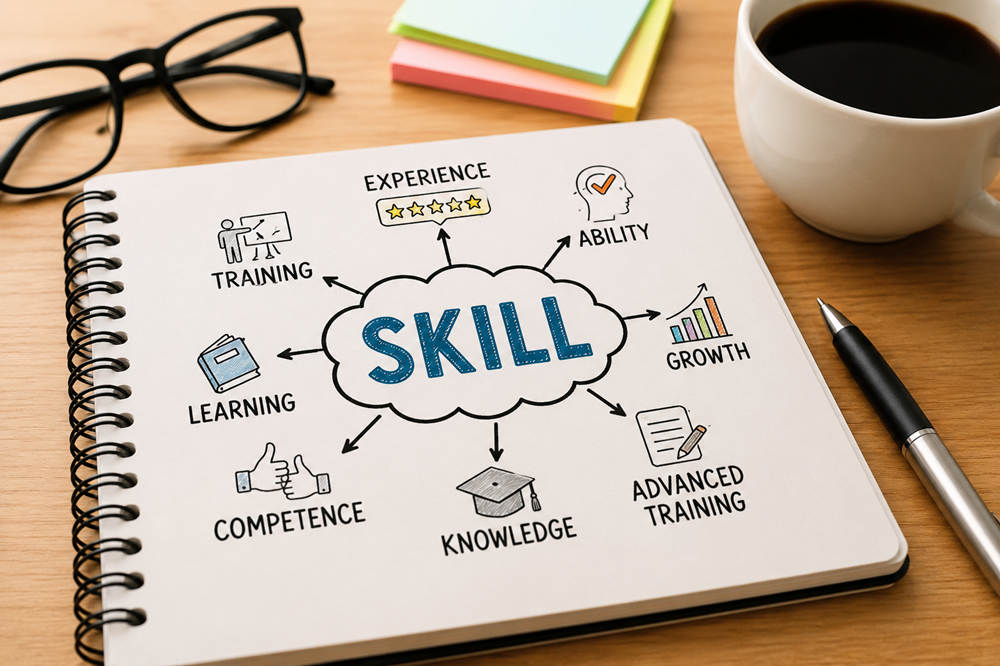
The best general synonym for skill is often ability. Other useful alternatives include expertise, proficiency, competence, talent, aptitude, mastery, technique, craft, and know-how.
These words are related, but they are not interchangeable in every sentence. Some describe natural ability, some suggest advanced experience, and others refer to a particular method of doing something. Choosing the right word makes your meaning clearer and more precise.
Common Synonyms for Skill and What They Mean
A thesaurus may present many alternatives for skill, but the most useful word depends on the exact idea behind the sentence. Understanding these differences can help you choose a word because it fits, not simply because it sounds different.
Ability
Ability means having the capacity to do something. It is broader than skill because it does not necessarily tell us whether that capacity came from training, practice, experience, or natural strengths.
Example: Her ability to explain complex ideas makes her an effective instructor.
Expertise
Expertise suggests advanced knowledge or skill in a particular subject or profession. It is appropriate when someone has developed considerable experience in a specialized area.
Example: The organization hired him for his expertise in cybersecurity.
Proficiency
Proficiency describes a well-developed level of competence, usually gained through learning and practice. It works particularly well with languages, software, technical tasks, and other abilities that can be developed over time.
Example: The position requires proficiency in Spanish.
Competence
Competence means having the knowledge and ability needed to perform something effectively. It does not necessarily suggest the advanced level implied by expertise or mastery.
Example: The course is designed to develop professional competence.
Talent
Talent commonly emphasizes a noticeable natural strength. Training can develop a talent further, but the word often places more emphasis on natural ability than skill does.
Example: She showed a talent for illustration at an early age.
Aptitude
Aptitude describes a natural capacity or potential to do or learn something well. It can be useful when the person has not yet developed advanced experience.
Example: His aptitude for mathematics became clear during his first year of college.
Mastery
Mastery makes a stronger claim than ordinary skill. It suggests an exceptionally high level of command developed through substantial learning or practice.
Example: Years of disciplined practice helped her achieve mastery of the instrument.
Technique
Technique refers to the way a task or activity is performed. Use it when you want to focus on the method rather than someone’s overall capability.
Example: Changing his lifting technique helped him perform the movement more efficiently.
Craft
Craft is especially useful for creative work, trades, and activities refined through practice. A writer, carpenter, photographer, designer, or musician might spend years developing their craft.
Example: She continued studying experienced filmmakers to improve her craft.
Know-How
Know-how is a more conversational term for practical knowledge gained through experience. It emphasizes knowing how to get something done in real situations.
Example: Repairing the equipment requires mechanical know-how.
More Synonyms and Related Words for Skill
Some alternatives are useful only in particular contexts. The following words can express an aspect of skill, experience, knowledge, or capability:
- Adeptness — being highly capable at a particular activity
- Artistry — skill expressed through creative or artistic work
- Capability — the capacity to accomplish or perform something
- Command — strong control or knowledge of a subject
- Craftsmanship — skill and care in making something
- Creativity — ability to produce original ideas or solutions
- Cleverness — mental quickness or resourcefulness
- Deftness — quick and skillful performance
- Dexterity — physical skill, especially involving precise hand movements
- Experience — knowledge developed through practical involvement over time
- Expertness — a high degree of competence
- Facility — ease in performing or learning something
- Finesse — skill in handling something difficult or delicate
- Flair — natural ability combined with distinctive style
- Gift — a strong natural ability
- Ingenuity — cleverness in developing ideas or solutions
- Knack — an informal term for being particularly good at something
- Knowledge — information and understanding gained through learning or experience
- Savvy — practical understanding, especially in business or technology
- Skillfulness — the quality of performing something effectively
Not every word in this list is a direct substitute for skill. For example, experience tells us how much exposure someone has had, while ingenuity emphasizes clever problem-solving. Use the word that expresses the specific quality you want to communicate.
Synonyms for Skill by Context
Context can narrow the choices quickly. Different words work better for professional expertise, natural strengths, hands-on work, creative activities, and practical experience.
For Professional Skills
Expertise, competence, proficiency, and capability work well in professional settings.
Expertise suits advanced knowledge, proficiency suggests a developed level of ability, and competence communicates that someone can perform the required work effectively.
For Natural Ability
Choose talent, aptitude, flair, gift, or knack when natural ability is important to the meaning.
Aptitude is useful when discussing potential to learn, while knack is informal and works well when someone seems unusually comfortable doing something.
For Hands-On or Technical Ability
Dexterity, technique, craftsmanship, and deftness are useful when physical execution or practical methods matter.
For example, a watchmaker may need manual dexterity, while a carpenter may develop strong craftsmanship.
For Creative Ability
Artistry, craft, finesse, and flair can describe different aspects of creative skill.
Artistry highlights creative expression, craft emphasizes ability refined through practice, and flair can suggest a distinctive natural style.
For Practical Experience
Know-how, savvy, experience, and command work when the focus is on practical understanding rather than a single isolated ability.
These terms can be particularly useful when someone knows how to handle real-world situations because they have worked with them repeatedly.
What Is a Better Word for Skill on a Resume?
On a resume, the best alternative depends on what you can honestly demonstrate. Words such as proficiency, expertise, competence, experience, and capability can be useful, but simply replacing skill with a more impressive word does not necessarily strengthen your application.
The UC Davis Career Center advises job seekers to tailor resumes to individual positions, incorporate relevant keywords and phrases from the job description, and consider stating proficiency levels for some technical skills.
That means you should not remove an important job-description keyword merely to avoid repetition. If an employer consistently uses a term such as “project management skills,” retaining that terminology where it fits may be more useful than replacing every occurrence with a synonym.
At the same time, specific evidence is often stronger than a broad claim:
- Instead of: Skill in Microsoft Excel
Try: Proficiency in Microsoft Excel - Instead of: Marketing skills
Try: Digital marketing expertise - Instead of: Skilled in data visualization
Try: Experienced in creating data visualizations with Tableau and Power BI - Instead of: Leadership skills
Try: Led a six-person team through a three-month product launch - Instead of: Communication skills
Try: Presented monthly performance reports to clients and senior managers
The last two examples demonstrate the ability rather than merely naming it. This can give the reader clearer evidence of what you have actually done.
How to Choose the Right Synonym for Skill
Before replacing skill, consider what the sentence needs to communicate.
- Decide whether you mean developed or natural ability. Words such as proficiency work well for developed abilities, while talent and aptitude can emphasize natural strengths or potential.
- Match the word to the person’s actual level. Expertise and especially mastery make stronger claims than competence.
- Separate the ability from the method. If you are describing how someone performs an activity, technique may be more accurate.
- Consider the tone. Expertise and proficiency fit formal writing, while knack and know-how are more conversational.
- Be specific when possible. Instead of a broad phrase such as “business skills,” naming negotiation, budgeting, sales, leadership, or market analysis gives the reader more information.
Final Takeaway
If you need a broad synonym for skill, ability is a useful starting point. For more precise writing, choose a word that reflects what you actually mean: expertise for advanced specialized knowledge, proficiency for developed competence, talent for natural strength, aptitude for potential, technique for a method, and know-how for practical experience.
The goal is not simply to replace the word skill. It is to choose the word that describes the ability most accurately.