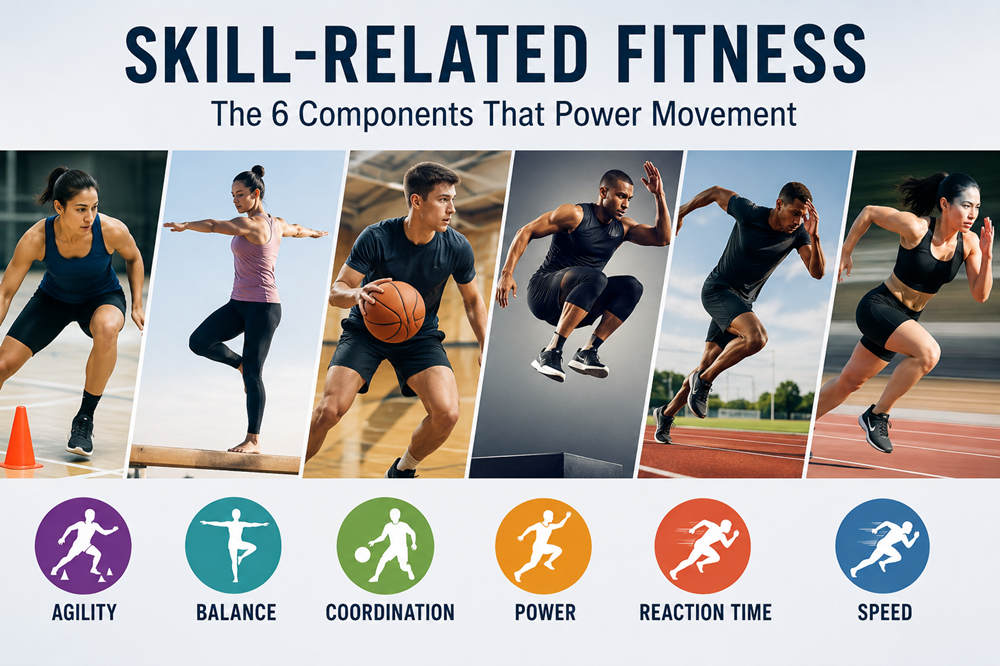
Skill-related fitness describes the abilities that help people perform physical movements with speed, control, accuracy, and efficiency. Its six commonly taught components are agility, balance, coordination, power, reaction time, and speed.
These components are separate enough to study individually, but they rarely work alone. Catching a pass, changing direction to avoid an opponent, landing from a jump, or reacting to a tennis serve can require several components within seconds. Understanding skill-related fitness therefore means knowing both what each component contributes and how the components support one another.
What Are the Six Components of Skill-Related Fitness?
Each component solves a different movement problem. The table below summarizes its basic role and why that role matters.
| Component | What It Does | Why It Matters |
|---|---|---|
| Agility | Helps the body change direction or movement quickly and effectively, especially when responding to changing conditions. | Allows a person to adapt when an opponent, ball, obstacle, or situation changes unexpectedly. |
| Balance | Helps maintain stability and control of body position while still or moving. | Supports controlled turning, stopping, landing, reaching, and changes in body position. |
| Coordination | Organizes movements of different body parts so they work together smoothly and accurately. | Makes complex skills such as catching, kicking, throwing, striking, and dribbling more effective. |
| Power | Allows force to be produced rapidly during dynamic movement. | Contributes to explosive actions such as jumping, accelerating, throwing, and striking. |
| Reaction time | Determines how quickly a response begins after a person detects a stimulus. | Helps a person start the appropriate movement before an opportunity passes or conditions change again. |
| Speed | Allows the body or a body part to move quickly. | Helps a person cover distance, reach a target, move into position, or complete an action in less time. |
These qualities are useful for much more than competitive sport. They can also contribute to recreational activities, physical education, dance, games, and many everyday tasks that require quick and controlled movement. The current SHAPE America National Physical Education Standards, released in 2024, place movement knowledge, physical competence, and fitness within the broader goal of helping students participate meaningfully in physical activity.
How Are the Components of Skill-Related Fitness Interrelated?
The six components are interrelated because successful movement usually happens as a sequence. A person may need to notice what is happening, begin a response, move quickly, change direction, keep the body stable, coordinate several actions, and apply force at the right moment.
Not every activity uses all six components equally. However, the effectiveness of one component often depends on the support of others.
Reaction Time, Speed, and Agility Often Work as a Sequence
Imagine a soccer defender watching an attacker who suddenly cuts toward the sideline. The defender first has to recognize the change and begin responding. That is where reaction time matters.
The defender must then reposition the body and change direction effectively, which involves agility. Once the correct direction has been established, speed helps the defender accelerate and stay close to the attacker.
This example also shows why speed and agility are not interchangeable. Someone may be very fast during a straight sprint but less effective when the movement requires an unexpected decision and change of direction.
Sports-science research makes a similar distinction between pre-planned change-of-direction ability and agility performed in response to an external stimulus. The reactive task adds perceptual and decision-making demands that are not present when a person already knows where to move.
Balance and Coordination Provide Control
Fast movement is not very useful if the body cannot control it. This is where balance and coordination become especially important.
Balance helps maintain stability as the body’s position changes. Coordination helps multiple body parts perform the correct movements in the correct sequence.
Consider jumping to catch a ball. The eyes track the ball while the legs create the jump and the arms move into position. After the catch, the body must prepare for a controlled landing. Coordination organizes the actions, while balance helps keep the body stable as it returns to the ground.
The same relationship appears during turns, sudden stops, changes of direction, and movements performed on a narrow or unstable base.
Power Connects Force and Movement Velocity
Power is another component that demonstrates how physical qualities interact.
It should not simply be treated as another word for strength. In mechanical terms, power depends on both force and velocity. The National Strength and Conditioning Association’s explanation of force-velocity-power relationships notes that power output is the product of force and velocity and changes as those factors change.
This helps explain why jumping, throwing, sprint acceleration, and similar actions are often described as powerful. The task is not merely to produce force, but to produce useful force while movement is occurring rapidly.
Other components still influence the final result. A powerful jump also requires coordination during takeoff and balance during landing. Producing force quickly is only useful if the movement remains appropriately directed and controlled.
Agility Shows How Several Abilities Can Combine
Agility is one of the clearest examples of interdependence among the components.
In a reactive situation, a person may have to:
- detect a change in the environment;
- begin responding quickly;
- slow or reposition the body;
- maintain balance;
- coordinate the feet, legs, and trunk;
- change direction; and
- accelerate again.
This is why agility is more complex than simply running quickly around cones. A recent systematic review of agility training in team-sport players describes agility as rapid whole-body movement in response to external stimuli and emphasizes the connection between perception and action.
How the Components Work Together in Real Activities
Looking at complete movements makes the relationships among skill-related fitness components easier to understand.
Basketball
Suppose a basketball player sees a missed shot rebound away from the basket. Reaction time helps the player begin responding to the ball’s new path. Speed helps the player move toward it, while agility may be needed to adjust around another player.
Power contributes to the jump for the rebound. Coordination helps time the jump and position the hands, while balance helps the player return to the floor under control.
One short play can therefore involve all six components without any of them performing exactly the same job.
Soccer
A soccer player receiving a pass needs coordination to position the foot and control the ball. If a defender suddenly approaches, reaction time helps the player respond, while agility allows a rapid change in movement.
Balance helps maintain control through the turn, and speed becomes useful when accelerating into open space. A forceful shot or long pass can then add a significant power demand.
Tennis
In tennis, a player normally does not know the exact direction, depth, or speed of the opponent’s next shot in advance.
Reaction time helps initiate the response. Speed and agility help the player move into position, while balance supports stopping and changing direction. Coordination connects visual tracking with body positioning and racket movement. Power may become important when producing a forceful serve or groundstroke.
The example demonstrates why skilled performance cannot be explained by speed alone. Getting to the ball is only part of the task; the player must also arrive in a position from which the next movement can be performed effectively.
Why Is the Relationship Between the Components Important?
Understanding how the components interact helps explain why a person can be strong in one physical quality but still struggle with a particular skill.
A fast runner may not automatically have excellent agility because reactive movement can also require decision-making, balance, and coordinated changes of direction. A powerful jumper may produce plenty of force but still need better balance to land consistently. Someone with quick reaction time may recognize what to do immediately but still need the speed or coordination to carry out the response effectively.
In other words, no single skill-related fitness component guarantees successful performance. The demands of the activity determine which combination matters most.
Can Training One Component Also Develop Others?
Many training activities challenge several components at the same time.
A change-of-direction exercise may emphasize agility while also requiring acceleration, balance, and coordination. Jumping exercises may emphasize power but still demand coordinated takeoffs and stable landings. Ball drills may challenge coordination while also requiring reaction time and movement speed.
However, this does not mean that improving one component automatically improves every related component. Physical adaptations are influenced by the specific task being practiced.
For example, repeatedly practicing a known running pattern may improve performance on that pattern, but it does not fully reproduce the perceptual demands of reacting to an unpredictable opponent or signal. Training is generally more specific when it includes the type of movement, information, and decisions required by the activity a person wants to improve.
Skill-Related Fitness vs. Health-Related Fitness
Skill-related fitness is sometimes confused with health-related fitness, but the two classifications answer different questions.
Skill-related fitness describes abilities that influence movement performance: agility, balance, coordination, power, reaction time, and speed.
Health-related fitness focuses more directly on physical qualities associated with health and the capacity to perform physical activity, including cardiorespiratory fitness, muscular fitness, flexibility, and body composition.
The categories are useful for learning, but they are not completely independent in real movement. Power, for example, is influenced by a person’s ability to produce muscular force. Repeated sport movements may also depend on sufficient muscular and cardiorespiratory fitness to maintain performance over time.
The main difference is therefore one of emphasis: health-related fitness focuses primarily on physical capacity and health, while skill-related fitness helps explain how effectively a person performs particular movements.
Putting the Six Components Together
A simple movement sequence shows how the six components can complement one another.
Imagine that a player receives an unexpected pass. The player first detects the ball and begins a response using reaction time. Speed helps the player move toward it. If the path changes, agility helps adjust direction. Balance keeps the body stable, while coordination helps control the ball. If the next movement requires an explosive jump, throw, or acceleration, power becomes important.
Each component contributes something different, but together they produce a complete and effective response.
Final Takeaway
The six components of skill-related fitness are agility, balance, coordination, power, reaction time, and speed. Each is important because it contributes a different quality to physical movement.
They are interrelated because most physical skills require more than one ability at a time. Reaction time may start the response, speed helps movement happen quickly, agility allows adjustment, balance provides stability, coordination organizes the action, and power contributes rapid force when the task demands it.
The most effective movement is therefore rarely the result of one component working by itself. It comes from several physical and perceptual abilities working together in the right combination for the situation.