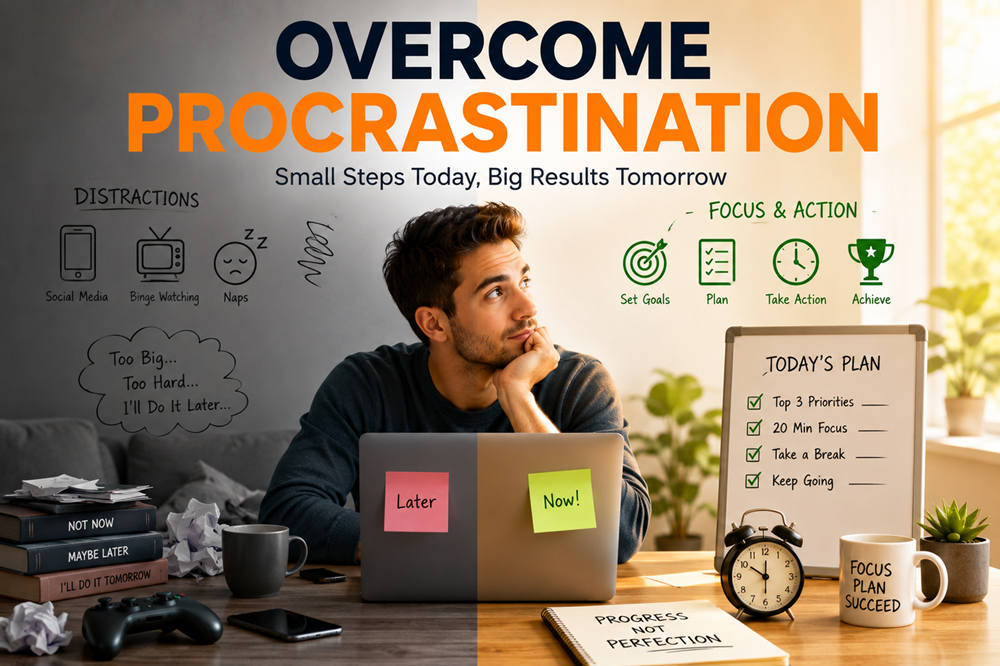
Procrastination is not always a time-management problem. Many times, it is a reaction to discomfort. A task feels boring, stressful, unclear, too big, or tied to the fear of doing it badly, so we delay it for short-term relief.
That relief does not last long. The task is still there, and now it comes with extra guilt, pressure, and less time. Psychologist Fuschia Sirois describes procrastination as an emotion-regulation issue, not simply laziness or poor planning.
The good news is that you do not need to become a completely different person to change the habit. You need a better way to start, a clearer next step, and less pressure around doing everything perfectly.
1. Name What You Are Avoiding
Before you tell yourself to “just do it,” ask a better question:
“What am I actually avoiding?”
You might be avoiding confusion, boredom, judgment, failure, effort, or the uncomfortable feeling of not knowing where to begin. Once you name the real problem, you can respond to it more clearly.
For example:
- If the task feels confusing, define the first step.
- If the task feels too big, break it down.
- If the task feels boring, use a timer.
- If the task feels scary, lower the pressure.
- If the task feels pointless, connect it to a real reason.
“I’m lazy” is not useful. “I don’t know how to start” is useful because you can work with it.
2. Make the First Step Smaller Than You Think It Should Be
A large task can freeze you before you begin. Instead of planning to finish the whole thing, make the first step almost too easy.
Try one of these:
- Open the document.
- Write one rough sentence.
- Read one page.
- Clear one small area.
- Reply to one message.
- List the next three steps.
- Work for five minutes.
The first step does not need to be impressive. It only needs to break the delay. Once the task is no longer untouched, it usually feels less intimidating.
3. Use the Five-Minute Rule
The five-minute rule is simple: choose one task and work on it for five minutes.
That is it.
You are allowed to stop after five minutes, but you may not avoid the first five. This works because the hardest part of procrastination is often the moment before starting. Once you begin, the task becomes more real and less dramatic.
Use this for writing, studying, cleaning, exercise, email, planning, or paperwork. Do not aim for a perfect work session. Aim for a small opening.
4. Turn Vague Tasks Into Clear Actions
Vague tasks are easy to avoid because your brain cannot see where to begin.
“Work on my project” sounds heavy.
“Write the first three bullet points” sounds doable.
“Clean the house” feels endless.
“Clear the kitchen counter” gives you a place to start.
“Study” is too broad.
“Review chapter two for 20 minutes” is clearer.
A major procrastination meta-analysis found that task aversiveness, task delay, low confidence, and impulsiveness are strong predictors of procrastination. In everyday language, we delay tasks more when they feel unpleasant, unclear, far away, or hard to succeed at.
A clear action lowers the mental resistance.
5. Use If-Then Planning
Motivation is unreliable. A plan works better when it tells you exactly what to do and when to do it.
Use this format:
If [specific situation happens], then I will [specific action].
Examples:
- If I finish breakfast, then I will answer two emails.
- If I sit at my desk, then I will open the assignment.
- If it is 7 p.m., then I will study for 20 minutes.
- If I feel like scrolling, then I will work for five minutes first.
- If I get home from work, then I will put my workout clothes on.
This is often called implementation intention planning. It works because it connects a clear situation with a clear action. You are no longer waiting to “feel ready.” You have already decided what happens next.
6. Lower the Pressure to Start
Perfectionism makes procrastination worse because it turns starting into a test of your worth.
A simple task becomes:
“What if this is not good enough?”
“What if I make a mistake?”
“What if someone judges it?”
“What if I cannot finish?”
That pressure creates avoidance.
Try replacing those thoughts with calmer ones:
- “This can be messy at first.”
- “I can improve it after I start.”
- “The first version does not need to be the final version.”
- “Done badly is better than avoided completely.”
- “I only need the next step right now.”
Lowering the pressure does not mean lowering your standards forever. It means giving yourself permission to begin before everything feels perfect.
7. Make the Task Less Annoying
Sometimes the best way to stop procrastinating is not to push harder. It is to remove friction.
Ask yourself:
- Can I use a template?
- Can I start with the easiest part?
- Can I move to a better location?
- Can I ask someone a quick question?
- Can I prepare the materials first?
- Can I pair the task with coffee, tea, or music?
- Can I set a shorter work block?
You do not have to love the task. You just need to make it easier to approach.
8. Use a Timer Instead of Relying on Mood
A timer gives your brain a clear boundary. You are not committing to hours of effort. You are committing to one focused block.
Try:
- 10 minutes for a task you strongly resist
- 20 minutes for school or work
- 25 minutes for a focused session
- 45 minutes for deeper work, if you can handle it
The Pomodoro Technique uses focused work intervals with short breaks. It can be helpful because it makes work feel contained, but it should not be treated as a magic fix. The best timer length is the one that helps you begin.
9. Remove Easy Distractions Before You Start
Do not test your willpower against a phone full of notifications.
Before a work block, make distraction harder:
- Put your phone across the room.
- Close extra tabs.
- Turn off notifications.
- Keep only the needed materials nearby.
- Use full-screen mode.
- Set a website blocker for one work period.
This is not about being strict all day. It is about protecting the first few minutes, because that is when procrastination usually tries hardest to pull you away.
10. Add a Small Reward After Action
Your brain likes quick rewards. Procrastination often wins because the reward of avoiding discomfort is immediate, while the reward of finishing the task feels far away.
Bring the reward closer.
Examples:
- Work for 20 minutes, then take a short walk.
- Finish one section, then make coffee.
- Send the email, then check your messages.
- Study for 30 minutes, then watch one episode.
- Clean one area, then rest for 10 minutes.
The reward should not swallow the whole day. It should simply make action feel less punishing.
11. Stop Attacking Yourself for Delaying
Shame may feel like motivation, but it usually keeps the cycle going.
When you say, “I’m so lazy,” the task becomes heavier.
When you say, “I always mess this up,” you feel more stuck.
When you say, “There’s no point now,” you delay even longer.
A better response is honest but not cruel:
“I delayed this, but I can still take the next step.”
That sentence keeps responsibility without adding hopelessness. A more self-compassionate response can make it easier to re-engage instead of shutting down in guilt.
12. Know When You Need More Than Productivity Tips
Occasional procrastination is normal. Everyone delays sometimes.
But if procrastination is seriously hurting your work, school, health, finances, sleep, or relationships, it may be connected to something deeper, such as anxiety, depression, ADHD, burnout, chronic stress, or perfectionism.
In that case, simple productivity tips may help a little, but support from a therapist, counselor, coach, doctor, or trusted professional may help more. The point is not to label yourself. The point is to understand why everyday tasks feel so hard and get the right kind of help.
A Simple Anti-Procrastination Plan
When you feel stuck, use this quick reset:
- Name the task.
- Ask what you are avoiding.
- Choose one tiny first step.
- Set a timer for five or ten minutes.
- Remove one distraction.
- Start before you feel ready.
- Stop or continue when the timer ends.
This works because it removes the need to solve everything at once. You only need to move from avoidance to action.
Summary
Overcoming procrastination is not about becoming perfectly disciplined. It is about making the next step easier to take.
Start by noticing what you are avoiding. Then shrink the task, use if-then planning, set a short timer, reduce distractions, and stop treating every delayed task like a personal failure.
You do not need to finish everything today. You just need one honest step that breaks the cycle.