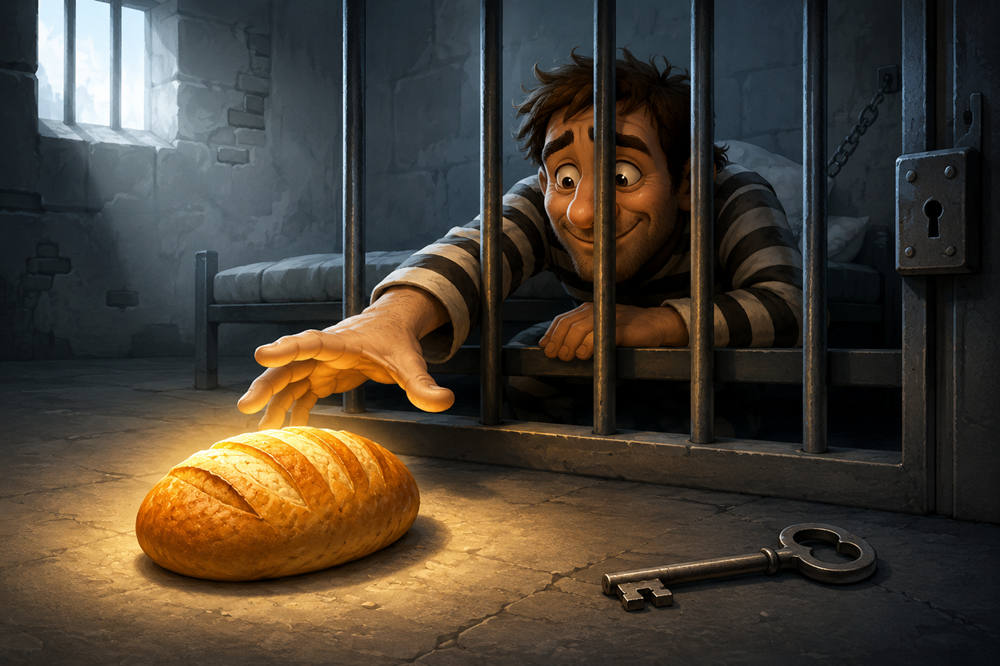
A prisoner sits behind metal bars and reaches toward a loaf of bread. A key lies nearby, apparently offering him a way out. The picture seems to ask a serious question: Why would someone choose food instead of freedom?
Then comes the unexpectedly simple answer:
“Because bread tastes better than key.”
That literal response turned a philosophical-looking image into a popular internet joke. Instead of analyzing hunger, fear, freedom, or human behavior, the punchline treats the situation as though the prisoner is deciding which object he would rather eat.
What Does “Bread Tastes Better Than Key” Mean?
“Bread tastes better than key” is a humorous answer to the question, “Why did the prisoner choose the bread instead of the key?”
The sentence is grammatically awkward. In standard English, someone would normally say, “Bread tastes better than a key.” However, the unusual wording has become part of the meme.
The phrase is often used when people are making a simple situation sound much deeper than it needs to be. One person may offer a long explanation about survival, psychology, or freedom, while another responds with the blunt punchline.
It is also a funny way to respond when someone is overanalyzing a meme, picture, movie scene, or ordinary decision.
The joke is essentially saying:
There may not be a complicated reason. Bread is food, and a key is not.
Where Did the Bread and Key Meme Come From?
The image was created by artist Pascal Gelu and posted in May 2020 under the title “The ‘Hunger’ for Freedom.” It shows a prisoner reaching through the bars toward bread while a key rests nearby.
The artwork was later reposted on social media with questions asking why the prisoner chose bread instead of the key. According to the documented history of the bread and key meme, these posts encouraged viewers to share their own interpretations.
Some people treated the image as a lesson about human nature. Others questioned whether the key would work or whether the prisoner needed food before attempting to escape.
Eventually, the answer “bread tastes better than key” became popular because it ignored all those serious theories and gave the most literal explanation possible.
Why Might the Prisoner Choose the Bread?
The artwork does not provide enough information to confirm one answer. However, a few interpretations are commonly discussed.
He Is Too Hungry to Think About Escaping
The prisoner may choose bread because hunger is his most immediate problem.
A key could offer freedom later, but food gives him something he needs right now. If he is weak or starving, eating first may be the most practical choice.
This interpretation reflects the idea that people often focus on food, safety, and other basic needs before considering larger goals.
He Plans to Take the Bread First
The image captures only one moment. It does not show what the prisoner does next.
He may eat the bread, regain his strength, and then reach for the key. Choosing bread first does not necessarily mean he has rejected freedom.
He Does Not Know Whether the Key Will Work
The prisoner knows what the bread can do. He can eat it.
The key is uncertain. It may not fit the lock, or escaping may expose him to another danger. The bread offers an immediate and reliable benefit, while the key offers only a possibility.
The Bread Represents Immediate Comfort
Many viewers see the bread as a symbol of immediate gratification, while the key represents a larger reward that requires patience and effort.
We sometimes make similar choices in everyday life. We may avoid a difficult conversation, delay an important task, or stay in a familiar situation because it feels easier in the moment.
Under this interpretation, the image asks whether temporary comfort can distract us from a better future. It is similar to the idea of delaying gratification, which involves resisting an immediate reward to receive a potentially better reward later.
Why Is “Bread Tastes Better Than Key” Funny?
The humor comes from the contrast between the image and the answer.
The picture looks like it should have a deep meaning. It invites viewers to discuss survival, imprisonment, freedom, and human priorities.
The punchline refuses to do any of that.
It acts as though the prisoner considered eating both objects and decided that bread would taste better. Of course, the key is meant to unlock the cell, not become dinner. That deliberate misunderstanding is what makes the answer funny.
The phrase also mocks the dramatic captions sometimes attached to social media puzzles, such as:
- “Only intelligent people understand this.”
- “Your answer reveals your personality.”
- “If you know the answer, you are a philosopher.”
These posts often encourage people to invent complicated explanations for images that do not have one clear answer. “Bread tastes better than key” breaks the serious mood with a response that is obvious, ridiculous, and technically true.
How Is the Phrase Used Online?
The phrase is now used beyond the original prisoner image.
People may comment “bread tastes better than key” when someone is overthinking a meme, movie scene, or ordinary decision. It can also be used to end a long debate with a deliberately simple answer.
For example:
Serious explanation: The prisoner prioritizes immediate survival because hunger affects his ability to think about the future.
Meme explanation: Bread tastes better than key.
The joke works because the second answer is much shorter and refuses to take the discussion seriously.
The Simple and Serious Meanings
The image can still support a thoughtful interpretation. It may represent hunger, immediate comfort, uncertainty, or the difficulty of choosing long-term freedom over a short-term reward.
But the meme does not require a philosophical answer.
Sometimes, the joke is simply that bread tastes better than key.