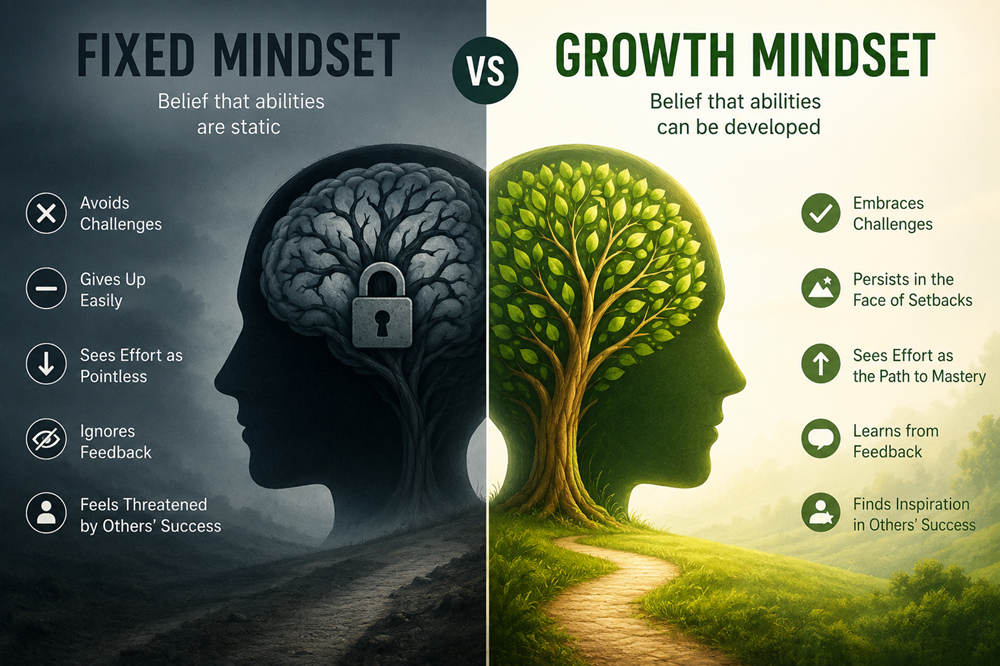
A fixed mindset treats abilities as largely set, while a growth mindset leaves room for abilities to develop through learning, effective practice, feedback, and better strategies. The important difference is not negative thinking versus positive thinking. It is how you interpret difficulty and what you do next.
Psychologist Carol Dweck is closely associated with the fixed and growth mindset framework through decades of research on beliefs about intelligence and ability. The concepts are useful, but they are not permanent personality labels. You can respond with a growth mindset in one situation and a much more fixed mindset in another.
What Is a Fixed Mindset?
A fixed mindset is the belief that a particular ability or quality is relatively unchangeable. Someone thinking this way might assume that people are naturally good or bad at mathematics, writing, leadership, public speaking, sports, or another skill.
The belief becomes particularly important when something gets difficult. If ability is viewed as fixed, struggling may seem to reveal a permanent weakness rather than a skill that has not yet been developed.
Fixed-mindset thoughts can sound like:
- “I’m just not good at this.”
- “If I were talented, this wouldn’t be so hard.”
- “I failed, so maybe this isn’t for me.”
- “I’d rather not get feedback because it will show what I’m bad at.”
This does not mean a person with a fixed response is lazy or unwilling to learn. The underlying issue is the meaning attached to difficulty. If difficulty seems to prove that you lack ability, avoiding the challenge can start to feel reasonable.
What Is a Growth Mindset?
A growth mindset is the belief that abilities can often be developed rather than being completely predetermined. It leaves open the possibility that current performance can change with learning, practice, useful feedback, stronger strategies, and appropriate support.
Growth-oriented thoughts might include:
- “I don’t understand this yet.”
- “This approach isn’t working. What else could I try?”
- “What does this mistake show me?”
- “What kind of feedback would help me improve?”
Growth mindset is sometimes reduced to “try harder,” but that misses an important part of the idea. Stanford’s guidance on growth mindset and learning emphasizes constructive feedback and better learning strategies rather than praising effort for its own sake.
If one method keeps failing, simply repeating it with more determination may accomplish little. Improvement can require a different method, better instruction, more appropriate practice, additional resources, or help from someone with more experience.
Growth Mindset Is Not the Same as Positive Thinking
A growth mindset does not require telling yourself that everything will work out. You can admit that a task is difficult, acknowledge that an attempt failed, and recognize that some limitations or circumstances are real.
The growth-oriented question is narrower and more practical: What, if anything, can I improve from here?
Fixed Mindset vs. Growth Mindset: Key Differences
| Situation | Fixed-Mindset Response | Growth-Mindset Response |
|---|---|---|
| Ability | Tends to see current ability as largely predetermined | Leaves room for ability to develop |
| Challenges | May interpret difficulty as evidence of weakness | May interpret difficulty as part of learning |
| Mistakes | Can treat mistakes as evidence of inability | Can treat mistakes as information about what needs work |
| Effort | May view high effort as evidence that talent is lacking | Sees useful effort as one part of development |
| Feedback | May experience criticism as a judgment of ability | Can use feedback to identify ways to improve |
| Setbacks | May reinforce the belief that improvement is unlikely | Can prompt a change in strategy or additional learning |
| Main question | “Am I good at this?” | “What would help me improve?” |
These are patterns, not strict rules. The same person can respond differently depending on the skill, situation, previous experiences, confidence level, and stakes involved.
Fixed and Growth Mindset Examples in Everyday Life
The difference becomes easiest to see in what happens immediately after a setback.
Learning a New Skill
Imagine that you are learning another language but struggle to understand people speaking at normal speed.
A fixed response might be: “I’m terrible at languages. Some people just have an ear for them.” If that becomes the final conclusion, you may practice less or stop altogether.
A growth-oriented response would make the problem more specific: “My listening skills are behind my reading skills. I need more practice with everyday spoken language.” That gives you a concrete next step.
Receiving Feedback at Work
Suppose a manager says your presentation contains useful information but is difficult to follow.
If you interpret the criticism as proof that you are a poor communicator, you may become defensive or avoid similar assignments. A more growth-oriented response is to identify what can be changed: reorganize the presentation, study clearer examples, rehearse with a colleague, or ask which parts were confusing.
You do not have to enjoy the criticism for the feedback to be useful.
Getting a Poor Test Result
A disappointing grade can quickly become “I’m bad at this subject.” But one result does not explain why the result happened.
A more useful response is diagnostic. Did you misunderstand an important concept? Start studying too late? Memorize material when the test required application? Practice the wrong types of problems?
Once the problem becomes specific, you can choose a more appropriate response.
Falling Short of a Personal Goal
If a routine falls apart, it is easy to turn the result into a character judgment: “I have no discipline.”
Instead, examine what actually happened. Identifying why the routine failed and what could be changed before another attempt gives you more useful information than assigning yourself a permanent label.
How Mindset Can Affect What You Do Next
Mindset does not make results appear through belief alone. Its practical value comes from how beliefs can influence behavior.
If difficulty seems to reveal a permanent limit, challenging tasks may feel less worthwhile. You may avoid situations where you could fail, ignore uncomfortable feedback, hide mistakes, or choose only tasks that already feel safe.
If you believe improvement is possible, a setback can lead to a different kind of investigation:
- What exactly went wrong?
- What skill am I missing?
- Do I need more practice or a different kind of practice?
- Who could give me useful feedback?
- Is this task appropriate for my current skill level?
That does not guarantee improvement. It creates better opportunities to learn from what happened.
What Does the Research Say About Growth Mindset?
Growth mindset has become highly influential in education and self-improvement, but the research does not support the idea that changing your mindset automatically produces major improvements in performance.
Evidence That Growth-Mindset Interventions Can Help
A large national experiment involving U.S. high school students tested a brief online intervention that taught students that intellectual abilities could develop.
The intervention produced a modest improvement in grades among lower-achieving students. Across the wider sample, students receiving the intervention were also more likely to enroll in advanced mathematics courses. Importantly, the effects varied with the school environment: grade improvements were stronger where peer norms supported taking on academic challenges.
That finding illustrates an important point. A person’s beliefs do not operate separately from the environment around them. Opportunities, expectations, teaching, resources, and social norms can affect whether a more growth-oriented belief translates into useful action.
Why the Evidence Should Not Be Oversold
Researchers continue to debate how consistently growth-mindset interventions improve measurable outcomes.
One systematic review and meta-analysis found small academic benefits when interventions were targeted at groups expected to benefit and delivered with high fidelity, while also emphasizing substantial variation across studies.
Another meta-analysis of academic achievement studies reached a more skeptical conclusion. Its authors found that the effect became statistically nonsignificant when the analysis was restricted to the highest-quality evidence.
The disagreement argues for a measured conclusion rather than a slogan. Mindset may play a role in how people respond to learning and setbacks, but it is only one part of a much larger picture. Prior knowledge, instruction, resources, opportunity, environment, effective practice, time, and feedback also matter.
A useful growth mindset creates room for improvement; it does not guarantee improvement.
You Can Have Both Fixed and Growth Mindsets
Fixed and growth mindsets are better understood as patterns of thinking than permanent types of people.
You might believe you can become a better cook but insist that you will never understand mathematics. You might be open to feedback most of the time but become defensive when criticism involves a skill that is closely tied to your identity.
Pressure, embarrassment, competition, repeated setbacks, or comparison with highly skilled people can also trigger more fixed reactions.
Stanford’s teaching guidance notes that people can show a combination of fixed and growth mindsets. The practical goal, then, is not to prove that you are a “growth mindset person.” It is to recognize when you are turning a temporary result into a permanent conclusion.
How to Develop a More Growth-Oriented Mindset
Changing your mindset is less about repeating motivational statements and more about changing the questions you ask when progress becomes difficult.
1. Notice Fixed Conclusions
Listen for broad statements such as “I can’t do this,” “I’m not creative,” or “I’m terrible with numbers.” Then ask whether you are describing your current performance or predicting your permanent ability.
2. Make the Problem Specific
“I’m bad at public speaking” offers little direction. “I speak too quickly when I’m nervous and lose my place” identifies something you can practice.
The more accurately you define the problem, the easier it becomes to choose an appropriate strategy.
3. Separate Current Ability From Future Ability
You do not need to pretend you are already good at something.
Instead of “I’m good at this” when you clearly are not, try “I’m still learning this.” That is both realistic and open to change.
4. Change the Strategy, Not Just the Effort
If additional effort keeps producing the same result, examine your method.
You might need instruction, deliberate practice on a smaller part of the skill, examples of stronger work, better tools, feedback from someone experienced, or a task closer to your current level.
5. Choose Challenges You Can Learn From
Useful challenges stretch your current ability while still allowing you to understand your mistakes.
A task that is too easy gives you little reason to adapt. A task far beyond your present skill level may produce frustration without enough useful feedback. Look for the middle ground where mistakes reveal something you can work on.
6. Treat Feedback as Data
Criticism can feel uncomfortable even when you have a growth mindset. The goal is not to eliminate that reaction.
Ask two separate questions: “How do I feel about this feedback?” and “Is there anything useful in it?” Separating emotion from information can make constructive criticism easier to use.
7. Measure Progress Against Your Earlier Performance
Comparing yourself only with experts can make genuine improvement difficult to see.
Save earlier work, track meaningful practice, record performance, or occasionally repeat the same kind of task. Comparing where you are now with where you started gives you better evidence about whether your approach is producing progress.
Common Growth Mindset Myths
Myth 1: Anyone Can Become Anything
Believing in development does not mean believing in unlimited potential. People differ in strengths, circumstances, health, opportunities, resources, interests, and constraints. Improvement may be possible without every outcome being possible.
Myth 2: You Just Need to Try Harder
Effort is valuable when it supports learning. Repeating an ineffective method is not automatically productive. Strategy, instruction, feedback, resources, and rest can be just as important.
Myth 3: Failure Should Always Feel Positive
Failure can be disappointing, frustrating, embarrassing, or costly. You do not have to celebrate it. The useful question is whether you can learn something from the result and decide what to do next.
Myth 4: Fixed and Growth Mindsets Are Personality Types
They are patterns that can vary across situations and abilities. Having a fixed reaction today does not permanently make you a fixed-mindset person.
Fixed Mindset vs. Growth Mindset: Which Is More Useful?
A growth-oriented mindset is generally more useful when the goal is to learn, improve a skill, adapt to feedback, or recover from a setback because it leaves room for your present ability to change.
But mindset works best as part of a larger process. Believing improvement is possible gives you a reason to keep learning; effective strategies, useful feedback, practice, resources, and opportunity help determine what happens after that.
Final Thoughts
The difference between a fixed mindset and a growth mindset becomes most useful when something does not go as planned.
Instead of turning “I struggled” into “I can’t,” pause before making the conclusion permanent. Identify what went wrong, what is within your control, and what you could change before another attempt.
You do not need to assume success is guaranteed. Start with a more practical question:
“What would help me get better at this?”
Sometimes the answer will be more practice. Sometimes it will be a different strategy, better instruction, useful feedback, or a more realistic goal. The value of a growth mindset is that it keeps those possibilities open.