
When emotions become intense, the urge to act can arrive before you have had time to think. You may want to send an angry message, argue back, make a sudden decision, or do something that could make the situation harder.
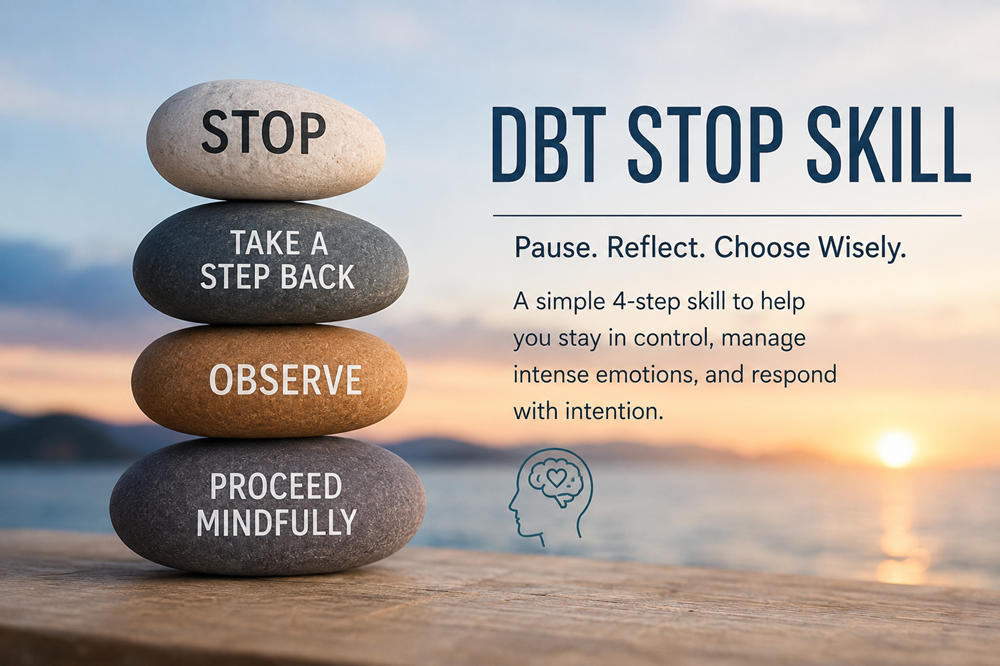
The DBT STOP skill provides a four-step response: Stop, Take a step back, Observe, and Proceed mindfully. It is a distress-tolerance skill designed for high-stress moments when acting impulsively could make things worse.
What Is the STOP Skill in DBT?
Dialectical Behavior Therapy, or DBT, teaches skills in four main areas: mindfulness, interpersonal effectiveness, emotion regulation, and distress tolerance. The STOP skill belongs to the distress-tolerance module, specifically among the crisis-survival skills.
Crisis-survival skills are short-term tools. Their purpose is not to solve every problem or make painful emotions immediately disappear. They are meant to help you get through an intense moment without adding an impulsive action that creates another problem.
The current DBT skills materials by Marsha Linehan organize distress tolerance alongside the other three core DBT skills modules.
What Does STOP Stand For?
S: Stop
The first instruction is simple: do not immediately act on the urge.
If you are about to send a hostile reply, stop typing. If you are preparing to say something you may regret, pause before speaking. If you feel driven to make a sudden decision because emotions are taking over, delay the action when it is safe and possible to do so.
Stopping does not mean denying what you feel. You can be angry, frightened, hurt, embarrassed, or frustrated and still decide not to act immediately.
The aim is to interrupt the automatic sequence between feeling something strongly and doing whatever the feeling urges you to do.
T: Take a Step Back
Next, create some distance from the situation.
That might mean physically stepping away, putting down your phone, sitting back, pausing a conversation, or taking a slow breath. In situations where physically leaving is not appropriate, you can still take a mental step back by delaying your judgment about what is happening.
You are not trying to escape the problem permanently. You are creating enough room to see it more clearly.
For example, if a conversation suddenly becomes heated, taking a step back may mean pausing before matching the other person’s tone. That small interruption gives you a better chance of deciding what you actually want to accomplish.
O: Observe
Once you have paused, notice what is happening both inside you and around you.
You can observe:
- the emotion you are experiencing;
- thoughts running through your mind;
- physical sensations such as tension or a racing heart;
- the action you feel urged to take;
- what other people are actually saying or doing;
- facts you know about the situation; and
- assumptions or predictions you may be adding.
This distinction between facts and interpretations can be especially useful.
Suppose someone has not replied to an important message. “There is no reply yet” is an observation. “They are deliberately ignoring me” is an interpretation. The interpretation might eventually prove correct, but you do not yet have enough information to know that.
Observing does not require you to argue with your emotions. It simply asks you to gather more information before deciding what happens next.
P: Proceed Mindfully
The final step is to act with awareness rather than impulse.
In DBT, proceeding mindfully includes considering your goals and drawing on what DBT calls Wise Mind—a way of approaching a situation without being driven entirely by emotion or entirely detached from it.
You might ask yourself:
- What do I want from this situation?
- What response is most likely to help?
- Could my first impulse make things worse?
- What information do I have now that I did not notice at first?
- What action fits both the facts and my longer-term goals?
Proceeding mindfully does not mean staying silent or passive. The effective response might be setting a boundary, leaving a situation, asking for clarification, correcting a misunderstanding, solving a problem, or speaking firmly.
The difference is that you are choosing the action rather than letting the emotional urge choose it for you.
When Is the STOP Skill Useful?
STOP is a crisis-survival skill rather than a tool that needs to be used for every ordinary inconvenience. It becomes especially relevant when emotional intensity is high, you feel a strong urge to react, and following that urge could worsen the situation.
Examples may include:
- An argument is escalating: You feel increasingly angry and are close to saying or doing something destructive.
- You receive upsetting criticism: You want to fire back before understanding what was said.
- An emotionally charged message arrives: You feel compelled to respond immediately even though you are not thinking clearly.
- You are about to make an impulsive decision: Strong emotion is pushing you toward an action with meaningful consequences.
- A stressful situation feels overwhelming: You notice that your urge is to react in a way that may create additional problems.
The specific trigger matters less than the pattern: emotion is intense, action feels urgent, and acting automatically carries a meaningful risk of making the moment harder.
A Practical STOP Skill Example
Imagine that you have spent hours preparing a proposal for work. A coworker responds with one sentence: “This needs to be redone.”
You immediately feel angry and disrespected. Your first impulse is to send a message defending your work and criticizing the lack of useful feedback.
Stop
You notice the urge and do not send the reply.
Take a step back
You move away from the message for a few minutes rather than continuing to type while angry.
Observe
You notice tension in your body, frustration, and the assumption that the coworker is dismissing all of your work. When you look at the actual message again, however, you realize that it is vague. You know revisions are wanted, but you do not know which parts need changing or why.
Proceed mindfully
Your goal is to understand the requested changes and move the project forward. Instead of sending the defensive response, you ask which sections need revision and what specific concerns need to be addressed.
STOP did not determine whether the coworker’s message was appropriate. It helped separate that question from the immediate urge to retaliate.
What STOP Is Not Designed to Do
Understanding the limits of the skill is as important as understanding the steps.
STOP is not intended to:
- make every unpleasant emotion disappear;
- convince you that your feelings are wrong;
- replace solving a problem that can be solved;
- make you tolerate mistreatment or remain in danger;
- prevent you from being assertive;
- serve as a complete mental-health treatment on its own.
Distress tolerance focuses on getting through situations that cannot immediately be improved without resorting to actions that make matters worse. An NHS overview of DBT similarly describes distress tolerance as learning crisis-survival skills for difficult feelings and situations that cannot immediately be changed.
Common Mistakes With the STOP Skill
Trying to solve the problem during “Stop”
You do not need an answer immediately. The first step simply interrupts the reaction so you can move through the rest of the process.
Confusing observation with judgment
“I am extremely angry” is an observation. “I am terrible for being this angry” is a judgment about the experience. Try to identify what is happening before evaluating yourself for it.
Assuming mindfulness means doing nothing
Effective action can be assertive. STOP creates space to choose how to respond; it does not require avoiding conflict or accepting unacceptable behavior.
Judging success by whether you feel calm
You may complete the steps and still feel distressed. The immediate goal of a crisis-survival skill is not necessarily emotional comfort. Preventing an impulsive action from making the situation worse can itself be a useful outcome.
How to Practice STOP Before an Intense Moment
A crisis is not an ideal time to encounter an unfamiliar sequence for the first time. You can therefore rehearse STOP when you are calm without treating every minor frustration as a crisis requiring distress-tolerance skills.
- Memorize the acronym. Practice recalling Stop, Take a step back, Observe, and Proceed mindfully.
- Choose a past or hypothetical scenario. Think about a situation in which strong emotion could lead to an impulsive response.
- Walk through the four steps mentally. Imagine what stopping and stepping back would look like.
- Identify what you would observe. Consider emotions, urges, body sensations, facts, and assumptions.
- Choose an effective response. Ask what action would best serve your goal after you had more information.
This kind of rehearsal helps make the sequence familiar without turning crisis-survival strategies into the default response to every small problem. DBT skills training also emphasizes moving from learning skills to applying them effectively in real situations.
How STOP Fits Into the Larger DBT Framework
STOP is one skill within a much broader treatment approach. Comprehensive DBT may combine individual therapy, skills training, between-session coaching, and support for the clinicians providing treatment.
Skills training itself covers mindfulness, interpersonal effectiveness, emotion regulation, and distress tolerance. The Behavioral Tech Institute’s description of DBT skills training also distinguishes skills training from comprehensive DBT treatment and emphasizes helping people apply learned skills in their everyday environments.
Other DBT skills address needs that STOP does not. Some focus on changing emotional responses, communicating effectively, accepting realities that cannot currently be changed, or reducing extreme physical arousal.
STOP has a narrower job: help interrupt an impulsive reaction so that another, more effective response becomes possible.
When STOP May Not Be Enough
A self-help explanation of one DBT skill is not a substitute for professional assessment or comprehensive treatment when someone is experiencing serious or persistent mental-health difficulties.
If intense emotions, self-harm, suicidal thoughts, substance use, impulsive behavior, or other difficulties are significantly affecting safety or everyday functioning, a qualified mental-health professional can help determine what type of support is appropriate.
If there is an immediate risk of serious harm or you cannot stay safe, seek urgent professional or emergency assistance rather than relying on STOP or another self-help technique alone.
Final Takeaway
The DBT STOP skill gives you four instructions for a moment when emotion-driven action could make a difficult situation worse:
Stop. Take a step back. Observe. Proceed mindfully.
Its value is not in eliminating every difficult feeling. It is in creating enough space to see what is happening and choose what you do next.
Frequently Asked Questions
Is STOP a distress-tolerance or emotion-regulation skill?
STOP is formally taught as a distress-tolerance crisis-survival skill in DBT. Using it can indirectly support emotion regulation because it may reduce impulsive emotion-driven behavior, but its primary placement is within distress tolerance.
Can you use the STOP skill outside DBT therapy?
The four-step sequence can be learned as an individual skill, but learning a DBT skill independently is not the same as receiving comprehensive DBT treatment. Formal DBT includes a broader set of therapeutic strategies and skills.
What is the difference between STOP and TIPP?
STOP focuses on interrupting an impulsive reaction so you can observe the situation and choose your next action. TIPP is another distress-tolerance skill set that focuses more directly on reducing extreme physiological arousal through body-based techniques.
What happens after you use STOP?
There is no single required action. Depending on the situation, you might communicate, solve the problem, set a boundary, wait for more information, use another DBT skill, or seek support. The point is to make that choice deliberately rather than automatically.