
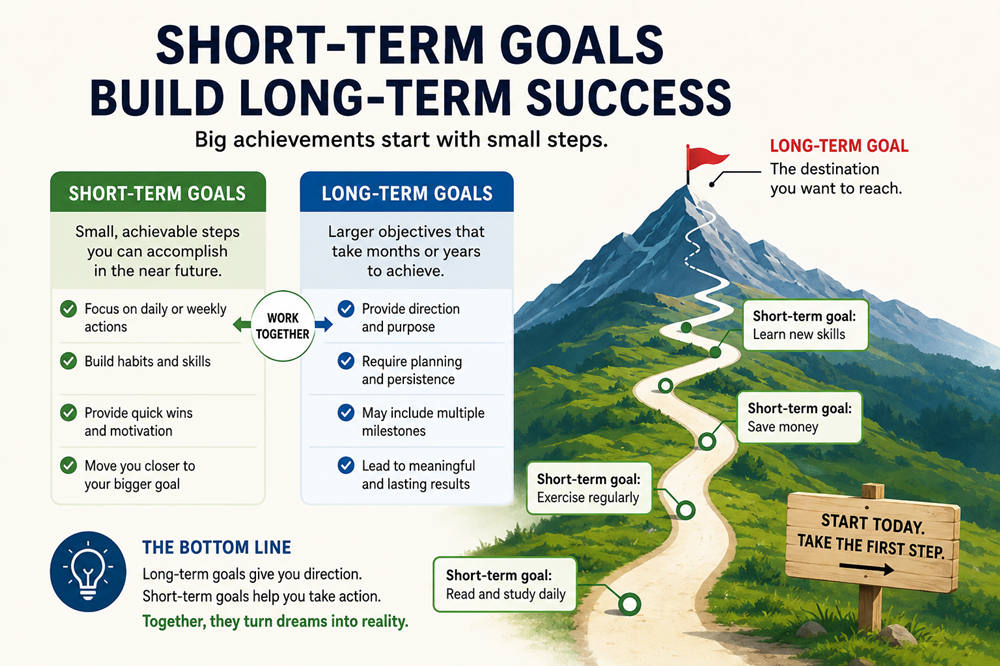
Short-term goals are smaller steps that help you reach a larger long-term goal. A long-term goal identifies where you want to go, while short-term goals show what you need to do next.
For example, graduating from college is a long-term goal. Attending classes, completing assignments, studying for exams, and passing each semester are short-term goals that move you toward graduation.
What Are Long-Term Goals?
Long-term goals are larger outcomes that may take months or years to achieve. They usually require continued effort, planning, and several stages of progress.
Examples include:
- Earning a college degree
- Buying a home
- Starting a business
- Building a successful career
- Saving for retirement
- Learning another language
- Reaching a major fitness goal
The exact timeframe depends on the situation. A goal that is long term for one person or project may be short term for another. The main differences are usually the amount of time required and the size of the goal.
According to Monash University’s guidance on planning goals, long-term goals focus on big-picture outcomes and are achieved through progress on connected short- and medium-term goals.
A long-term goal provides direction, but it can feel overwhelming when you view it as one large task. Breaking it into smaller steps makes it easier to get started and recognize progress.
What Are Short-Term Goals?
Short-term goals are smaller results you expect to achieve relatively soon. They may take a day, a week, a month, or another limited period, depending on the larger objective.
Examples include:
- Saving $100 this month
- Completing three workouts this week
- Submitting a job application by Friday
- Reading one chapter each evening
- Creating a monthly budget
- Studying for an hour before a test
The New York City Case Management Toolkit describes short-term goals as benchmarks and milestones on the journey toward long-term goals.
A short-term goal should be clear enough that you can tell whether you completed it. “Improve my grades,” for example, is vague. “Study math for 30 minutes every weekday” gives you a specific action to follow.
How Short- and Long-Term Goals Work Together
The best description of their relationship is:
Long-term goals provide direction, while short-term goals provide the steps needed to make progress.
The American Psychological Association’s explanation of goal-setting theory notes that short-term goals can be used to reach long-range goals. Specific goals also help direct attention and effort toward the activities that matter most.
Think of a long-term goal as a destination on a map. Short-term goals are the turns and smaller distances that get you there. Without a destination, you may take many actions without knowing whether they are useful. Without the smaller directions, you may know where you want to go but have no practical route for reaching it.
The relationship works in both directions:
- Your long-term goal helps you choose useful short-term actions.
- Your short-term results show whether the larger plan is working.
- Completing smaller goals builds progress and motivation.
- Difficulties with short-term goals may reveal that the plan needs to change.
You might even discover that your original long-term goal no longer fits your interests or circumstances. Adjusting it after gaining new information is not necessarily a failure. It can be a sensible part of planning.
A Simple Example
Suppose your long-term goal is to save $12,000 for a home down payment within two years.
That goal tells you the amount you need and when you want to have it, but it does not tell you what to do this week. You could turn it into several short-term goals:
- Review your income and expenses this weekend.
- Open a separate savings account.
- Set aside $500 each month.
- Reduce unnecessary spending by $100 a month.
- Check your progress every three months.
- Look for a way to increase your income within six months.
Each short-term goal supports the larger financial target. If you cannot save $500 one month, you can review your spending, adjust the deadline, or find another solution instead of abandoning the entire goal.
Key Differences
| Short-Term Goals | Long-Term Goals |
|---|---|
| Usually completed sooner | Usually take months or years |
| Focus on immediate progress | Focus on a larger future result |
| Are narrower and more specific | Are broader and more ambitious |
| Make the next action clear | Provide overall direction |
| Can be reviewed frequently | Often contain several milestones |
Short-term goals are often process-focused because they describe actions and habits. Long-term goals are often outcome-focused because they describe the result you ultimately want.
However, this is not a strict rule. Either type can include actions, results, or a combination of both. Monash University explains that process goals focus on actions and habits, while outcome goals define what you want to achieve.
Why You Need Both
A long-term goal without short-term steps can remain an idea rather than becoming a workable plan. You may feel inspired by the outcome but still be unsure how to begin.
Short-term goals make progress manageable. They help you focus on one action at a time, measure what you have accomplished, and notice problems early. Research-based educational guidance also suggests that short-term, specific, and moderately challenging goals can improve motivation because progress is easier to judge.
However, short-term goals also need long-term direction. Staying busy does not always mean you are moving forward. You could complete dozens of tasks that have little connection to what you actually want.
Before choosing a short-term goal, ask:
- Does this move me closer to my larger goal?
- Is it specific enough to complete?
- Can I measure the result?
- Is the deadline realistic?
- Is this the most useful next step?
Make Each Goal Clear and Measurable
Goals are easier to follow when they are specific, measurable, realistic, and connected to a deadline. The commonly used SMART goal-setting framework encourages people to create goals that are specific, measurable, achievable, relevant, and time-bound.
Instead of saying:
I want to exercise more.
You could say:
I will walk for 20 minutes on Monday, Wednesday, and Friday.
The second version gives you a clear action, schedule, and way to measure completion.
The National Institute on Aging gives a similar example, recommending that a general desire to become more active be turned into an actionable goal, such as taking a 10-minute walk three times per week.
How to Connect Your Goals
Start with the result you want and work backward.
Write down your long-term goal, identify the major milestones needed to reach it, and turn the first milestone into a few manageable actions. Give each action a deadline and review your progress regularly.
For example:
Long-term goal: Get a new job within six months.
Short-term goals:
- Update your résumé by Friday.
- Identify five suitable openings this week.
- Submit three applications by next Monday.
- Practice common interview questions twice this month.
- Contact two professional connections.
Regular reviews allow you to see what is working and adjust your plan when necessary. Recognizing completed milestones can also help maintain momentum over a long period.
Final Answer
Short- and long-term goals support each other. Long-term goals define the future result you want, while short-term goals divide that result into smaller, measurable steps.
Long-term goals keep you focused on the bigger picture. Short-term goals help you take action today. When the two are connected, large ambitions become more organized, manageable, and achievable.