
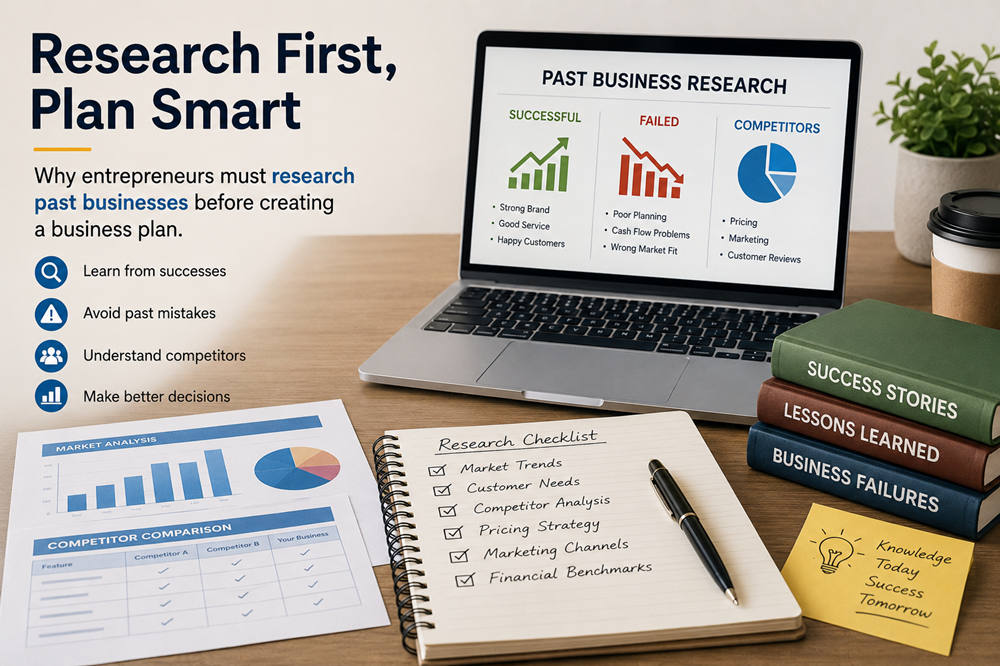
Before creating a business plan, an entrepreneur should study businesses that came before them. A good idea can feel exciting, but excitement alone does not prove that customers will buy, prices will work, or the market has room for another option.
Past business research helps you make better decisions before money is on the line. It shows what has worked, what has failed, what customers expect, and where your business may have a real chance to stand out. The U.S. Small Business Administration explains that market research and competitive analysis can help business owners understand customers and find a stronger position in the market.
What It Means to Research Past Businesses
Researching past businesses does not mean copying old ideas. It means learning from real examples.
An entrepreneur may study successful companies, failed businesses, current competitors, customer reviews, pricing, marketing strategies, and industry trends. This gives the business plan a stronger foundation because it is based on evidence, not just personal opinion.
For example, someone planning to open a bakery should look beyond recipes. They should study local bakeries, customer complaints, popular menu items, delivery options, pricing, and reasons similar businesses closed. Those details can shape the product, budget, marketing plan, and customer experience.
The goal is simple: learn before you launch.
Why This Research Matters
A business plan should answer practical questions. Who are your customers? What problem are you solving? Who else is serving the same market? Why would people choose your business? How much will it cost to operate? What risks should you prepare for?
Without research, these answers can become too general. An entrepreneur may assume there is strong demand when the market is already crowded. They may set prices too low, underestimate expenses, or target the wrong customers.
Studying past businesses helps reduce those mistakes. It gives you a clearer view of what customers value and what problems other business owners faced. That makes the business plan more realistic and useful.
Learning From Successful Businesses
Successful businesses can show what customers respond to. A company may grow because it offers better service, easier access, stronger branding, fair pricing, faster delivery, or a more personal experience.
The point is not to copy another business. The point is to understand why it worked.
A popular coffee shop, for example, may not succeed only because of its drinks. Customers may return because the space feels comfortable, the staff is friendly, the service is quick, and the brand feels local. A successful online store may grow because the website is easy to use, shipping is reliable, and product information is clear.
These lessons can help entrepreneurs design a better offer. Instead of guessing what customers might like, they can study what customers have already supported.
Learning From Failed Businesses
Failed businesses are also worth studying. They often reveal warning signs that are easy to miss in the early planning stage.
Some businesses fail because there is not enough demand. Others struggle with poor cash flow, weak pricing, bad timing, unclear marketing, high expenses, or a product that does not fit the market. CB Insights lists several common startup failure reasons, including lack of product-market fit and running out of cash.
Failure research helps entrepreneurs ask better questions. Did customers understand the offer? Were prices realistic? Did the business grow too fast? Were expenses higher than expected? Did competitors offer something stronger?
Harvard Business School also notes that startup failure often follows patterns, which means entrepreneurs can learn from earlier mistakes instead of treating every failure as random bad luck.
This kind of research may feel uncomfortable, but it can save time, money, and stress later.
Researching Competitors Before Writing the Plan
Competitor research is one of the most important steps before writing a business plan. Competitors show what customers already have and what your business must do differently.
You should study both direct and indirect competitors. Direct competitors sell a similar product or service. Indirect competitors solve the same customer problem in another way.
For example, a meal-prep business may compete directly with other meal-prep companies. It may also compete indirectly with grocery stores, restaurants, frozen meals, and food delivery apps.
When reviewing competitors, look at:
- What they sell
- How they price their products or services
- Who their customers are
- What customers praise
- What customers complain about
- How they market themselves
- What makes them different
- Where they seem weak
SCORE recommends organizing market and competitor research so it can support the business plan instead of becoming scattered notes.
The goal is not to be better at everything. The goal is to give the right customers a clear reason to choose your business.
How Research Improves the Business Plan
Past business research can improve every major part of a business plan.
It helps the market analysis become more specific because you understand your customers and competitors better. It helps the marketing plan become more focused because you can see which messages, channels, and offers already connect with people.
It also helps with pricing. When you know what customers already pay, you can avoid choosing numbers that are too high, too low, or disconnected from the market.
Financial planning becomes stronger too. Instead of making random sales and cost estimates, you can use real examples from similar businesses to create more realistic projections.
Research also improves risk planning. If similar businesses struggled with seasonal demand, rent, staffing, supply costs, or customer retention, your plan can explain how you will prepare for those challenges.
A strong business plan does not ignore problems. It shows that the entrepreneur has thought through them carefully.
Common Mistakes to Avoid
One common mistake is studying only famous success stories. Big companies can be inspiring, but they may not match your budget, location, audience, or stage of growth. Small businesses in similar markets often provide more useful lessons.
Another mistake is copying competitors too closely. Research should help you find your own position, not make your business look like everyone else.
Entrepreneurs should also avoid relying on outdated information. Customer habits, technology, advertising costs, and buying behavior change over time. What worked several years ago may not work the same way today.
The biggest mistake is ignoring failed businesses. Failure can reveal problems that a polished success story may hide.
Summary
Before creating a business plan, an entrepreneur should research past businesses because real examples make planning smarter. Successful businesses show what customers value. Failed businesses show what to avoid. Competitors show what already exists and where there may still be room for something better.
A business plan should not be built on hope alone. It should be built on research, clear thinking, and practical decisions. The more an entrepreneur learns before writing the plan, the better prepared they are to build a business that can survive in the real market.