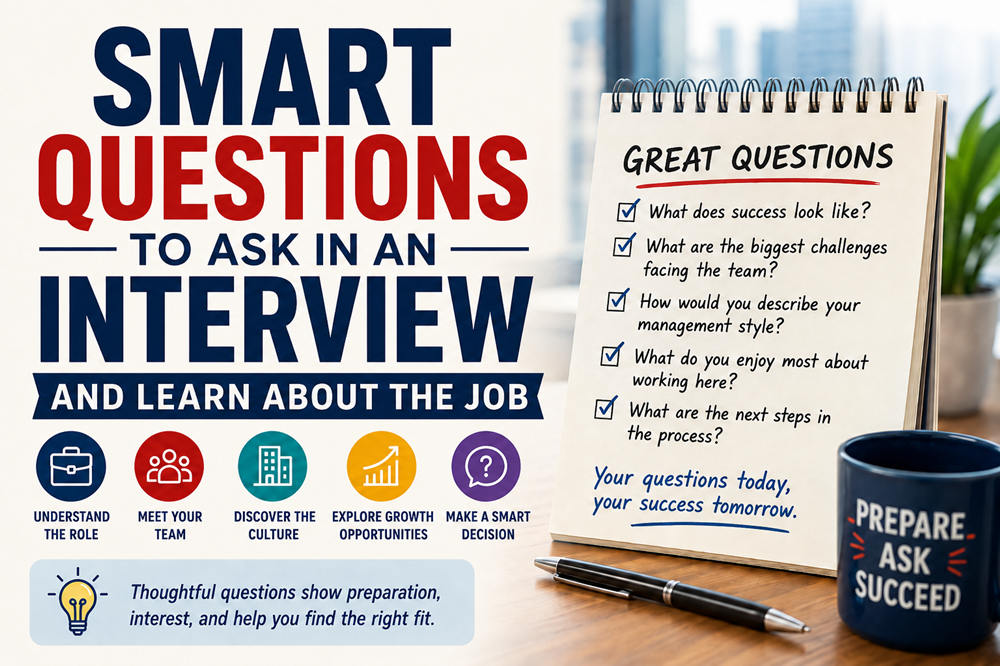
A job interview is a two-way conversation. The employer wants to learn whether you are right for the position, but you also need to decide whether the job, manager, and workplace are right for you.
Thoughtful questions show that you prepared and care about making a smart career decision. They can also reveal details that are missing from the job description, such as the manager’s expectations, the team’s working style, and the challenges you may face.
You will not need all 75 questions. Choose five to eight before the interview, then ask the ones that have not already been answered.
Questions About the Role
Start by learning what the position looks like in practice.
- What does a typical day in this role look like?
- What are the most important responsibilities of this position?
- What would you like the new hire to focus on first?
- What are the biggest priorities for this role right now?
- Is this a new position, or am I replacing someone?
- How has the role changed since it was first created?
- Which parts of the job take up the most time?
- What skills are most important for doing well in this position?
- What is the most challenging part of the role?
- What do new employees often find surprising about the job?
- How much freedom would I have to organize my daily work?
- Are there any major projects I would begin working on immediately?
Questions About Success and Expectations
These questions help you understand how your work would be judged and what the employer expects during your first few months.
- What would you like me to accomplish in my first 30 days?
- What should the person in this role achieve within the first 90 days?
- What would success look like after six months?
- How is performance measured in this position?
- Which goals or results matter most?
- How often are performance goals reviewed?
- What separates someone who is good at this job from someone who is exceptional?
- What mistakes do people commonly make when starting this role?
- What could cause someone to struggle in this position?
- How are priorities handled when several urgent tasks come up at once?
- How often do responsibilities or goals change?
- What would make you feel confident that you hired the right person?
Questions About the Manager
Your relationship with your manager can shape your entire experience at work. Use these questions to understand how they lead and communicate.
- How would you describe your management style?
- How do you prefer team members to communicate with you?
- How often do you hold one-on-one meetings?
- How do you usually provide feedback?
- How involved are you in your team’s daily work?
- What do you expect employees to do when they run into a problem?
- How do you support someone who is learning a new responsibility?
- How do you recognize strong performance?
- What qualities do you value most in the people you manage?
- What do you enjoy most about leading this team?
- What is one thing you would like the team to improve?
- How do you help employees work toward their career goals?
Questions About the Team
Even when a job involves independent work, you will probably depend on other people to share information, solve problems, and complete projects.
- Can you tell me about the team I would be joining?
- Who would I work with most closely?
- How are responsibilities divided among team members?
- Does the team work mostly independently or collaboratively?
- How does the team share updates and important information?
- How often does the team meet?
- How are disagreements or different opinions handled?
- What are the team’s biggest strengths?
- What is the team currently trying to improve?
- What recent accomplishment is the team most proud of?
- How does this team work with other departments?
- Are there any major changes happening within the team?
Questions About Company Culture
Instead of asking whether the company has a “good culture,” ask about everyday behavior. The answers will usually tell you more.
- How would you describe the working environment here?
- What type of person tends to do well at this company?
- What values influence everyday decisions?
- How are employees encouraged to share new ideas?
- How does leadership communicate important changes?
- What usually happens when a project does not go as planned?
- How does the company support a healthy work-life balance?
- What is something new employees often notice about the culture?
- What has kept you working here?
- How has the company culture changed since you joined?
Questions About Growth and Development
These questions show that you want to learn and contribute over time, not that you are already looking for your next position.
- What skills could I develop in this role?
- What training is available for new employees?
- Does the company offer mentoring or coaching?
- Are employees able to attend courses, workshops, or conferences?
- What career paths have people in this position followed?
- How are employees considered for promotions?
- Are there opportunities to take on more responsibility over time?
- Can employees work on projects outside their usual department?
Questions About Remote or Hybrid Work
For a remote or hybrid position, find out how the policy works in practice.
- How often would I be expected to work in the office?
- Are office days fixed, or can employees choose them?
- Are team members expected to be available during specific hours?
- How does the team keep remote employees involved in discussions and decisions?
- Does the company provide equipment or support for a home office?
Questions to Ask at the End of the Interview
Use your final questions to clear up concerns and understand what happens next.
- Is there anything about my background or experience that you would like me to clarify?
- Is there any other information I can provide to help with your decision?
- What are the next steps in the hiring process?
- When do you expect to make a decision?
The Best Questions for a First Interview
During an early interview, focus on the role, team, and basic expectations. Strong choices include questions about:
- The position’s main priorities
- What a normal day looks like
- How success is measured
- The people you would work with
- Why the position is available
- The next step in the hiring process
Detailed questions about minor policies may be better saved for a later interview. However, you should still ask about anything that could affect whether the job works for you.
The Best Questions for a Final Interview
A final interview is a good time to explore long-term fit. By this point, you should understand the basic duties, so focus on the manager’s expectations, upcoming challenges, and the company’s direction.
You may also want to clarify salary, benefits, paid time off, scheduling, travel requirements, and remote-work arrangements. These are reasonable topics, especially when the employer is seriously considering you. A recruiter or human resources representative is often the best person to answer them.
Questions to Handle Carefully
A few questions can sound negative or overly demanding when they are asked too early.
Be careful with wording such as:
- How quickly can I get promoted?
- How soon can I take vacation?
- Can I work from home whenever I want?
- How little overtime can I expect?
- Did I get the job?
The topics themselves may be valid. The problem is usually the wording or timing.
For example, instead of asking, “How little overtime can I expect?” you could ask, “Are there times of the year when the team’s workload is especially heavy?”
Instead of asking, “How quickly can I get promoted?” ask how people in the role usually grow and what skills are needed to take on more responsibility.
Avoid asking questions that could have been answered with a quick visit to the company’s website. Basic interview preparation helps you ask more specific and useful questions.
How Many Questions Should You Ask?
Three to five thoughtful questions are usually enough. Prepare more because the interviewer may answer some of them during the conversation.
Listen carefully and avoid asking something that has already been covered. You can also turn an interviewer’s comment into a natural follow-up question.
For example:
“You mentioned that the team is preparing for a major product launch. How would this position contribute to that project?”
A question connected to the actual conversation will usually make a stronger impression than one read directly from a prepared list.
The goal is not to ask as many questions as possible. It is to leave the interview with a clearer picture of the work, the people, and whether the opportunity fits what you are looking for.