Most habits do not disappear in 21 days.
That number sounds neat, but real habit change is usually less predictable. A small habit may feel easier to manage after a few weeks. A stronger habit, especially one tied to stress, comfort, boredom, or addiction, can take months to change.
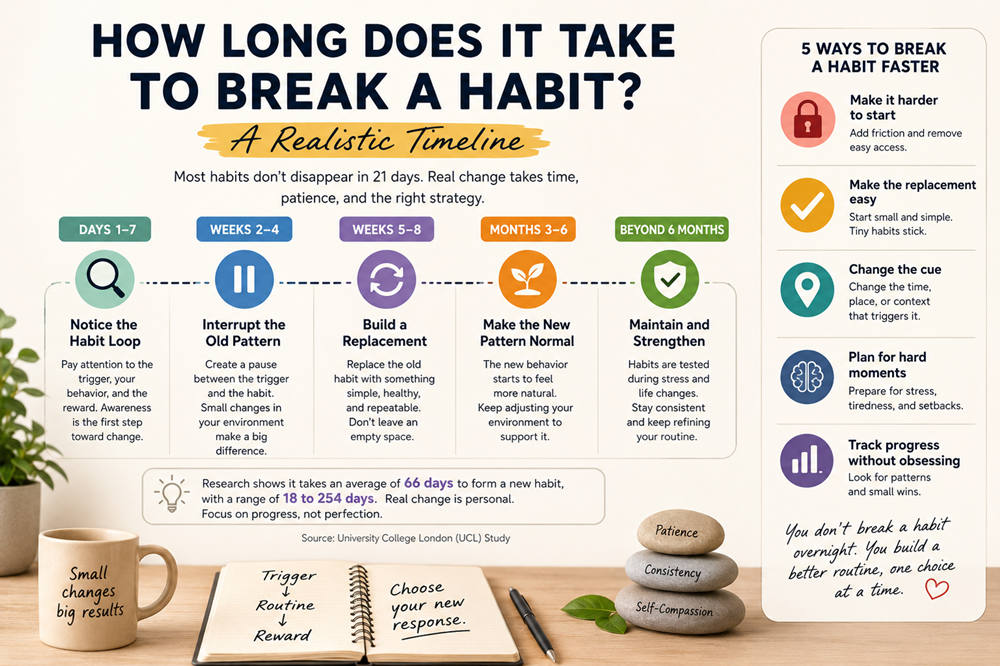
A more realistic answer is this: you may notice progress within 2 to 4 weeks, but many habits need 2 to 3 months or longer before the new pattern feels steady. University College London research found that forming a new automatic habit took 66 days on average, with a wide range from 18 to 254 days. That study was about building habits, not magically erasing old ones, but it helps explain why real behavior change often takes longer than people expect.
Breaking a Habit Means Replacing a Pattern
A habit is not just something you do. It is usually a loop.
A cue appears. You respond with the habit. Then you get some kind of reward, even if the reward is only temporary relief.
For example, you feel stressed, so you snack. You feel bored, so you scroll. You feel overwhelmed, so you avoid the task. After enough repetition, your brain starts treating that response like the default option.
This is why breaking a habit is hard. You are not only trying to stop the behavior. You are trying to change the cue, the response, and the reward that keep the habit alive.
Why the “21 Days” Rule Is Too Simple
The 21-day rule is popular because it gives people hope. The problem is that it makes habit change sound much faster and cleaner than it usually is.
Some habits are light and easy to interrupt. Others are deeply connected to your emotions, schedule, environment, relationships, or identity. Those habits need more time because they have more roots.
Instead of asking, “How many days until this habit is gone?” ask, “How long will it take to make the better response easier than the old one?”
That question is more useful because most habits are not broken by force. They are weakened by repetition, better cues, and better replacement behaviors.
A Practical Timeline for Breaking a Habit
There is no perfect timeline for every person, but this gives you a realistic way to think about the process.
Days 1–7: Notice the Habit Loop
The first week is mostly about awareness.
Before you try to fix everything, pay attention to when the habit happens. Notice the time of day, the place, the emotion, and the trigger.
Ask yourself:
- What usually happens right before this habit?
- What am I feeling?
- What reward do I get from it?
- What situation makes it harder to resist?
This step matters because many habits run on autopilot. Once you can see the pattern, you can start changing it.
Weeks 2–4: Interrupt the Old Pattern
After you understand the habit loop, start interrupting it.
This does not mean you need to be perfect. It means you create a pause between the trigger and the old behavior.
For example:
- Put your phone in another room before bed.
- Keep tempting snacks out of easy reach.
- Open your work document before checking messages.
- Take a two-minute walk when stress hits.
- Delay the habit for 10 minutes before deciding what to do.
A pause gives your brain a chance to choose something different.
Weeks 5–8: Build a Replacement Habit
By this stage, the goal is not just to avoid the old habit. The goal is to practice a new response.
If you only remove the habit, you leave an empty space. That empty space often pulls you back to the old routine.
Replace the habit with something simple and repeatable:
- Instead of late-night scrolling, read one page.
- Instead of stress snacking, make tea or take a short walk.
- Instead of avoiding a task, work on it for five minutes.
- Instead of checking your phone first thing, drink water and open the curtains.
The replacement does not have to be dramatic. It just needs to be easy enough to repeat.
Months 3–6: Make the New Pattern Feel Normal
After a few months, the new behavior may start feeling more natural. The old urge may still appear, but it usually becomes easier to catch.
This is where environment matters. Habit researcher Wendy Wood has explained that many routines are shaped by context, not just conscious intention. In everyday life, that means your surroundings can quietly pull you toward the old habit or help you practice a new one.
Make the better choice easier:
- Remove obvious triggers.
- Keep helpful tools visible.
- Change the time or place where the habit usually happens.
- Spend less time around people or situations that reinforce the old pattern.
- Create a clear “if this happens, I will do that” plan.
The less you rely on willpower, the better.
Why Some Habits Take Longer to Break
Some habits fade quickly because they are small and not very emotional. Others take longer because they help you cope with something.
A habit may take longer to break if:
- It gives quick comfort or relief.
- It happens when you are stressed or tired.
- It is tied to anxiety, loneliness, boredom, or anger.
- You have repeated it for years.
- Your environment keeps triggering it.
- People around you do the same thing.
- You do not have a clear replacement behavior.
This is why two people can work on the same habit and have completely different timelines. The habit itself matters, but the trigger behind it matters too.
What to Do When You Slip
A slip does not mean you failed.
It means the old pattern showed up again. That is normal, especially during stress, travel, poor sleep, or major life changes.
Instead of saying, “I ruined it,” ask:
- What triggered the slip?
- Was I tired, stressed, hungry, or overwhelmed?
- Did I make the old habit too easy?
- Was my replacement habit too hard?
- What can I adjust next time?
The National Institute of Diabetes and Digestive and Kidney Diseases describes changing health habits as a process with stages, roadblocks, and gradual progress. That is a healthier way to see setbacks: not as proof you cannot change, but as information you can use.
How to Break a Habit Faster
You cannot always force a habit to disappear quickly, but you can make change easier.
1. Make the Habit Harder to Start
Add friction.
Log out of the app. Put your phone across the room. Stop buying the snack you keep overeating. Move your credit card away from shopping apps. Make the old behavior less convenient.
A habit becomes weaker when it is harder to repeat.
2. Make the Replacement Easy
Do not choose a replacement that requires a full personality change.
If you want to stop scrolling at night, do not replace it with a 90-minute self-care routine. Start with something small, like charging your phone outside the bedroom and reading one page.
Small behaviors are easier to repeat, and repeated behaviors are easier to trust.
3. Change the Cue
If the same cue keeps triggering the same habit, change the cue.
If you snack every time you sit on the couch, change your evening routine. If you procrastinate at your desk, clear the desk before starting. If you check your phone in bed, keep the phone outside the room.
Your surroundings can either pull you toward the old habit or support the new one.
4. Plan for the Hard Moments
Most people do not slip when life is calm. They slip when they are tired, stressed, rushed, lonely, or overwhelmed.
Plan for those moments before they happen.
Try this sentence:
“When I feel ___, I will ___ instead.”
For example:
“When I feel stressed, I will take three slow breaths and walk to the kitchen for water.”
That small plan gives your brain another route to follow.
5. Track Progress Without Obsessing
Tracking can help, but do not turn it into another way to judge yourself.
You can track:
- How many times you delayed the habit
- How many days you practiced the replacement
- What triggers showed up most often
- What helped you recover after a slip
Progress is not only “I never did it again.” Progress also means you noticed sooner, stopped faster, and came back more calmly.
When a Habit Needs Extra Support
Some habits need more than self-discipline.
If the habit involves substance use, self-harm, gambling, disordered eating, or behavior that feels out of control, it may be time to get professional help. The National Institute of Mental Health explains that substance use and mental health concerns can overlap and may require proper support, diagnosis, and treatment.
Getting help does not mean you are weak. It means the habit is serious enough to deserve stronger support.
Summary
So, how long does it take to break a habit?
For many people, early progress can happen within a few weeks. A more stable change often takes 2 to 3 months. Stronger habits may take 6 months or longer, especially if they are tied to stress, emotion, addiction, or a repeated environment.
The goal is not to count days perfectly. The goal is to understand your trigger, interrupt the old loop, and build a replacement behavior that is easier to repeat.
You do not break a habit by hating yourself into change.
You break it by making the old pattern harder, the new pattern easier, and the next choice a little more intentional than the last one.