Some problems cannot be fixed the moment they appear. You may be waiting for news, grieving a loss, dealing with conflict, or facing stress that needs time to unfold.
Emotion-focused coping helps in those moments. It is not about pretending the problem does not exist. It is about calming your emotional response so you can think, breathe, and choose your next step with more clarity.
What Is Emotion-Focused Coping?
Emotion-focused coping is a way of handling stress by managing the feelings that come with it. Instead of focusing first on changing the stressful situation, you focus on how you are reacting emotionally.
For example, if you are waiting for important results, you may not be able to speed up the answer. But you can breathe, journal, talk to someone you trust, take a walk, or remind yourself that you only need to handle the next step.
This kind of coping is especially helpful when a situation feels uncertain, painful, or outside your control. It gives your mind and body a chance to settle before you react.
Emotion-Focused Coping vs. Problem-Focused Coping
Emotion-focused coping and problem-focused coping are both useful. They simply serve different purposes.
Problem-focused coping asks:
“What can I do to change this situation?”
Emotion-focused coping asks:
“How can I support myself emotionally while this is happening?”
If your inbox is overloaded, problem-focused coping might mean making a task list, replying to urgent emails, or asking for an extension. If you feel overwhelmed before you start, emotion-focused coping might mean taking a few slow breaths, stepping away for five minutes, or writing down what feels stressful.
Most real-life problems need both. You calm yourself first, then take action when you can.
When Emotion-Focused Coping Is Helpful
Emotion-focused coping works best when the problem cannot be solved right away or when your emotions are too intense to ignore.
It can help during:
- Grief or loss
- A breakup
- Family tension
- Health worries
- Financial uncertainty
- Work stress
- Waiting for results or decisions
- Big life changes
- Anxiety before a hard conversation
- Disappointment after a setback
In these situations, jumping straight into “fix it mode” may not help. Sometimes the first step is to get steady enough to see the situation clearly.
Healthy Emotion-Focused Coping Examples
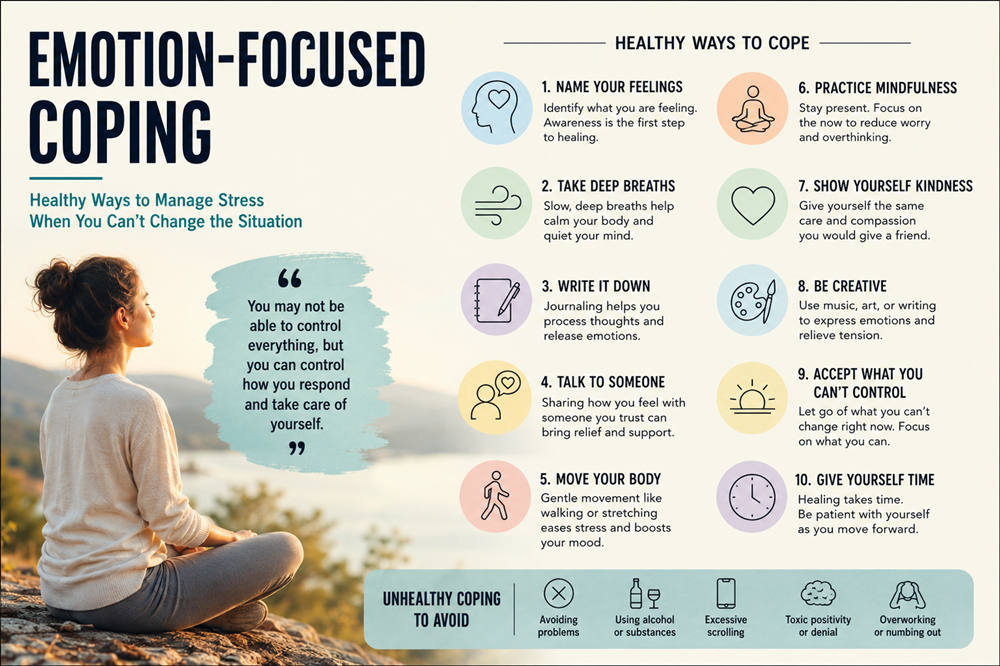
Healthy emotion-focused coping helps you process your feelings instead of burying them. Here are practical ways to use it.
1. Name What You Are Feeling
Stress often feels bigger when it stays vague. Instead of saying, “I feel bad,” try to name the real emotion.
You might say:
- “I feel disappointed.”
- “I feel embarrassed.”
- “I feel scared.”
- “I feel left out.”
- “I feel overwhelmed.”
- “I feel angry because this feels unfair.”
Naming the emotion does not magically solve the problem, but it gives you a clearer place to start.
2. Use Slow Breathing to Calm Your Body
When stress rises, your body may react before your mind catches up. Your chest may tighten, your jaw may clench, or your thoughts may race.
Simple breathing techniques can help your body slow down.
Try this:
Breathe in for four counts.
Pause for one count.
Breathe out for six counts.
Repeat for one to three minutes.
You do not need to do it perfectly. The goal is to create a small pause between the feeling and your reaction.
3. Write Down What Is Bothering You
Journaling gives your thoughts somewhere to land. It is useful when your mind keeps circling the same worry.
Try writing answers to simple prompts:
- What am I feeling right now?
- What part of this can I control?
- What part is outside my control today?
- What do I need most in this moment?
- What would I say to a friend who felt this way?
You are not writing for anyone else. You are giving yourself space to be honest.
4. Reframe the Situation Honestly
Reframing means looking at a stressful situation from a more balanced angle. It is not fake positivity.
Instead of saying, “Everything is ruined,” you might say, “This is hard, but I can deal with one part at a time.”
Instead of saying, “I failed,” you might say, “This did not go how I wanted, but I can learn from it.”
A helpful reframe should feel believable. If it sounds forced, soften it until it feels true enough to hold onto.
5. Talk to Someone Safe
Some feelings become easier to carry when you say them out loud. A supportive person can help you feel less alone and more grounded.
You can make the conversation easier by being clear about what you need:
“I do not need advice yet. I just need someone to listen.”
Or:
“Can you help me calm down before I decide what to do?”
Good support does not always mean someone fixes the problem. Sometimes it means they sit with you while you find your footing again.
6. Move Your Body Gently
Stress often shows up physically. You may feel tense, restless, heavy, or drained.
Gentle movement can help release some of that pressure. You might take a short walk, stretch your shoulders, clean one small area, dance to one song, or step outside for fresh air.
This is not about forcing an intense workout when you are already exhausted. It is about helping your body move through stress instead of holding everything in.
7. Practice Mindfulness
Mindfulness helps you return to the present moment when your thoughts are stuck in the past or rushing into the future.
A simple grounding exercise is the 5-4-3-2-1 method:
Name five things you can see.
Name four things you can feel.
Name three things you can hear.
Name two things you can smell.
Name one thing you can taste.
This gives your mind something steady to focus on when emotions feel loud.
8. Let Yourself Feel Without Shame
Not every coping skill looks calm. Sometimes healthy coping looks like crying, sitting quietly, admitting you are hurt, or taking a break before you speak.
Feeling your emotions does not make you weak. It means you are being honest about what is happening inside you.
The key is to let the feeling move through you without letting it make every decision for you.
9. Create a Small Comfort Routine
Small routines can help you feel more grounded during stressful seasons.
Your routine might include making tea, taking a warm shower, reading a few pages, listening to calming music, lighting a candle, sitting outside, or putting your phone away for 20 minutes.
A comfort routine should support you, not numb you for hours. Think of it as a soft landing place, not a hiding place.
10. Accept What You Cannot Control Right Now
Acceptance does not mean you like the situation. It means you stop using all your energy to fight the fact that it is happening.
You might tell yourself:
“I cannot change this today, but I can take care of myself today.”
That one sentence can be powerful. It brings your attention back to what is possible right now.
Unhealthy Emotion-Focused Coping to Avoid
Emotion-focused coping can become unhealthy when it turns into avoidance. Some habits feel soothing in the moment but keep you stuck later.
Watch out for patterns like:
- Pretending you are fine when you are not
- Avoiding every hard conversation
- Blaming yourself for things outside your control
- Scrolling for hours to escape your feelings
- Overworking so you do not have to think
- Using food, alcohol, or other habits to numb pain
- Forcing positive thinking when you actually need support
- Venting over and over without reflecting or healing
A simple question can help:
“Is this helping me process my emotions, or is it helping me avoid them?”
Healthy coping usually leaves you feeling a little clearer or steadier. Unhealthy coping often leaves you feeling more stuck once the distraction ends.
How to Use Emotion-Focused Coping in Real Life
You can use emotion-focused coping with a simple process.
1. Pause Before Reacting
Before you send the message, make the decision, or say something you might regret, pause.
Even a few seconds can help you respond with more control.
2. Ask What You Can Control
Ask yourself:
“Can I change this right now?”
If the answer is yes, you may need to take practical action. If the answer is no, start by caring for your emotional response.
3. Choose One Coping Tool
Pick one healthy tool. Do not overwhelm yourself with ten steps at once.
You might breathe, journal, walk, pray, stretch, call a friend, or sit quietly for a few minutes.
4. Let the Feeling Settle
Emotions often rise like waves. They build, peak, and soften.
You do not have to solve your whole life while the wave is at its highest. Give yourself time to come down before deciding what to do next.
5. Return to Action When You Can
Emotion-focused coping does not replace action. It helps you become steady enough to take better action.
Once you feel clearer, ask:
“What is one helpful step I can take next?”
That step might be setting a boundary, asking for help, making a plan, apologizing, resting, or having a difficult conversation.
Summary
Emotion-focused coping helps you handle stress by caring for your emotional response. It is useful when you cannot change a situation right away or when your feelings are too intense to push aside.
Healthy emotion-focused coping can include breathing, journaling, talking to someone supportive, reframing your thoughts, moving your body, practicing mindfulness, and accepting what you cannot control in the moment.
The goal is balance. Use emotion-focused coping to calm and process your feelings, but do not let it become avoidance. When action is possible, take action. When action is not possible yet, give yourself the support you need to move through the moment with more steadiness and self-respect.