
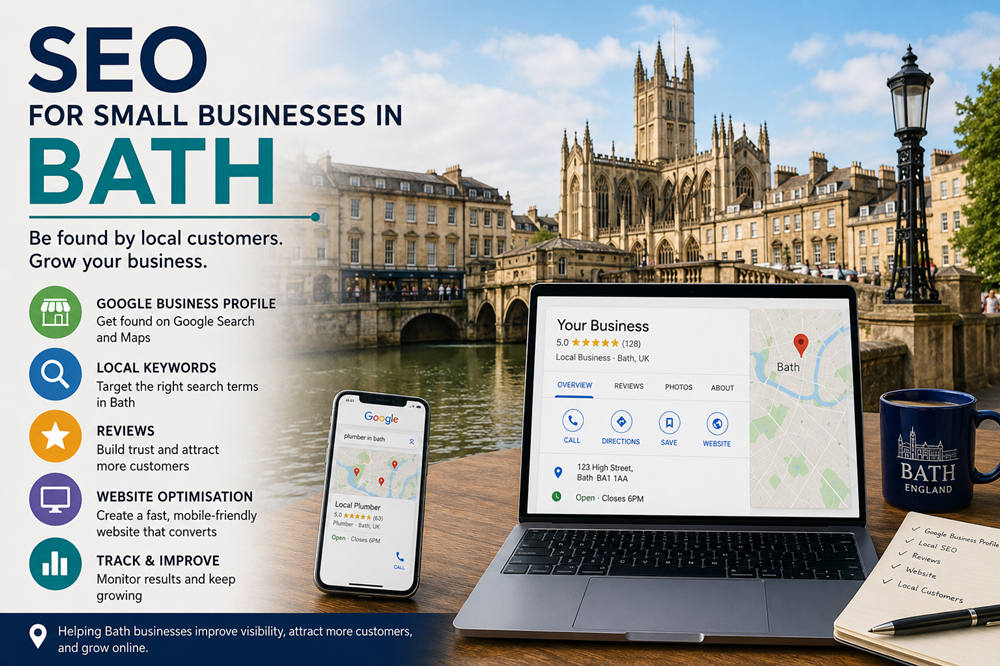
A great local business can still be easy to miss online. Someone may need a café near Bath Abbey, a plumber in Oldfield Park, a salon in the city centre, or an accountant for a small company in Bath. If your business does not show up when they search, they may choose another option simply because it appeared first.
That is why SEO matters. SEO for small business Bath is about helping nearby customers find your website, your Google Business Profile, your reviews, and your contact details at the moment they are ready to visit, book, call, or buy.
Bath has a busy local business scene. Bath BID’s directory includes more than 650 businesses in the city centre, covering hospitality, retail, offices, and local facilities. Bath is also a strong visitor destination, with Visit Bath covering attractions, accommodation, shopping, events, and places to eat. That means many local businesses are competing not only on service and reputation, but also on online visibility.
What SEO Means for a Small Business in Bath
SEO stands for search engine optimisation. In simple terms, it means improving your online presence so search engines can understand your business and show it to the right people.
For a small business in Bath, SEO usually has two sides:
- Local SEO, which helps your business appear in Google Maps and local search results.
- Website SEO, which helps your pages appear when people search for your services, products, or advice.
Local SEO is especially important because many people search with location in mind. They may type “near me,” “in Bath,” or the name of a specific area, such as Larkhall, Weston, Bathwick, Combe Down, or Oldfield Park.
Google explains that local ranking is mainly based on relevance, distance, and prominence. That means Google looks at how well your business matches the search, how close it is to the searcher, and how trusted or well-known it appears online.
Start With Your Google Business Profile
For many small businesses, the Google Business Profile is the most important local SEO asset. It is the listing that can appear in Google Maps and local search with your reviews, photos, opening hours, address, phone number, website, and directions.
A complete profile gives customers quick answers. It also helps Google understand what your business does and where it operates.
Check that your profile includes:
- Correct business name
- Accurate address or service area
- Current phone number
- Website link
- Opening hours
- Main business category
- Services or products
- Photos of your shop, team, work, food, rooms, products, or location
- Clear business description
According to Google’s own guidance on how to improve your local ranking, businesses with complete and accurate information are more likely to show up in relevant local searches.
Do not set it up once and forget it. Update seasonal hours, add fresh photos, reply to reviews, and check your details whenever something changes.
Use Bath Keywords Without Stuffing Them
Local keywords help connect your business with the area you serve. The goal is not to repeat “Bath” in every sentence. The goal is to describe your services clearly.
A vague line like “we provide professional solutions for modern clients” does not help much. A clearer line would be “tax and bookkeeping support for small businesses in Bath.”
Examples of useful local keywords include:
- Hair salon in Bath city centre
- Emergency plumber Bath
- Independent café near Bath Abbey
- Wedding photographer in Bath
- Small business accountant Bath
- Local SEO services Bath
- Beauty clinic in Bath
- Restaurant near the Roman Baths
Use these phrases naturally on your homepage, service pages, headings, title tags, image descriptions, and contact page. The writing should still sound human. Customers should feel like they are reading helpful information, not a list of search terms.
Build Pages for Your Main Services
Your homepage cannot do all the work. If you offer different services, create separate pages for the ones that matter most.
A Bath tradesperson might need pages for boiler repairs, emergency plumbing, bathroom installation, and heating services. A salon might need pages for haircuts, colour treatments, bridal hair, brows, and facials. A marketing consultant might need pages for SEO, content writing, website audits, and Google Business Profile support.
Each page should answer basic customer questions:
- What do you offer?
- Who is it for?
- Where do you provide it?
- What does the process look like?
- How can someone book or ask a question?
- Why should they trust you?
Google’s SEO Starter Guide explains that good SEO helps search engines crawl, index, and understand website content. Clear, focused pages make that easier.
Avoid creating lots of nearly identical pages just to target slightly different keywords. One useful page for “plumbing services in Bath” is stronger than five thin pages saying the same thing in different words.
Make Your Website Easy to Act On
Traffic is useful only if people know what to do next. A small business website should make action simple.
Your website should have:
- A visible phone number
- A clear booking button
- A short contact form
- Opening hours
- Service area details
- Prices or starting rates when helpful
- Reviews or testimonials
- Photos of real work, products, staff, or premises
- Directions or parking details if customers visit you
Think about the person searching on a phone. They may be walking through Bath, comparing two restaurants, trying to book a same-day appointment, or looking for a tradesperson during a stressful moment. Do not make them hunt for basic information.
Strengthen Your Contact Page
Many small business contact pages are too thin. A strong contact page can support trust and local SEO at the same time.
Include your business name, address, phone number, email, opening hours, map, and service areas. If you work across Bath and nearby neighbourhoods, say so clearly.
For example:
“We serve customers across Bath, including Bathwick, Weston, Larkhall, Oldfield Park, Combe Down, Widcombe, and nearby areas.”
This helps customers understand whether you cover their location. It also gives search engines clearer local context.
Ask for More Local Reviews
Reviews are one of the strongest trust signals for small businesses. A person choosing between two local companies often looks at star ratings, review text, review dates, and how the business responds.
BrightLocal’s Local Consumer Review Survey shows that online reviews remain a powerful driver of trust and decision-making for local businesses.
Ask happy customers for reviews after a good experience. This could be after a meal, appointment, completed project, delivery, consultation, repair, or purchase. Make it easy by sending a direct review link.
Reply to reviews too. Thank people for positive feedback. If a review is negative, stay calm and professional. A thoughtful response can show future customers that you care about service, not just ratings.
Use Trusted Local and Industry Listings
Business listings can support local SEO, but quality matters. Do not add your business to every random directory you find. Focus on trusted, relevant places.
Good options may include:
- Bath business directories
- Local business groups
- Tourism or hospitality listings, if relevant
- Professional associations
- Trade directories
- Industry-specific platforms
- Chamber or local enterprise resources
The most important detail is consistency. Your business name, address, phone number, and website should match across listings. If one site shows an old address and another shows a different phone number, customers may lose confidence.
Create Content Around Real Customer Questions
Blog posts and guides can help your website appear for more searches, but only when the content is useful. Do not publish generic posts just to fill space. Write about the questions your customers actually ask.
A Bath wedding supplier could write about how early couples should book local vendors. A restaurant could write about private dining in Bath. A café could create a guide to finding a quiet place for coffee and work. A tradesperson could explain what to do before calling an emergency plumber. A wellness clinic could answer questions about treatments, appointments, and aftercare.
Good local content does three things:
- Helps customers make decisions
- Shows your experience
- Gives search engines more context about your business
Keep it practical. A helpful article with local detail is more valuable than a long post full of vague advice.
Improve Mobile Speed and Usability
Many local searches happen on mobile. People want quick answers: Are you open? Where are you? Can they call now? Can they book online? Do you offer the service they need?
Your website should load quickly, look clean on a phone, and make buttons easy to tap. The text should be readable without zooming. Forms should be short. Your phone number should be clickable.
Mobile experience matters because local customers often make fast decisions. If your site is slow or confusing, they may go back to Google and choose someone else.
Track the Results That Matter
SEO should bring more than traffic. For a small business, the real goal is action: calls, bookings, visits, enquiries, directions, and sales.
Track simple numbers such as:
- Website clicks from Google
- Calls from your Google Business Profile
- Direction requests
- Contact form submissions
- Booking requests
- Review growth
- Search terms people use to find you
- Pages that bring in enquiries
Google Search Console can show how your site appears in search, what queries bring clicks, and which pages perform best.
Your Business Profile performance data can also help you understand how people interact with your business on Search and Maps.
Do not obsess over one keyword. A small business may get better results from ranking for several specific searches than from chasing one broad phrase.
Common SEO Mistakes to Avoid
Small businesses often struggle with SEO because the basics are unfinished. The good news is that most of these issues can be fixed.
Avoid these common mistakes:
- Leaving your Google Business Profile incomplete
- Using old opening hours
- Forgetting to add service areas
- Writing vague website copy
- Not mentioning Bath or nearby areas
- Ignoring reviews
- Creating duplicate service pages
- Having a slow mobile website
- Making contact details hard to find
- Adding your business to low-quality directories
- Expecting results overnight
SEO takes time, but it does not need to be overwhelming. Small, steady improvements can build stronger visibility month by month.
A Simple SEO Plan for Bath Small Businesses
Start with the foundations.
First, update your Google Business Profile. Add accurate details, strong photos, services, opening hours, and a clear description.
Second, improve your website pages. Make sure your homepage and service pages explain what you do, where you work, and how people can contact you.
Third, ask happy customers for reviews. Make this part of your normal follow-up process.
Fourth, check your local listings. Keep your name, address, phone number, and website consistent.
Fifth, create helpful content based on real customer questions.
Sixth, track calls, forms, bookings, and direction requests so you can see what is actually working.
This plan is simple, but it covers the parts of SEO that small businesses often need most.
Summary
SEO for small businesses in Bath is not about tricks or keyword stuffing. It is about helping the right local customers find you when they need what you offer.
Start with a complete Google Business Profile. Build clear service pages. Use Bath-based keywords naturally. Make your website easy to use on mobile. Ask for reviews. Keep your local listings consistent. Then track the actions that matter most: calls, bookings, visits, and enquiries.
Bath is a competitive city, but small businesses can still stand out online. The businesses that win local search are usually the ones that make themselves easy to find, easy to trust, and easy to contact.