
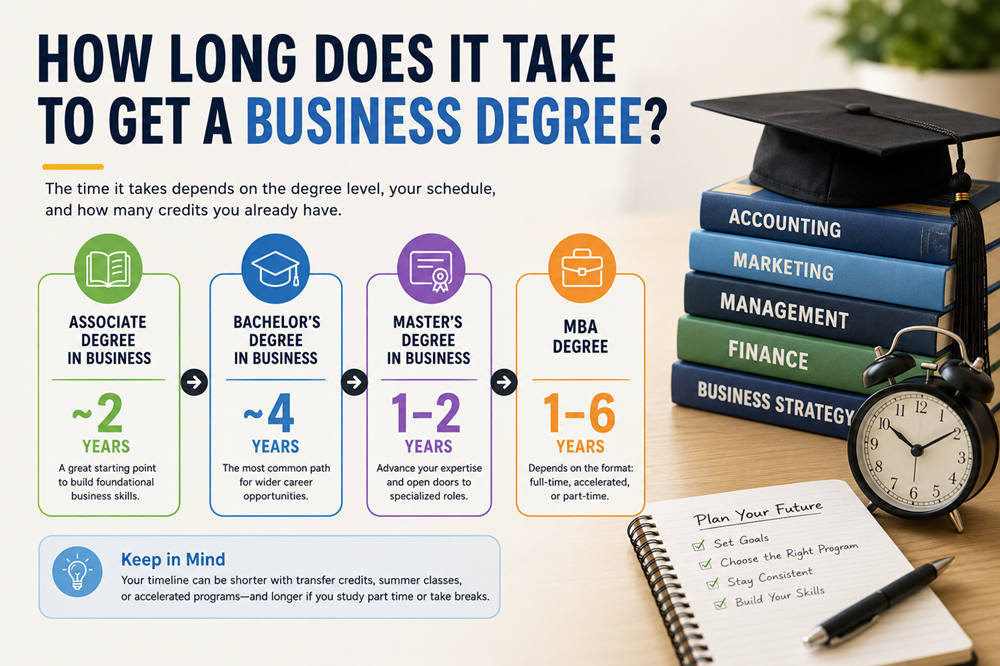
Most business degrees take two to four years, but the full timeline depends on the degree level, your schedule, and how many credits you already have. A full-time student may finish much faster than someone taking one or two classes at a time while working.
For a simple starting point, an associate degree in business usually takes about 2 years, a bachelor’s degree is usually planned as a 4-year path, and a graduate business degree often takes 1 to 2 additional years.
Business Degree Timeline at a Glance
Here is the basic timeline most students can expect:
- Associate degree in business: about 2 years
- Bachelor’s degree in business: about 4 years
- Master’s degree in business: often 1 to 2 years after a bachelor’s degree
- MBA: about 1 to 2 years for many full-time or accelerated programs, longer for part-time programs
These are standard timelines, not strict rules. Your path may be shorter if you transfer credits, take summer classes, or choose an accelerated program. It may be longer if you study part time, change majors, repeat courses, or pause school for work or family reasons.
Associate Degree in Business: About 2 Years
An associate degree is usually the shortest business degree path. It is often offered by community colleges, technical colleges, and career colleges. Some four-year universities also offer associate degrees.
A business associate degree usually covers the basics, such as accounting, marketing, management, business communication, economics, and computer applications. It can help you prepare for entry-level office, sales, administrative, or bookkeeping-related roles.
This path can also be a smart first step if you want to save money before earning a bachelor’s degree. Many students complete general education and introductory business courses at a community college, then transfer to a four-year school. The important part is planning. Not every class transfers cleanly, so it helps to check transfer rules before choosing courses.
Bachelor’s Degree in Business: About 4 Years
A bachelor’s degree is the most common business degree for students who want broader career options. It is usually designed as a four-year program, but some students finish sooner and others take longer.
A bachelor’s degree in business may be called business administration, management, accounting, finance, marketing, entrepreneurship, international business, supply chain management, or another related name. Most programs include general education classes, core business courses, electives, and sometimes a concentration.
Common business concentrations include:
- Accounting
- Finance
- Marketing
- Human resources
- Entrepreneurship
- Business analytics
- Operations management
- Supply chain management
- Management information systems
A full-time student usually has a better chance of finishing in four years. A part-time student may need five or six years, especially if they are working or caring for family while studying.
The timeline can also change if you transfer schools, switch majors, add a minor, or take fewer credits each semester. That does not mean you are behind. It simply means your degree plan has to fit your real life.
Master’s Degree in Business: Usually 1 to 2 Years
A master’s degree in business usually comes after a bachelor’s degree. Some programs are broad, while others focus on one skill area.
Common graduate business degrees include:
- Master of Business Administration
- Master of Accounting
- Master of Finance
- Master of Marketing
- Master of Business Analytics
- Master of Management
- Master of Human Resource Management
A focused master’s degree may be useful if you already know where you want to grow. For example, a Master of Accounting may help someone preparing for accounting-related goals, while a business analytics program may fit someone interested in data, reporting, and decision-making.
Some full-time master’s programs can be completed in about one year. Others take closer to two years. Part-time programs may take longer, but they can be easier to manage if you are working.
MBA Degree: About 1 to 6 Years, Depending on Format
An MBA is one of the most recognized graduate business degrees. It is often chosen by people who want to move into leadership, management, consulting, entrepreneurship, or higher-level business roles.
The timeline depends on the type of program you choose. A traditional full-time MBA is often a two-year program, while accelerated and part-time MBA formats can change the schedule. Accelerated programs may take about a year or a little longer, while part-time MBA programs can take several years.
That range is why format matters so much. A full-time MBA may be faster, but it often requires a bigger time commitment. A part-time MBA may take longer, but it can let you keep working while you study.
What Can Make a Business Degree Take Longer?
A program may advertise a two-year or four-year timeline, but real life can stretch the schedule. Common reasons include:
- Part-time enrollment: Taking fewer classes each term naturally extends the degree.
- Work responsibilities: Many students reduce their course load to balance school and income.
- Changing majors: A new major may come with new required courses.
- Transfer issues: Some credits may not count toward the new program.
- Course repeats: Retaking a required class can delay progress.
- Limited class availability: Some courses may only be offered once or twice a year.
- School breaks: Financial, health, family, or personal reasons can pause enrollment.
- Extra academic goals: A second major, minor, or certificate may add more classes.
The best way to avoid delays is to keep a clear degree plan and meet with an advisor before registering each term.
What Can Help You Finish Faster?
You may be able to shorten your business degree timeline with careful planning. Helpful options include:
- Transfer credits: Previous college credits may reduce the number of classes you need.
- Community college first: This can lower costs and help you complete basic requirements.
- Summer or winter classes: Extra terms can help you move through the program faster.
- Accelerated programs: Some schools offer shorter terms or faster degree tracks.
- Online courses: Flexible scheduling may make it easier to take classes year-round.
- Clear course planning: Choosing the right classes early can prevent wasted credits.
- Credit for prior learning: Some schools may offer credit for military training, exams, or work experience.
Faster is not always better, though. A heavy course load can become stressful if you are also working or managing family responsibilities. A steady pace is often more realistic than a rushed one.
Is an Online Business Degree Faster?
An online business degree can be faster, but it is not automatic. Some online programs follow the same semester schedule as campus programs. Others use shorter terms, flexible start dates, or year-round classes.
Online learning can be a good fit if you need flexibility. You may be able to study after work, avoid commuting, or take classes while living far from campus. That flexibility can help some students stay enrolled and finish sooner.
Before choosing an online business degree, check college accreditation carefully. Accreditation helps show that a college or university meets accepted quality standards, which matters for credit transfer, employer recognition, and future graduate study.
Is a Business Degree Worth the Time?
A business degree can be worth the time when it supports a clear goal. Business is a broad field, so the degree can lead in many directions: accounting, finance, marketing, sales, operations, project management, human resources, business analytics, entrepreneurship, or management.
According to the U.S. Bureau of Labor Statistics, business and financial occupations are projected to grow faster than the average for all occupations from 2024 to 2034. BLS also reports about 942,500 projected openings each year on average in this group, with a median annual wage of $80,920 in May 2024.
That does not mean a business degree guarantees a high-paying job. Your results will depend on your experience, location, internships, technical skills, communication skills, and the type of role you pursue. The degree is most useful when you pair it with practical experience and a clear career direction.
Which Business Degree Timeline Is Right for You?
The right path depends on what you need from school.
Choose an associate degree if you want a shorter, lower-cost starting point. This can work well if you want to enter the workforce sooner or transfer later.
Choose a bachelor’s degree if you want broader career options. For many business roles, this is the degree employers are most likely to expect.
Choose a master’s degree or MBA if you already have a bachelor’s degree and want to build leadership skills, specialize, or move into higher-level roles.
Choose a part-time program if flexibility matters more than speed. It may take longer, but it can make school possible while you work.
Choose an accelerated program if finishing quickly is your priority and you can handle a heavier workload.
Summary
So, how long does it take to get a business degree? For most students, the answer is about 2 years for an associate degree, about 4 years for a bachelor’s degree, and 1 to 2 more years for many graduate business degrees. An MBA may take around a year in an accelerated format, about two years full time, or several years part time.
The best timeline is not always the fastest one. It is the one that fits your budget, schedule, energy, and career goals. A business degree can open useful doors, but the real value comes from choosing the right program and building skills you can actually use after graduation.