
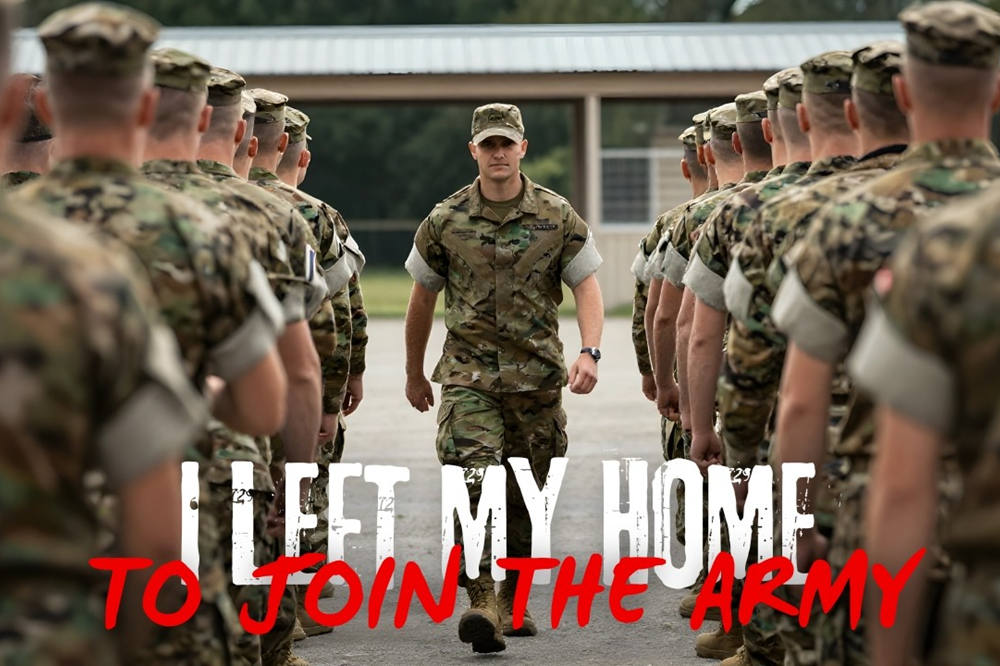
“I Left My Home” is a military cadence about the personal cost of leaving family to serve. Its call-and-response structure sounds simple, but the story carries fear, pride, duty, and grief.
The cadence is strongly associated with the U.S. Army, although different units and performers have adapted it over the years. Jonathan Michael Fleming recorded a widely heard version for his 2022 album Cadences Volume 1. The full words are available on his official “I Left My Home” lyrics page.
What Does “I Left My Home” Mean?
The cadence follows a service member as he says goodbye to his family before joining the Army. Each person reacts differently, showing that enlistment affects an entire household—not only the person who leaves.
The central themes are:
- Separation from family
- Fear about the dangers of military service
- Pride in choosing to serve
- The transition from civilian life to becoming a soldier
- The sacrifices made by spouses, children, and parents
The narrator continues with his decision even though he can see how deeply it hurts the people he loves.
The Meaning Behind the Family Goodbyes
The cadence moves through several short family scenes. Together, they show different sides of the same departure.
The Mother
The narrator’s mother cries because she is afraid for her child. Her reaction reflects the worry many parents feel when a son or daughter enters military service.
She may be proud of his decision, but pride does not remove the fear that he could be injured or killed. Her goodbye represents the emotional burden carried by military parents who cannot control what happens after their child leaves.
The Wife
The narrator’s wife watches him leave and fears that he may not return.
Her part of the story highlights the uncertainty military spouses often face. While the service member begins training or deployment, the partner at home must manage daily life while dealing with distance and worry.
The scene is brief, but it shows that military service can place real pressure on a marriage.
The Son
The narrator’s young son does not fully understand why his father is leaving. He only knows that someone important is going away.
This part gives the cadence much of its emotional weight. Children of service members may experience long absences, missed birthdays, holidays, school events, and ordinary time together.
For the child, ideas such as duty and national service may be difficult to understand. The loss feels much more immediate: his father will no longer be at home.
The Father
The narrator’s father responds with a handshake and recognizes that his son has become a man.
His reaction is more restrained than the others, but that does not mean he feels less. The handshake expresses pride, respect, and acceptance while possibly hiding his own concern.
It also marks a change in the relationship. The son is no longer simply being protected by his father. He is taking on adult responsibilities and preparing to serve alongside other soldiers.
The Main Themes of the Cadence
Duty Versus Family
The main conflict is between the narrator’s commitment to serve and his love for his family.
He does not leave because home means nothing to him. He leaves even though home means everything to him. That is what makes the choice painful.
The cadence does not claim that military service is easy or emotionally clean. It shows that someone can believe in a duty while still grieving what must be left behind.
Pride and Fear
The family’s reactions contain both pride and fear.
The father appears proud of his son’s maturity. The mother, wife, and child focus more openly on the danger and separation. These feelings are not contradictory. A family can support a service member while still wishing that the person did not have to leave.
Growing Into a New Identity
Leaving home also represents the narrator’s transition into military life.
At home, he is a son, husband, and father. In the Army, he will also become a soldier expected to follow orders, work as part of a unit, and accept responsibilities that may place him in danger.
The cadence captures the moment between those two identities.
Why Military Cadences Use Call and Response
Military cadences are designed to be repeated by a group while marching or running. A cadence caller delivers a line, and the formation answers.
This structure helps service members:
- Maintain a steady rhythm
- Move together as a unit
- Control breathing during physical training
- Build morale and group identity
- Distract from fatigue during long runs or marches
In “I Left My Home,” the repeated lines also strengthen the story. One person begins the goodbye, but many voices answer. The narrator’s private experience becomes something shared by the group.
That shared response matters because many service members understand what it means to leave family, friends, and familiar routines behind.
A Brief History of Military Cadences
Military forces have used songs, chants, drums, and rhythmic calls for centuries to organize movement.
According to the U.S. Army Center of Military History, the modern American jody call is often connected to Private Willie Lee Duckworth. In 1944, Duckworth used a rhythmic chant while marching with other soldiers at Fort Slocum, New York.
His call combined military counting with call-and-response traditions. Other soldiers repeated it, and the style spread through the Army.
Over time, cadences developed around many subjects, including training, homesickness, relationships, humor, military pride, and the realities of combat. Since they were often passed from one group to another by word of mouth, the wording could change between units and generations.
Is “I Left My Home” a Traditional Cadence?
Jonathan Michael Fleming has stated that he did not write the original cadence. On his official page, he describes it as a piece passed down through generations of service members and says the original author is unknown to the best of his knowledge.
That history explains why different versions exist. A cadence caller may change a line, add a verse, rearrange the order, or adapt the branch named in the song.
As a result, people may hear slightly different words while still recognizing the same basic story and rhythm.
Jonathan Michael Fleming’s Version
Jonathan Michael Fleming helped bring “I Left My Home” to a much larger audience through his recorded performance.
His version appears on Cadences Volume 1, released in 2022. It keeps the traditional call-and-response sound rather than turning the cadence into a conventional pop song.
The recording became especially popular online, where military cadences often reach veterans, active-duty service members, military families, and civilian listeners. Fleming’s performances also help preserve material that was traditionally shared during training rather than through commercial recordings.
The Rap Adaptation
Some people searching for “I left my home to join the Army lyrics” may be looking for a rap track rather than Fleming’s traditional cadence recording.
MJHanks released a song titled “I Left My Home” featuring Topher and The Marine Rapper. The track uses the familiar cadence as a foundation but adds original rap verses about military life, identity, sacrifice, and service.
The two versions are related but not identical:
- Fleming’s recording presents the traditional cadence in call-and-response form.
- The MJHanks version expands the idea into a full hip-hop track.
Knowing the difference can help listeners find the version they remember.
Why the Cadence Remains Powerful
“I Left My Home” stays with listeners because it focuses on familiar family moments rather than giving a long speech about courage or patriotism.
A mother cries. A wife watches her husband leave. A child does not understand. A father offers a final sign of respect.
These scenes make military sacrifice feel personal. They show that enlistment is not only about uniforms, training, or service. It also involves people waiting at home.
The cadence respects the narrator’s decision without pretending that the goodbye is easy. Its message is clear: serving may bring purpose and pride, but it can also require painful separation from the people who matter most.
Featured image source: https://www.youtube.com/watch?v=piij5lcB5kE