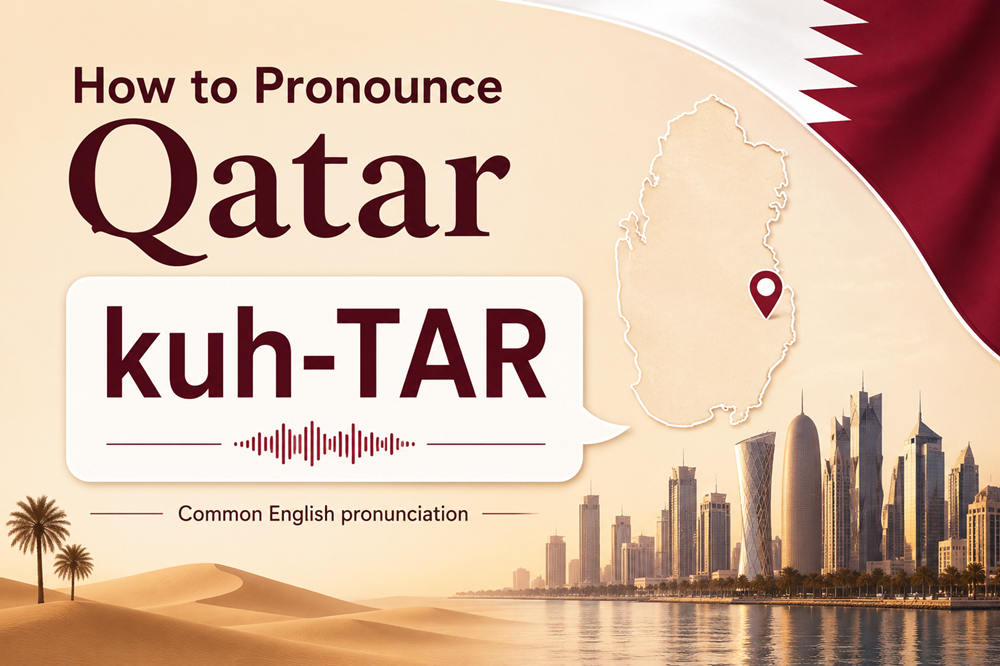
The most common English pronunciation of Qatar is:
kuh-TAR
The first syllable is short and soft, while the second syllable receives more emphasis. Say it naturally as kuh-TAR, without adding a “w” sound after the Q.
You can also listen to the pronunciation on the Visit Qatar website.
What Is Qatar?
Qatar is a country on the Arabian Peninsula in the Middle East. Its capital and largest city is Doha. The country shares a land border with Saudi Arabia and is surrounded by the Arabian Gulf on its other sides.
More geographical information is available from Qatar’s Ministry of Foreign Affairs.
In English, Qatar is a proper noun, so it should always begin with a capital letter.
The easiest way to remember the pronunciation is to divide it into two parts: a soft kuh followed by a stronger TAR.
Break Qatar Into Two Syllables
Qatar has two syllables:
kuh + TAR
Start by saying each part separately:
- kuh — a quick, relaxed sound
- TAR — similar to the English word “tar”
Then bring them together:
kuh-TAR
Keep the first part light and place the stress on the second syllable.
Are There Different Ways to Pronounce Qatar?
You may hear several English pronunciations of Qatar, including versions that sound like:
- kuh-TAR
- KUH-tah
- KAH-ter
- cutter
These differences often come from regional accents. For example, American speakers usually pronounce the final “r,” while many British speakers use a softer ending.
The Cambridge Dictionary provides both British and American audio examples.
Although the pronunciations vary, kuh-TAR is a simple and widely understood choice in English.
How Is Qatar Pronounced in Arabic?
Qatar is written قطر in Arabic.
The original Arabic pronunciation includes sounds that do not have exact English equivalents. The first consonant is produced farther back in the mouth than a normal English “k,” and the middle consonant has a stronger sound than an ordinary English “t.”
For that reason, kuh-TAR should be understood as an English approximation rather than an exact copy of the Arabic pronunciation.
You do not need to reproduce every Arabic sound perfectly in an English conversation. A clear kuh-TAR will usually be understood.
Is Qatar Pronounced “Cutter”?
Some English speakers pronounce Qatar in a way that sounds close to “cutter.” This is another attempt to approximate the Arabic name using familiar English sounds.
However, saying kuh-TAR is often easier for learners and is commonly used in international English.
The important thing is to avoid pronouncing the name according to the usual English “qu” spelling rules.
Common Pronunciation Mistakes
Saying “KAY-tar”
Do not pronounce the first letter like the name of the letter Q.
Incorrect:
KAY-tar
Better:
kuh-TAR
Adding a “W” Sound
In English words such as “queen,” “quick,” and “question,” the letters “qu” create a “kw” sound. Qatar comes from Arabic, so that spelling rule does not apply.
Avoid saying:
kwah-TAR
There should be no strong “w” sound.
Putting Too Much Stress on the First Syllable
The first syllable should be quick and relaxed. The stronger sound comes at the end:
kuh-TAR
Trying Too Hard to Copy the Arabic Accent
It is helpful to know that the Arabic pronunciation differs from the English version, but forcing unfamiliar sounds can make the word less clear. Begin with the standard English pronunciation and focus on speaking naturally.
How to Pronounce Qatari
Qatari describes a person or something connected with Qatar.
It is commonly pronounced:
kuh-TAR-ee
Examples include:
- Qatari culture
- Qatari food
- a Qatari athlete
- the Qatari government
Qatar and Qatari are used differently:
- “She lives in Qatar.”
- “She is Qatari.”
- “We tried traditional Qatari food.”
Do not use “Qatar” as the name for a person. Someone from Qatar is called a Qatari.
Practice Saying Qatar
A simple way to practise is to begin with the strongest syllable.
First, say:
tar
Next, add the short first syllable:
kuh-TAR
Repeat it a few times at a comfortable speed. Then use the word in complete sentences:
- “Doha is the capital of Qatar.”
- “My friend recently travelled to Qatar.”
- “Qatar is located on the Arabian Peninsula.”
- “They attended a conference in Qatar.”
- “She is learning about Qatari culture.”
Practising the name inside a sentence will make it sound more natural than repeating it by itself.