
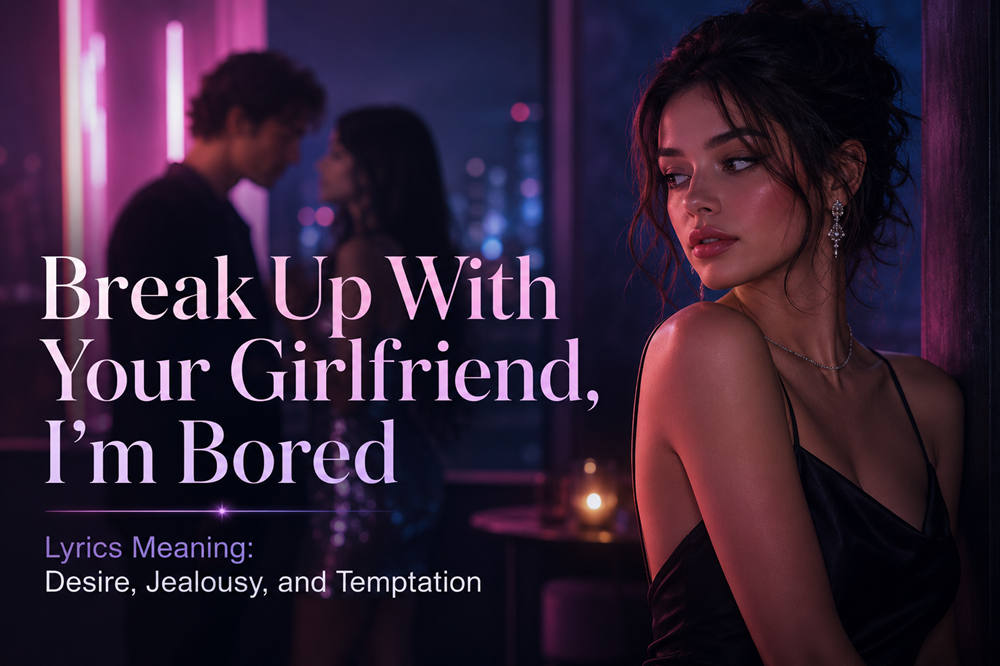
Ariana Grande’s “Break Up With Your Girlfriend, I’m Bored” turns an uncomfortable romantic impulse into a bold pop song. You can read the song’s full lyrics here before exploring their meaning. The narrator meets someone she finds attractive, discovers that he already has a girlfriend, and wishes he would end that relationship.
The title makes her request sound casual and almost humorous, but the song is built around stronger emotions: desire, jealousy, impatience, and the excitement of wanting someone unavailable.
Released in 2019 on Grande’s album Thank U, Next, the track does not present its narrator as innocent or morally right. Instead, it lets her say the selfish thought out loud without disguising it as a perfect love story.
What Is “Break Up With Your Girlfriend, I’m Bored” About?
The song is about being attracted to someone who is already in a relationship.
The narrator notices a man, feels an immediate connection to him, and becomes frustrated when she realizes he is unavailable. Rather than stepping away, she imagines him leaving his girlfriend so they can be together.
Her attraction appears to be based mostly on chemistry and physical desire. She does not describe a deep bond or a long history with him. She simply wants him and dislikes the fact that another person stands in the way.
That makes the song less about love and more about temptation. It captures the moment when desire takes over before patience, responsibility, or consequences enter the picture.
Why Does She Say “I’m Bored”?
The phrase “I’m bored” gives the song its careless attitude.
Ending a relationship is a serious decision, yet the narrator offers boredom as her reason for wanting it to happen. The contrast is intentionally dramatic. She is asking someone to disrupt an existing relationship because she wants excitement and attention.
However, “bored” may not be completely literal. It can also suggest emotional restlessness. The narrator is searching for something new, and an unavailable person creates instant tension.
Wanting someone who is already taken can feel more exciting because there is an obstacle involved. The situation becomes a challenge rather than a normal romantic connection.
Calling herself bored also helps the narrator appear detached. She acts as though the man is only a temporary distraction, even while her jealousy suggests that she is more affected than she wants to admit.
Desire, Jealousy, and Competition
The narrator’s attraction quickly becomes competitive.
Once she learns about the girlfriend, she does not view the relationship from the couple’s perspective. She sees the girlfriend mainly as the reason she cannot get what she wants.
This is one of the song’s most deliberately selfish elements. The narrator is focused on her own feelings, not on the pain her request could cause.
Still, expressing an emotion in a song is not the same as recommending it in real life. Research into music and emotional experience shows how songs can evoke and help people process a wide range of feelings, including desire, anxiety, defiance, and sadness.
Many listeners can recognize the feeling of being attracted to someone unavailable, even if they would never interfere with that person’s relationship. The song exaggerates that private thought and turns it into a confident demand.
Desire Is Not the Same as Love
The narrator wants the man, but the song offers little evidence that she loves him.
Her feelings are immediate and driven by attraction. She has not built trust with him, learned about his values, or developed the kind of emotional connection that usually supports a lasting relationship.
What she wants is access to him. She wants the obstacle removed so the fantasy can become possible.
That difference is important. Love usually involves patience and concern for another person’s well-being. Desire can be more focused on the present: wanting someone because they are attractive, exciting, or difficult to obtain.
This intense but undeveloped attraction is closer to infatuation. Cleveland Clinic’s explanation of limerence and love similarly distinguishes obsessive longing from a mutual relationship built on intimacy and commitment.
The song stays firmly in that impulsive space. It is interested in the rush of temptation, not in what a real relationship between the two people might look like afterward.
Is the Narrator Confident or Insecure?
On the surface, the narrator sounds highly confident. She assumes that the man could want her and speaks as though his current relationship can be easily replaced.
Yet her confidence may not be as secure as it first appears.
She becomes preoccupied with someone she barely knows and reacts strongly when she cannot have his full attention. Her frustration may suggest that she is not accustomed to being denied what she wants.
There may also be an element of validation. Being chosen over the girlfriend would confirm that the narrator is desirable. However, the song does not explain her motives clearly enough to make this the only interpretation.
Her attitude can therefore be read in two ways: as fearless confidence or as confidence used to cover jealousy and uncertainty.
The Music Video Adds Another Meaning
The official music video makes the story more complicated.
Grande appears attracted to a man who is dating a woman styled to look noticeably similar to her. This resemblance creates a mirrored effect, as though the narrator is watching another version of herself.
Near the end, her attention appears to move toward the girlfriend rather than remaining entirely focused on the man. That shift has led to several interpretations.
Some viewers read the ending as a sign that the narrator was attracted to the girlfriend. Others see the girlfriend as a reflection of Grande’s character, turning the video into a story about self-recognition or identity.
The repeated similarities between the two women may also suggest that the narrator is chasing an image of herself. Instead of simply wanting another woman’s boyfriend, she may be drawn to a situation that reflects her own desires and insecurities.
The video does not confirm one clear explanation. Its ambiguity gives the song more depth than the provocative title suggests.
Is the Song Meant to Be Taken Seriously?
The song works best as an exaggerated fantasy rather than relationship advice.
Its title is so blunt that it immediately feels playful and provocative. Grande performs from the perspective of someone who says the inappropriate thought instead of filtering it.
The narrator understands that the man has a girlfriend. She also appears aware that her desire is unreasonable. She simply does not care enough to hide it.
That self-awareness is part of the humor. The song does not try to convince listeners that interfering in a relationship is romantic, noble, or justified. It presents the fantasy in its most unapologetic form.
Listeners can enjoy the confidence and drama without agreeing with the behavior.
Why the Song Connected With Listeners
Part of the song’s appeal comes from its honesty.
Attraction does not always arrive at a convenient time. People may feel drawn to someone who is unavailable, incompatible, or simply wrong for them. Having the feeling does not mean they must act on it.
“Break Up With Your Girlfriend, I’m Bored” gives that forbidden attraction a catchy and exaggerated voice. Instead of softening the emotion, it leans into its selfishness.
The song also fits the emotional world of Thank U, Next, an album that explores relationships without pretending that every feeling is mature or easy to explain. Confidence, loneliness, desire, humor, and emotional confusion often exist beside one another.
Here, the narrator can sound powerful while still being driven by jealousy. She can claim to be bored while clearly feeling fascinated. Those contradictions make the song more interesting than a simple story about stealing someone’s boyfriend.
Final Meaning
“Break Up With Your Girlfriend, I’m Bored” is about wanting someone who is already taken and allowing desire to speak before reason does.
The narrator treats the situation casually, but her jealousy reveals that she is emotionally invested. She wants excitement, attention, and the satisfaction of getting something that is currently unavailable.
The song does not portray that impulse as healthy love. It presents it as a bold, selfish fantasy—one made more complex by a music video that raises questions about attraction, identity, and self-image.