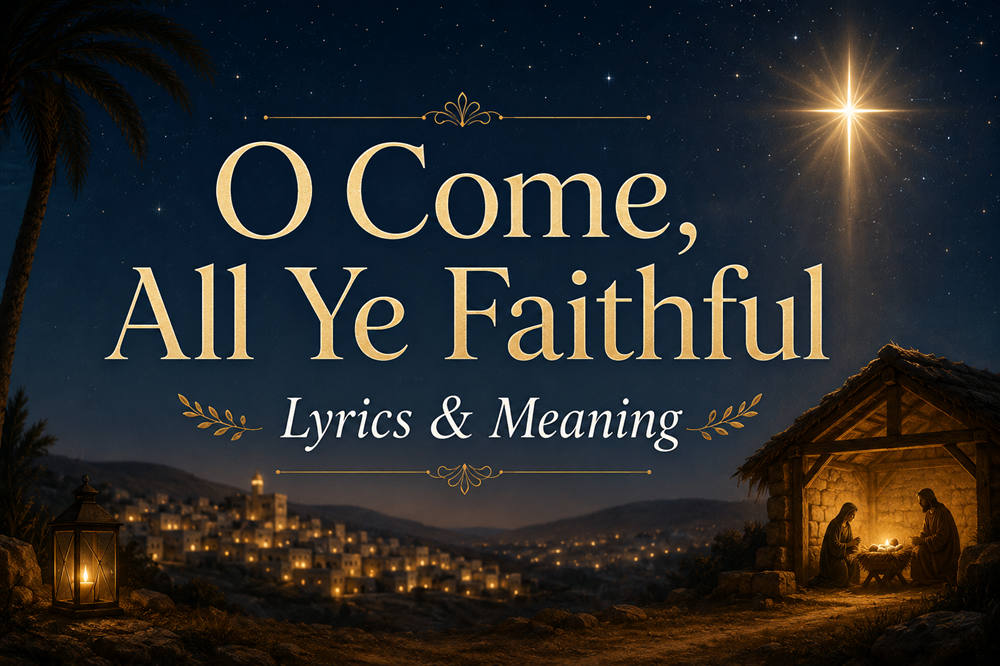
“O Come, All Ye Faithful” is one of the most joyful and recognizable Christmas hymns. From its opening line, it invites listeners to travel in spirit to Bethlehem, see the newborn Jesus, and join the angels in worship.
The hymn was first widely known by its Latin title, “Adeste Fideles.” Its familiar refrain, “O come, let us adore Him,” gives the song a clear purpose: Christmas is not only a story to remember but also a reason to celebrate.
O Come, All Ye Faithful Lyrics
Verse 1
O come, all ye faithful,
Joyful and triumphant,
O come ye, O come ye to Bethlehem;
Come and behold Him,
Born the King of angels;
Refrain
O come, let us adore Him,
O come, let us adore Him,
O come, let us adore Him,
Christ the Lord.
Verse 2
God of God,
Light of Light,
Lo, He abhors not the Virgin’s womb;
Very God,
Begotten, not created;
Refrain
O come, let us adore Him,
O come, let us adore Him,
O come, let us adore Him,
Christ the Lord.
Verse 3
Sing, choirs of angels,
Sing in exultation;
Sing, all ye citizens of heaven above!
Glory to God,
All glory in the highest;
Refrain
O come, let us adore Him,
O come, let us adore Him,
O come, let us adore Him,
Christ the Lord.
Verse 4
Yea, Lord, we greet Thee,
Born this happy morning;
Jesus, to Thee be all glory given;
Word of the Father,
Now in flesh appearing;
Refrain
O come, let us adore Him,
O come, let us adore Him,
O come, let us adore Him,
Christ the Lord.
Some hymnals include additional verses or slightly different wording. The commonly sung English version is in the public domain, and more versions can be found through Hymnary.org.
What Does “O Come, All Ye Faithful” Mean?
The hymn invites believers to respond to the birth of Jesus with joy and worship. The repeated word “come” makes the song feel personal. Rather than describing Bethlehem from a distance, it asks each singer to enter the scene.
The opening verse reflects the journey of the shepherds in the Gospel of Luke. After hearing the angels’ announcement, they went to Bethlehem to see the child for themselves.
The hymn encourages the same kind of response. It asks listeners to pause, approach the Christmas story with fresh attention, and recognize why the child in the manger matters.
The faithful are called “joyful and triumphant” because Christ’s birth represents hope. The word “triumphant” does not suggest that life is free from pain or difficulty. It points to the Christian belief that God has kept His promise and that the Savior has come.
“Come and Behold Him, Born the King of Angels”
The first verse presents one of the central contrasts of the Christmas story. Jesus appears as a vulnerable baby, yet the hymn calls Him the “King of angels.”
There is no royal palace, public ceremony, or display of earthly power. Instead, the King is found in humble surroundings in Bethlehem.
“Behold” means more than simply looking. It suggests paying close attention and recognizing the importance of what is being seen. The hymn asks listeners to look beyond the manger and understand the identity of the child.
This contrast between humility and kingship is part of what gives the hymn its emotional power. The newborn Jesus looks small and ordinary, but the song declares that His birth has meaning for both earth and heaven.
Why Does the Refrain Repeat “O Come, Let Us Adore Him”?
The refrain repeats the same invitation three times:
“O come, let us adore Him.”
The repetition allows the meaning to settle in and gives the congregation a shared response to each verse. The verses describe who Jesus is, while the refrain answers with worship.
In this context, “adore” means to honor, love, and worship Christ as Lord. It is deeper than simply admiring the beauty of the Nativity scene.
The phrase “let us” is also important. The hymn does not describe worship as a private act. It welcomes everyone to join together. That communal feeling helps explain why the song works so well in churches, schools, choirs, and family Christmas gatherings.
“God of God, Light of Light”
The second verse uses language connected to the Nicene Creed, an early Christian statement about the nature of Jesus.
“God of God” and “Light of Light” express the belief that Jesus is fully divine. The hymn does not present Him only as a wise teacher, prophet, or important historical figure. It identifies Him as God entering human life.
The line “begotten, not created” also comes from the language of the Nicene Creed. In traditional Christian teaching, it means that Christ is not a created being. He shares the divine nature of God.
These phrases give the hymn more theological depth than its cheerful melody may first suggest. It is both a Christmas celebration and a statement of Christian belief.
What Does “He Abhors Not the Virgin’s Womb” Mean?
This line can sound confusing because it uses older English.
“Abhors not” means “does not reject” or “does not refuse.” The verse is saying that Christ willingly accepted human birth through the Virgin Mary.
The line emphasizes the humility of the Incarnation. According to Christian belief, Jesus did not remain distant from human weakness or ordinary physical life. He entered the world as a baby and experienced human life from birth.
The wording may feel unusual today, but its message is simple: Christ willingly became human.
“Sing, Choirs of Angels”
The third verse moves from the stable in Bethlehem to a much larger heavenly celebration.
It reflects the angelic announcement in Luke 2, when a multitude of angels praised God and declared, “Glory to God in the highest.”
The hymn invites the singers to join that praise. The “choirs of angels” and “citizens of heaven” show that Jesus’ birth is not only a local event taking place in a small town. It has heavenly importance.
This verse also gives the song its triumphant sound. The worship grows from a quiet invitation to “come and behold” into a full chorus of praise.
“Word of the Father, Now in Flesh Appearing”
The final commonly sung verse connects the Nativity story to the opening chapter of the Gospel of John.
John describes Jesus as “the Word” who was with God and was God. He later writes that “the Word became flesh.”
The phrase “Word of the Father, now in flesh appearing” refers to the Incarnation—the Christian belief that God became human in Jesus.
The line explains why the child in the manger receives such honor. The hymn presents Him as the eternal Word made visible in human form.
This verse brings the hymn’s message together. The newborn child is the King of angels, the Light of Light, and the Word of the Father. The natural response is the repeated refrain: “O come, let us adore Him.”
The History of O Come, All Ye Faithful
The exact origins of “O Come, All Ye Faithful” are not completely certain. The earliest surviving versions were written in Latin under the title “Adeste Fideles.”
John Francis Wade, an English hymn writer and music copyist, is commonly associated with the hymn. A version appeared in a collection he published in 1751, although historians have debated whether he wrote the words and melody himself or copied an earlier work.
The English version developed during the 19th century. Frederick Oakeley is usually credited with the familiar translation beginning, “O come, all ye faithful, joyful and triumphant.”
Over time, different translators produced additional English verses. This is why the number and wording of the verses may vary between hymnals.
The strong melody has helped the hymn remain popular. It begins with a confident invitation and builds naturally toward the refrain, making it suitable for both small gatherings and large choirs.
The Main Message of the Hymn
“O Come, All Ye Faithful” brings the central parts of the Christmas story together: Bethlehem, the newborn Jesus, the angels’ praise, and the belief that God has entered the world in human form.
Its message is both simple and meaningful. Come to Bethlehem. Look closely at the child. Understand who He is. Then join others in worship.
That invitation has kept the hymn alive for generations. Each Christmas, its refrain gives people of different ages and backgrounds the same words with which to celebrate:
“O come, let us adore Him, Christ the Lord.”