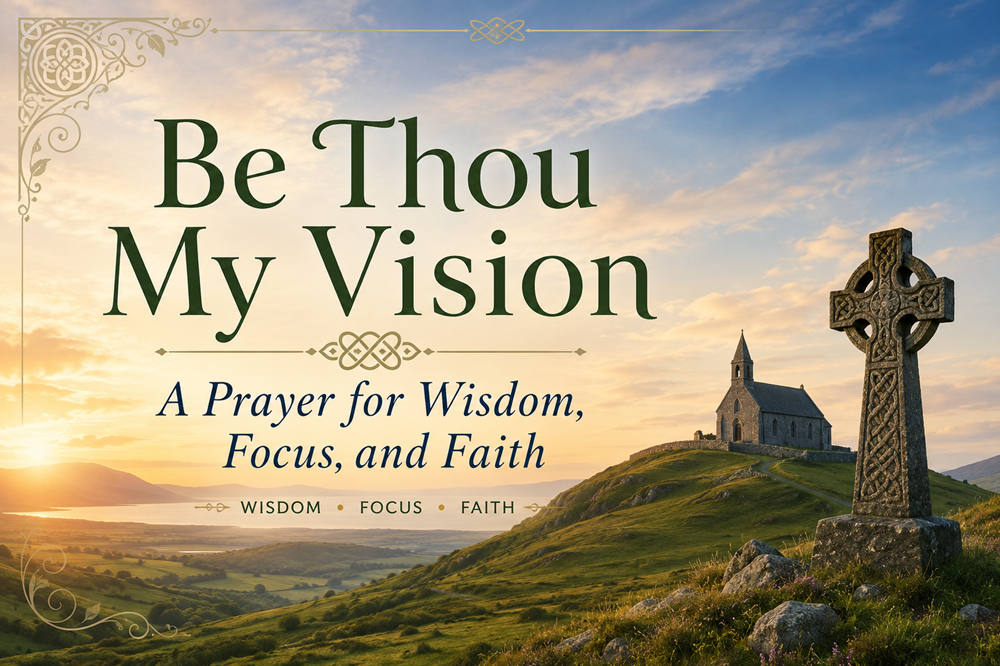
“Be Thou My Vision” is an ancient Irish Christian prayer about keeping God at the center of life. Instead of asking for wealth, comfort, or an easy path, the singer asks for wisdom, protection, spiritual direction, and a faithful heart.
You can read Eleanor Hull’s familiar 1912 English version on Hymnary’s “Be Thou My Vision” page.
What Does “Be Thou My Vision” Mean?
The title is a request for God to guide the way the singer sees the world.
“Vision” does not refer only to physical sight. It represents perspective, judgment, direction, and purpose. The singer wants faith to shape every decision rather than being led by fear, pride, ambition, or public approval.
The hymn also treats spiritual focus as something needed throughout the day. God is not presented as someone to remember only during worship or difficult moments. His presence is meant to influence ordinary thoughts, relationships, choices, and responsibilities.
God as Wisdom and Truth
The hymn moves naturally from vision to wisdom. Seeing the right path means little without the understanding and courage to follow it.
When the singer asks God to be both wisdom and the “true Word,” the phrase can suggest dependable divine truth. In Christian belief, it may also call to mind Christ as the Word of God.
Human opinions change, emotions can cloud judgment, and popular ideas are not always wise. The hymn asks for something steadier: truth that does not depend on circumstances or social approval.
The language also becomes deeply personal. God is described as a father who remains close to his child and lives within the believer. This is not a distant relationship based only on rules. It is a prayer for closeness, guidance, and belonging.
Protection During Life’s Struggles
Some versions of the hymn include images of a shield, sword, shelter, armor, and strong tower.
These images come from the language of battle, but the struggle does not have to be physical. It can represent temptation, grief, doubt, injustice, disappointment, or the pressure to compromise personal convictions.
A shield suggests protection. A sword suggests courage and the ability to respond. Shelter and a strong tower represent safety when life feels unstable.
The hymn does not promise that faithful people will avoid hardship. It asks that God remain their source of strength when hardship arrives.
Riches, Praise, and True Treasure
One of the hymn’s clearest messages is that wealth and human praise should not become the center of a person’s identity.
The words do not necessarily condemn money, achievement, or recognition. They challenge the belief that these things can provide lasting security.
Money can be lost. Success can become exhausting to maintain. Public admiration can disappear as quickly as it arrives. A person who depends completely on these things may never feel satisfied.
The singer chooses a different kind of treasure. Instead of measuring life by possessions or status, the hymn presents a relationship with God as the greater inheritance.
This message remains relevant in a culture where people are often judged by income, appearance, productivity, popularity, and online attention. The hymn offers freedom from the constant need to prove personal worth.
The Meaning of “High King of Heaven”
“High King of Heaven” is a title of authority and majesty. It presents God as the ruler above every earthly power.
Yet the hymn does not describe this King as cold or distant. He is also called the singer’s treasure and the deepest love of the heart. The powerful and personal sides of faith appear together.
The final part of the hymn looks toward heaven and asks for joy beyond the struggles of earthly life. Its hope is not based on personal achievement but on remaining close to God.
What Does “Heart of My Own Heart” Mean?
“Heart of my own heart” expresses complete closeness and devotion.
The heart traditionally represents a person’s love, desires, identity, and will. Calling God the heart within one’s heart means that he is not simply one interest among many. He is the center beneath everything else.
The phrase also makes the hymn more intimate. Earlier images describe God as a king, shield, sword, tower, and source of wisdom. Here, the prayer becomes quieter and more personal.
The singer asks for that relationship to remain steady “whatever befall”—regardless of success, disappointment, uncertainty, or loss. Faith is not limited to moments when life feels comfortable or prayers are answered quickly.
The History of “Be Thou My Vision”
The hymn is based on an anonymous Early Middle Irish prayer called Rop tú mo baile. It has traditionally been attributed to the sixth-century poet Dallán Forgaill, but the surviving text is generally considered much later. The University College Cork’s CELT collection identifies the author as unknown and preserves an edited version of the early Irish text.
Mary Elizabeth Byrne translated the prayer into English prose for the Irish academic journal Ériu in 1905. Eleanor Hull then adapted Byrne’s translation into verse and published it in The Poem-Book of the Gael in 1912. Hull’s version became the foundation for the hymn commonly sung today.
Modern hymnals do not always include the same stanzas. Some omit the verse containing the battle imagery, while others alter individual words or adjust the meter. This explains why listeners may encounter slightly different versions.
The Story Behind the “Slane” Melody
“Be Thou My Vision” is usually sung to the traditional Irish melody known as “Slane.”
The folk tune appeared in Patrick W. Joyce’s Old Irish Folk Music and Songs in 1909. It was paired with the hymn in a 1919 Church of Ireland hymnal, and David Evans later created an arrangement that appeared in the 1927 Church Hymnary.
The name “Slane” refers to Slane Hill in County Meath, Ireland. According to Christian tradition, Saint Patrick lit an Easter fire there in defiance of the ruling king.
The melody feels gentle but strong, which suits the hymn’s message. It carries the calmness of a personal prayer while still giving weight to its language of courage, loyalty, and spiritual victory.
Why the Hymn Still Feels Relevant
“Be Thou My Vision” speaks to anyone who feels distracted, uncertain, or pressured to build an identity around success.
Modern life offers endless demands for attention. Work, money, comparison, social media, personal goals, and other people’s expectations can easily compete for control of the heart.
The hymn does not provide a detailed plan for solving every problem. It begins with a more basic question: What deserves to guide everything else?
Its answer is consistent. Wisdom matters more than popularity. Faithfulness matters more than recognition. God’s presence matters more than temporary security.
That is why the hymn is often meaningful during weddings, funerals, graduations, illnesses, and major life changes. It expresses both trust and need: a commitment to follow God and an honest request for help doing so.
Final Thoughts
“Be Thou My Vision” is a prayer for a life directed by faith rather than fear, wealth, pride, or approval.
It asks God to provide wisdom for decisions, strength during struggles, freedom from false measures of success, and hope for what lies beyond this life.
Its central request is simple: whatever changes, may God remain the clearest guide and greatest treasure of the heart.