
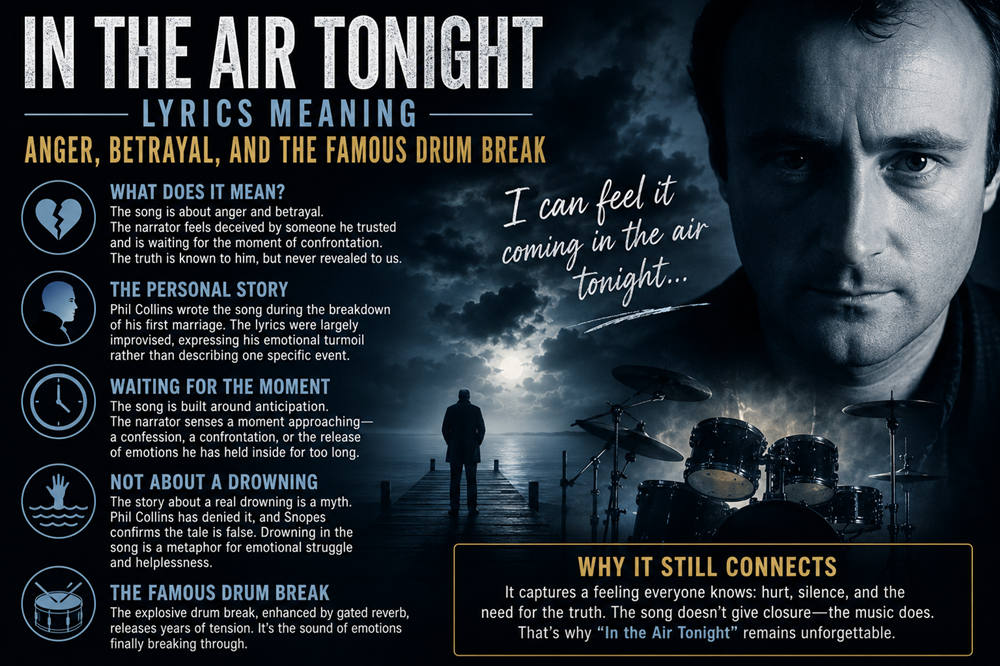
Few songs build tension as effectively as Phil Collins’ “In the Air Tonight.” It begins with a quiet drum-machine pattern and a restrained vocal, then gradually moves toward one of the most recognizable drum breaks in popular music.
Released in 1981, the track was Collins’ debut solo single and appeared on his first solo album, Face Value. You can read the complete “In the Air Tonight” lyrics on LyricsTranslate.
The song sounds like a dark story about betrayal and revenge, but Collins has explained that it was not based on one specific incident. Instead, it grew from the anger, confusion, and grief he experienced during the breakdown of his first marriage.
What Does “In the Air Tonight” Mean?
“In the Air Tonight” is about emotions that have been held back for too long.
The narrator appears to feel betrayed by someone he once trusted. He believes he knows the truth and is waiting for the other person to face it. However, the song never explains exactly what happened or identifies who caused the pain.
That uncertainty is part of its appeal. The story can be interpreted as romantic betrayal, dishonesty, abandonment, or the collapse of a close relationship.
The title suggests that a confrontation is approaching. The narrator can sense it before it happens, almost as though the tension has become something physical in the air around him.
The song captures the uncomfortable period before an emotional breaking point, when anger has been building but has not yet been expressed.
The Personal Turmoil Behind the Song
Collins began writing material for Face Value while separating from his first wife, Andrea Bertorelli. The end of the marriage affected the mood of the album, which often moves between sadness, frustration, loneliness, and anger.
However, the song should not be treated as a factual account of the separation. Collins has said that much of its wording came through improvisation while he was singing. He was expressing how he felt rather than carefully describing a real event.
This explains why the song feels deeply personal without offering a clear storyline. The emotions are specific, but the situation remains open to interpretation.
Listeners can connect the song to many experiences, including:
- Discovering that someone has lied
- Feeling abandoned by a partner
- Losing trust in a close relationship
- Replaying an argument that was never resolved
- Waiting for someone to admit the truth
The details are unclear, but the emotional experience is easy to recognize.
Anger, Betrayal, and Emotional Restraint
The narrator’s anger is powerful because it remains controlled.
He does not begin by shouting or directly confronting the person who hurt him. Instead, he sounds calm, distant, and watchful. His words suggest that he has carried the memory for a long time and has repeatedly thought about what happened.
That restraint makes the song more unsettling. A sudden outburst might pass quickly, but this anger has had time to grow.
The lyrics also suggest that the narrator no longer trusts the other person’s explanations. He believes something has been hidden from him, although the song never confirms whether his suspicions are correct.
This ambiguity leaves room for two possibilities. The narrator may be preparing to expose someone’s dishonesty, or he may be trapped inside his own unresolved pain.
Either way, he has not moved on. The coming confrontation seems to matter because he believes it will finally release everything he has kept inside.
What Is He Waiting For?
The song repeatedly refers to a moment that is about to arrive, but Collins never tells us exactly what that moment is.
It may represent a confession, a confrontation, the end of a relationship, or the point when suppressed feelings can no longer be controlled.
The waiting is more important than the event itself. It shows how completely the narrator has become focused on obtaining some form of emotional release.
The music keeps listeners waiting with him. The arrangement remains sparse for much of the track, delaying the explosive moment everyone knows is coming.
Is the Song About Someone Drowning?
No. The story that Collins witnessed a drowning is an urban legend.
One popular version claims that he saw a man refuse to rescue someone from the water. According to the rumor, Collins later invited that man to a concert and exposed him while performing the song.
There is no evidence that this happened. Collins has denied the story, and Snopes has classified it as false.
The rumor probably developed because the song uses vivid images of drowning, helplessness, and refusing to help. Those images sound like pieces of a real story, even though Collins did not write the track about an actual drowning.
In the song, drowning works better as an emotional metaphor. It can represent desperation, isolation, or a relationship that has already reached the point where it cannot be saved.
Why the Music Feels So Dark
The song’s meaning comes as much from its production as from its words.
For most of the track, the arrangement is unusually spacious. The drum machine, atmospheric keyboards, distant guitar, and close vocal create a lonely, claustrophobic mood.
The music refuses to provide an immediate release. It holds listeners inside the tension, mirroring the narrator’s effort to contain his anger.
Collins sounds as though he is speaking from inside a private memory. His performance is controlled, but small changes in his voice reveal the emotion underneath.
As the song progresses, the pressure becomes harder to ignore. By the time the full drums arrive, the music has already spent several minutes preparing listeners for the impact.
Why the Drum Break Is So Powerful
The drum break is the emotional turning point of “In the Air Tonight.”
Its effect comes partly from the long wait. The song remains restrained for so long that the sudden entrance of the drums feels much larger than a normal change in rhythm.
The sound is closely associated with gated reverb, a production technique that allows the drum’s echo to expand before cutting it off sharply. Engineer Hugh Padgham helped shape the effect, which later became a defining sound of 1980s pop and rock production.
The drums do what the narrator cannot do through words alone. They release the anger that has been building throughout the song.
That is why the break remains memorable even for people who do not know the complete story behind the track. It feels like an emotional explosion rather than a simple musical fill.
Why the Song Still Connects With Listeners
“In the Air Tonight” remains popular because it does not explain everything.
A more literal song might have revealed who betrayed the narrator, what happened between them, and how the conflict ended. Collins leaves those questions unanswered.
As a result, listeners can bring their own experiences to the song. It can sound like a breakup, a warning, a private argument, or a memory that still causes pain years later.
The structure also reflects a familiar emotional pattern. Someone stays quiet, tries to keep functioning, and hides what they are feeling. The pressure continues to build until it finally breaks through.
The song never gives the narrator a clear resolution. The music provides the release instead.
Final Meaning
The “In the Air Tonight” lyrics are not about a real drowning or an elaborate plan for revenge. They are an expression of anger, mistrust, and emotional pain during a difficult period in Phil Collins’ life.
The narrator feels that someone has betrayed him and waits for a moment when the truth can finally be faced. We never learn whether that confrontation happens.
What we do hear is the emotional release. The quiet tension, unclear imagery, and explosive drum break turn a private feeling into something listeners can immediately understand.