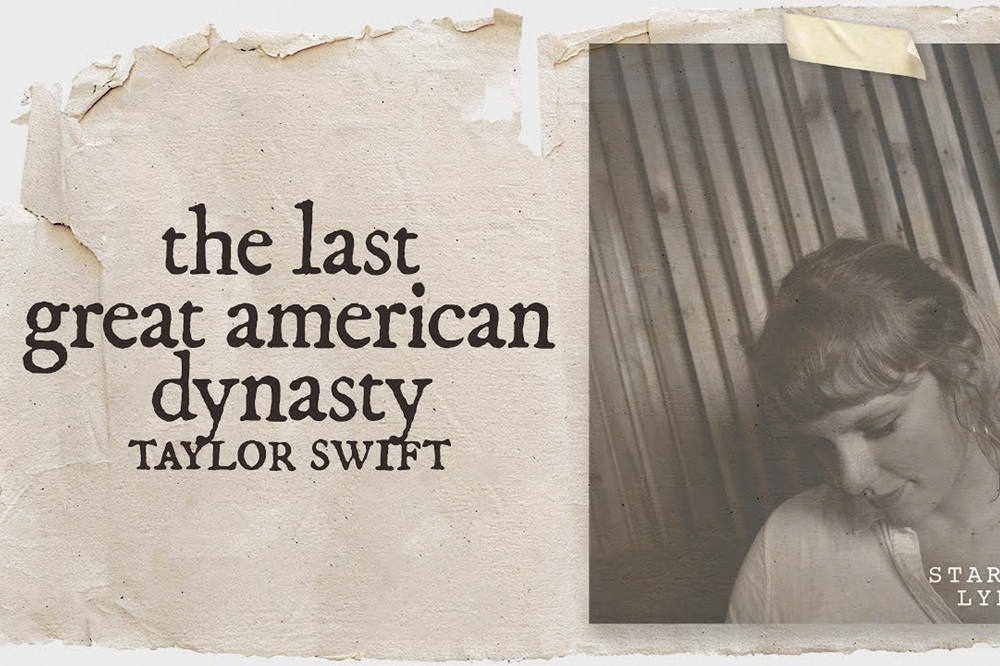
Taylor Swift’s “The Last Great American Dynasty” tells the story of Rebekah Harkness, a wealthy and unconventional woman who once owned Swift’s Rhode Island mansion. What begins as a colorful piece of local history gradually becomes a reflection on gossip, female reputation, and Swift’s own public image.
You can read the complete lyrics on Genius. The lyrics are not reproduced here, but the story and meaning are explored below.
What Is “The Last Great American Dynasty” About?
The song follows Rebekah Harkness after she marries William Hale Harkness, an heir to a fortune connected to Standard Oil. The couple settles at Holiday House, a large coastal home in Watch Hill, Rhode Island.
After William dies, Rebekah remains at the property and begins living on her own terms. She throws elaborate parties, spends freely, supports the arts, and pays little attention to what her wealthy neighbors consider respectable.
The local community turns her into a scandalous figure. She is blamed for upsetting the Harkness family, disturbing the neighborhood, and bringing chaos wherever she goes.
Near the end, Swift reveals why she is telling this particular story: she later bought Holiday House herself. The connection changes the song from a historical portrait into a comparison between two women who lived in the same home and faced similar public judgment.
Who Was Rebekah Harkness?
Rebekah Harkness, born Rebekah Semple West in 1915, was an American socialite, arts patron, composer, and dancer.
She married William Hale Harkness in 1947. After his death in 1954, she inherited considerable wealth and became known for an extravagant lifestyle that attracted frequent attention from newspapers and society writers.
Her reputation, however, was more complicated than the image of a reckless heiress.
Rebekah supported dance companies and later founded the Harkness Ballet. She also funded artistic projects and medical research. Her parties and unusual decisions made good gossip, but they were only one part of her life.
Swift does not present the song as a complete biography. Instead, she uses the stories surrounding Rebekah to show how a real person can slowly become a local legend.
History, Rumor, and Folklore
The song includes dramatic stories about expensive parties, gambling, artists, arguments, and a neighbor’s pet being dyed green. Some details are connected to accounts of Rebekah’s life, while others appear to have changed through years of retelling.
The pet, for example, is described differently in historical accounts than it is in the song. That small change fits the larger idea behind folklore: stories rarely remain perfectly accurate as they pass from one person to another.
Rebekah’s life has been filtered through neighbors, newspapers, biographies, and local rumors. By the time Swift tells it, history and gossip have become almost impossible to separate.
That does not weaken the song. It is part of its point.
The community does not remember Rebekah as a complete person. It remembers the most entertaining version of her.
Why Rebekah Became the Villain
Rebekah enters a wealthy, established family but never behaves like the quiet and obedient society wife her surroundings seem to expect.
She had been divorced before marrying William. After becoming a widow, she continued to spend money publicly, host unusual guests, and follow her artistic interests. Rather than disappearing into private life, she became more visible.
That visibility made her an easy target.
The song suggests that the community blamed Rebekah not only for her actual behavior, but also for the decline of the Harkness family and the loss of the neighborhood’s peaceful image. Personal tragedy and family problems were reduced to a simple story: an unruly woman arrived and ruined everything.
Swift treats that claim with humor. The accusation is so dramatic that it begins to reveal more about the people spreading it than about Rebekah herself.
The Connection Between Rebekah Harkness and Taylor Swift
Swift bought Holiday House in 2013. Like Rebekah, she became a highly visible woman living in a quiet and wealthy coastal community.
Her ownership of the home attracted media attention, celebrity guests, and public curiosity. Her Independence Day gatherings were photographed and discussed far beyond Rhode Island.
This gives Swift a personal reason to identify with Rebekah.
Both women were wealthy, independent, and frequently described as excessive. Both had their choices analyzed by people who did not know them personally. Both became part of a story about a woman supposedly disturbing a respectable place.
Swift is not claiming that their lives were identical. Instead, she recognizes a familiar pattern: once a woman becomes powerful and visible, her personality can be rewritten as a public problem.
The final reveal turns Rebekah into more than the subject of the song. She becomes Swift’s symbolic predecessor.
What Does “Ruining Everything” Mean?
The idea of ruining everything is intentionally exaggerated.
Rebekah did not literally destroy the town. What she disturbed was its preferred social order. She ignored expectations, brought unfamiliar people into an exclusive environment, and used her wealth without asking for approval.
Swift has faced similar criticism throughout her career. Her relationships, friendships, business choices, ambition, and public image have often received as much attention as her music.
By embracing the accusation rather than denying it, Swift takes away some of its power.
The song does not argue that every choice Rebekah made was wise. It allows her to be complicated, impulsive, creative, and difficult without reducing her entire life to a warning about badly behaved women.
Why Holiday House Matters
Holiday House links Rebekah and Swift across different generations.
Under Rebekah, the property became associated with artists, parties, wealth, and scandal. Under Swift, it again became a place that attracted attention and inspired rumors.
The house remains still while the same social pattern repeats around its owners.
That makes it more than a setting. It becomes a witness to the way communities create stories about women who stand out. Rebekah leaves, Swift arrives, and the neighborhood finds a new person to watch.
The property also gives Swift an unusual relationship with history. She is not simply researching someone from the past. She lives inside a place shaped by that person’s reputation.
Why Is It Called “The Last Great American Dynasty”?
The title refers partly to the wealthy Harkness family, whose fortune and social status resembled an American dynasty.
However, Swift gives the word a more playful meaning. Rebekah may not pass Holiday House directly to her, but Swift still becomes her cultural successor. The connection is based on personality, reputation, and shared experience rather than blood.
The title also makes neighborhood gossip sound like a grand national history. A story involving parties, grudges, money, and social judgment is presented with the importance of the rise and fall of a powerful family.
That contrast gives the song much of its charm. It is both a sweeping American tale and a sharply observed story about what neighbors say behind closed doors.
The Song’s Main Themes
Female Reputation
Rebekah’s identity is largely created by the people around her. Her neighbors decide she is reckless, destructive, and responsible for the family’s troubles.
Swift shows how easily repeated criticism can become accepted as truth, especially when the subject is a woman who refuses to appear modest or agreeable.
Wealth and Social Rules
Money gives Rebekah freedom, but it does not protect her from judgment. In fact, her wealth makes every decision more visible.
The song also shows that wealthy communities have their own strict rules. Rebekah belongs financially, but she never fully belongs socially.
Gossip as Storytelling
Rumors turn ordinary events into legend. With every retelling, the story becomes more entertaining and less reliable.
This theme connects naturally to folklore, an album filled with memory, imagination, shifting perspectives, and stories whose truth cannot always be confirmed.
Reclaiming the Villain Role
Instead of trying to prove that Rebekah was perfectly innocent, Swift allows her to remain messy and fascinating.
She then steps into the same role herself. If independence, ambition, and visibility are enough to make a woman the neighborhood villain, Swift appears willing to accept the title.
Why the Song Stands Out on Folklore
“The Last Great American Dynasty” is one of Swift’s strongest examples of narrative songwriting.
The song introduces a central character, builds her reputation through vivid details, and ends with a reveal that changes the listener’s understanding of the story. Swift begins as a narrator looking into the past, then quietly places herself inside the same history.
That structure makes the song feel like a short story set to music.
It also gives folklore one of its lighter moments without losing emotional depth. Rebekah’s life is entertaining, but the treatment she receives raises serious questions about who controls a woman’s public story.
Final Meaning
“The Last Great American Dynasty” is about the stories people create around women who refuse to live quietly.
Rebekah Harkness becomes infamous because her neighbors turn her independence into scandal. Decades later, Taylor Swift buys the same house and recognizes how easily she can be placed in the same role.
By linking their lives, Swift transforms gossip into a kind of inheritance. Rebekah’s reputation survives in Holiday House, but Swift does not treat it as a warning. She embraces it as proof that some women would rather be remembered for causing a stir than disappear while trying to please everyone.
Featured image source: https://www.youtube.com/watch?v=bIuvl4t4weg