
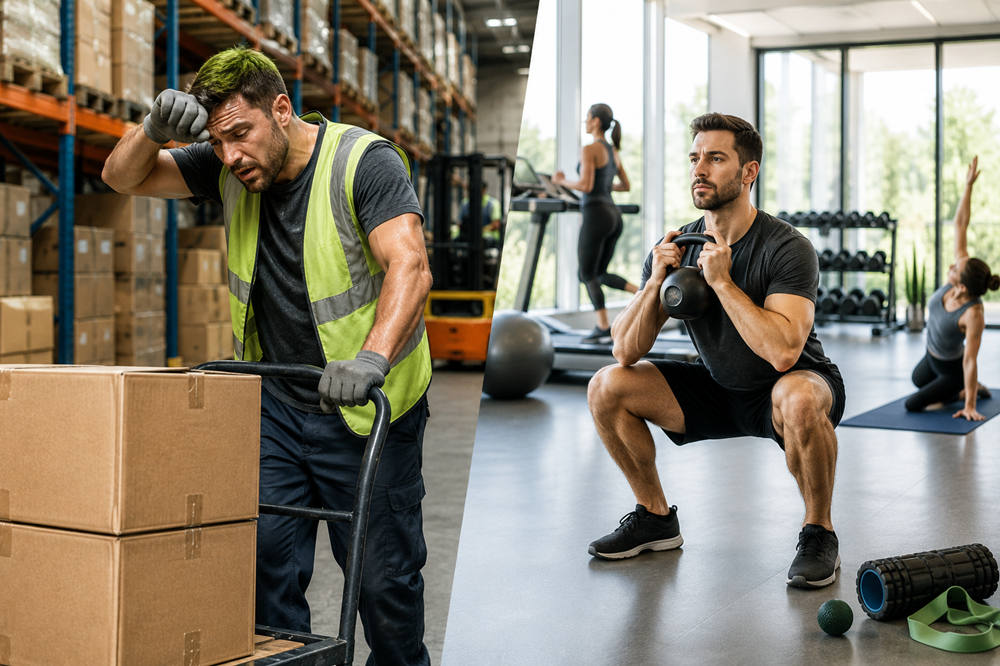
A construction worker may lift heavy materials all day. A nurse may walk thousands of steps during a shift. A warehouse employee may spend hours pushing carts, stacking boxes, and moving equipment.
These jobs clearly require physical effort. Still, having an active job does not automatically mean someone has strong cardiovascular endurance, balanced muscles, good mobility, or a healthy body composition.
The reason is that physical activity and physical fitness are not the same thing.
Workplace movement can support your health, but most jobs are designed to complete tasks—not to train the body in a balanced and progressive way.
Physical Activity and Physical Fitness Are Different
Physical activity includes almost any movement that uses energy. Walking, lifting, cleaning, climbing stairs, standing, and carrying supplies all count.
Physical fitness describes how well your body performs. It includes several areas:
- Cardiovascular endurance
- Muscular strength
- Muscular endurance
- Flexibility and mobility
- Balance and coordination
- Healthy body composition
A job may challenge one or two of these areas while barely affecting the others.
For example, a delivery driver may carry packages and climb stairs but also spend hours sitting in a vehicle. A cleaner may build endurance in certain muscles while having limited upper-body strength. A retail worker may spend the whole day standing without doing enough sustained movement to improve aerobic fitness.
Being tired after work does not always mean the entire body has been trained effectively.
Work Usually Trains Specific Tasks
Most physical jobs involve a limited set of repeated movements.
A worker may bend in the same direction, carry weight on one side, push the same equipment, or twist the body hundreds of times during a shift. Over time, the body becomes efficient at those exact tasks.
That does not mean it becomes equally strong in every direction.
A person who repeatedly lifts boxes from the floor may develop strength and endurance in the muscles used for that movement. However, the job may do little for pulling strength, balance, shoulder mobility, or core stability.
A well-rounded fitness routine includes different movement patterns, such as:
- Pushing
- Pulling
- Squatting
- Hinging
- Rotating
- Carrying
- Stabilizing
Most jobs do not provide that variety. They strengthen the movements required for the work and may leave other areas underused.
Repetition, forceful movements, awkward posture, and stationary positions are also recognized workplace ergonomic risk factors. These risks depend on the task, workload, working conditions, and time available for recovery.
Workplace Movement May Not Be Intense Enough
Being on your feet all day can add a large amount of movement, but the intensity still matters.
Slow walking, standing, or frequently stopping and starting may not raise your heart rate enough to improve cardiovascular endurance. Aerobic fitness usually develops when the heart and lungs are challenged at a moderate or vigorous level.
Walking at work can support your health, especially when it is brisk and continuous. However, a high step count alone does not show how hard the body was working.
Someone can record 15,000 steps during a shift and still struggle with endurance during brisk walking, running, swimming, or cycling.
Steps are useful, but they are only one measure of activity. The World Health Organization’s physical activity guidelines consider the frequency, intensity, duration, and type of activity—not just the total number of movements completed.
Physical Work Does Not Always Build Balanced Strength
Lifting at work may look similar to strength training, but the two are not identical.
Strength training normally includes:
- Controlled technique
- Planned resistance
- Balanced exercises
- A clear number of repetitions
- Gradual increases in difficulty
- Enough rest between sessions
At work, the task determines the weight and movement. The load may be too light to build more strength or too heavy to handle comfortably. A worker may also perform the same lift repeatedly without enough recovery.
The goal is to move the object and finish the task, not to train the muscles through a safe, controlled range of motion.
A person can become very good at a specific workplace lift without developing well-rounded strength.
Repeating the Same Work Can Lead to a Fitness Plateau
The body improves when it is gradually challenged beyond what it is used to. This is called progressive overload.
In exercise, someone might slowly increase the weight, distance, pace, repetitions, or range of motion.
Most jobs do not progress in that way. The worker performs similar tasks at roughly the same level day after day.
At first, the job may feel physically demanding. Over time, the body adapts and becomes more efficient. Once that happens, the work may maintain task-specific ability without continuing to improve overall fitness.
You may become better at doing your job without becoming noticeably fitter in other areas.
Long Hours of Activity Can Create Strain
Purposeful exercise usually includes a clear period of effort followed by recovery.
Physical labor may continue for eight, ten, or twelve hours. Workers may have limited control over the pace, load, posture, temperature, or number of breaks.
This can create prolonged strain rather than a short, controlled training session.
Researchers sometimes use the term physical activity paradox when discussing why leisure-time exercise is consistently connected with health benefits while high levels of occupational activity may not always produce the same results.
Possible reasons include:
- Long periods of low-level effort
- Repetitive lifting
- Awkward postures
- Limited rest
- Static standing
- Little control over workload
This does not mean physical work is automatically harmful. Research is still developing, and the effects can vary depending on the occupation, workload, worker’s health, and recovery opportunities.
Standing All Day Is Not a Complete Workout
Standing uses more energy than sitting, but it does not train the body in the same way as varied movement.
A security guard, hairstylist, retail employee, or factory worker may spend most of the day upright while doing little moderate-intensity aerobic activity.
According to research reviewed by the National Institute for Occupational Safety and Health, prolonged standing at work has been associated with tiredness, physical fatigue, leg swelling, muscle discomfort, and lower-back pain. Changing positions and allowing workers to move between sitting, standing, and walking may be more helpful than remaining in one position.
Standing may reduce sitting time, but it does not replace strength training, cardiovascular exercise, mobility work, or recovery.
An Active Job Does Not Guarantee Weight Loss
Physical work may increase the number of calories you use, but it does not guarantee weight loss or a healthy body composition.
Body weight is affected by many factors, including:
- Food intake
- Sleep
- Stress
- Genetics
- Medication
- Hormones
- Total daily energy use
Physically active workers may also feel hungrier after demanding shifts. Large portions, sugary drinks, convenience foods, and irregular meals can offset some of the energy used at work.
Fitness should not be judged by appearance alone. Someone can look thin while having low muscle mass and poor endurance. Another person can carry extra body fat while being strong and capable.
Fatigue Can Make Exercise Outside Work Harder
After a long physical shift, many workers have little energy left for a workout.
That is understandable. However, job-related fatigue does not mean every part of the body has been trained.
A worker’s shoulders, hands, or lower back may be exhausted while the upper back, core, hips, or cardiovascular system still need attention.
The answer is not always a longer or harder workout. A short, focused routine can target what the job misses without adding unnecessary stress.
Recovery Still Matters
Physical activity creates the training stimulus, but the body needs recovery to adapt.
Sleep, hydration, nutrition, and rest all affect physical fitness. Workers with long shifts, overnight schedules, or regular overtime may struggle to recover fully.
Poor recovery can contribute to ongoing soreness, reduced energy, and declining performance.
Persistent pain, unusual shortness of breath, or a noticeable loss of strength should not simply be dismissed as part of having a physical job. These symptoms may require changes in workload, better recovery, or advice from a healthcare professional.
How Active Workers Can Improve Their Fitness
You do not necessarily need long workouts after every shift. The goal is to fill the gaps left by your job.
Identify What Your Job Already Trains
Think about what you do most often.
Do you mainly walk, lift, push, sit, stand, climb, or carry?
Then consider what is missing. A worker who walks all day may need upper-body strength. Someone who lifts frequently may benefit from mobility, pulling exercises, and core stability. A driver may need more cardiovascular activity and exercises that counter long periods of sitting.
Add Short Strength Sessions
Two focused strength sessions each week can help build more balanced fitness. The CDC’s activity guidelines for adults recommend muscle-strengthening activities on at least two days per week, along with at least 150 minutes of moderate-intensity aerobic activity. Work activity may count when it reaches the appropriate intensity.
Useful exercises may include:
- Rows
- Squats
- Glute bridges
- Push-ups
- Resistance-band exercises
- Core stability movements
- Controlled carries
The routine should support your work rather than leave you too sore to perform it safely.
Include Purposeful Aerobic Activity
Choose an activity that raises your heart rate without placing too much stress on tired joints.
Brisk walking, cycling, swimming, or using an elliptical machine may be easier to recover from than high-impact exercise.
Even short sessions can help when done consistently. The weekly activity total can be divided into smaller sessions instead of being completed all at once.
Work on Mobility and Recovery
A few minutes of mobility work can help reduce stiffness from repeated work positions. Focus on areas that feel tight, such as the hips, ankles, chest, shoulders, wrists, and upper back.
Regular sleep, balanced meals, hydration, and rest days are just as important. Exercise cannot fully compensate for poor recovery, unsafe lifting practices, or unsuitable working conditions.
The Bottom Line
A physically active job can provide valuable daily movement and help maintain certain skills. However, it usually trains the tasks required for the job rather than the whole body.
Better physical fitness depends on a balance of intensity, variety, progression, and recovery.
The goal is not to add more exhaustion after a demanding shift. It is to use a small amount of purposeful exercise to strengthen the areas your job overlooks.