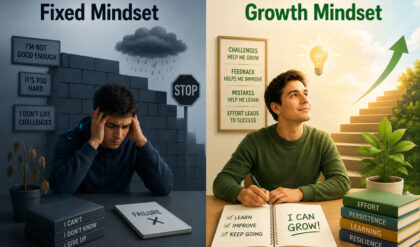
A great growth mindset book does more than tell you to “think positive.” It helps you understand how learning really works, why mistakes feel uncomfortable, and how you can build skills through practice, feedback, better strategies, and patience.
The books below approach growth mindset from different angles. Some explain the psychology. Some are written for teachers, parents, or kids. Others focus on habits, confidence, perseverance, and learning culture. Together, they give you a practical reading list for building a healthier relationship with growth.
1. Mindset: The New Psychology of Success by Carol S. Dweck
Mindset: The New Psychology of Success is the best place to begin if you want to understand the idea of growth mindset from the source. Carol S. Dweck popularized the concept, and her book explains why your beliefs about ability can shape how you learn, work, parent, lead, and respond to setbacks.
The core idea is simple. A fixed mindset makes you believe intelligence, talent, or ability is mostly set. A growth mindset helps you see ability as something that can develop through effort, feedback, practice, and better strategies.
What makes the book powerful is how many areas of life it touches. Dweck applies mindset to school, sports, business, parenting, relationships, and leadership. That makes it useful whether you are a student trying to improve your grades, a parent helping a child handle mistakes, or an adult trying to become more confident at work.
One of the most important lessons is that growth mindset is not the same as blind effort. It does not mean repeating the same mistake forever while telling yourself to keep trying. Real growth also requires reflection, new strategies, coaching, and honest feedback.
This book is especially valuable if failure feels personal to you. It helps you see that a setback does not have to become an identity. You can be struggling with something and still be capable of improving.
Best for: Beginners, students, parents, teachers, coaches, leaders, and anyone who wants a strong foundation.
2. Cultures of Growth by Mary C. Murphy
Sometimes your mindset is not the only thing holding you back. The environment around you matters too. Cultures of Growth looks at how families, classrooms, workplaces, and teams can either make growth easier or make people afraid to fail.
Mary C. Murphy explains that growth mindset is not just a personal belief. It is also shaped by culture. In some spaces, people feel safe asking questions, admitting what they do not know, and improving over time. In other spaces, people hide mistakes because they are afraid of looking weak or unprepared.
That idea is important for leaders, teachers, and managers. You can tell people to learn and grow, but if your culture rewards perfection, status, and constant comparison, people may protect their image instead of taking smart risks.
The book is useful because it moves growth mindset beyond motivational language. It shows that real growth requires systems, expectations, and everyday behaviors that support learning.
For workplaces, this book can help leaders build teams where feedback is normal and mistakes are treated as information. For schools, it can help educators think about how classroom culture affects student confidence.
Best for: Managers, educators, school leaders, team builders, parents, and workplace professionals.
3. Limitless Mind by Jo Boaler
Few beliefs are as limiting as “I’m just not good at this.” Limitless Mind challenges that kind of thinking directly.
Jo Boaler focuses on how people learn and how old labels can damage confidence. Many readers carry painful beliefs from school, especially around intelligence, creativity, or math. This book pushes back against the idea that your ability is fixed by age, background, or past performance.
The book is encouraging without feeling shallow. It does not pretend learning is always easy. Instead, it shows that the brain can keep changing and adapting when you challenge yourself in the right ways.
This makes the book helpful for adults who want to return to learning after years of self-doubt. Maybe you want to learn a language, improve your writing, understand money better, or try something creative. Limitless Mind gives you a more hopeful way to approach the process.
Parents and teachers can also benefit from it because it explains why labels like “gifted,” “slow,” “not academic,” or “bad at math” can shape how children see themselves. The book encourages language that supports curiosity, effort, and progress.
Best for: Lifelong learners, students, parents, teachers, and adults rebuilding confidence.
4. Mathematical Mindsets by Jo Boaler
“I’m not a math person” is one of the most common fixed mindset beliefs. Mathematical Mindsets is written for anyone who wants to challenge that belief, especially teachers, parents, tutors, and students.
Jo Boaler explains that math ability can grow when learners are given better messages, better teaching methods, and more room to think creatively. Instead of treating math as a race to get the right answer, the book encourages exploration, discussion, visual thinking, and problem-solving.
This is especially helpful for students with math anxiety. When learners believe speed equals intelligence, they may panic when they need more time. Mathematical Mindsets helps reframe math as a subject that rewards deep thinking, not just fast answers.
Teachers will find the book practical because it offers a different way to design math learning. It supports classrooms where students explain their thinking, compare strategies, and learn from mistakes instead of feeling ashamed by them.
Parents can also use this book to change the way they talk about math at home. Even a simple phrase like “I was never a math person either” can reinforce a child’s fear. This book gives adults a better message to pass on.
Best for: Math teachers, parents, tutors, students, and anyone working through math anxiety.
5. The Growth Mindset Coach by Annie Brock and Heather Hundley
Teachers often understand growth mindset in theory but need help using it in real classroom moments. The Growth Mindset Coach gives educators a practical path.
The book is organized as a month-by-month guide, which makes it easier to apply across the school year. Instead of giving one big lecture on mindset, teachers can build growth-focused language, routines, and activities gradually.
This matters because growth mindset can become too vague when it is reduced to posters and slogans. Students need more than “believe in yourself.” They need help naming fixed mindset thoughts, choosing better strategies, reflecting on mistakes, and staying engaged when work gets difficult.
The book helps teachers think about praise, feedback, challenge, and classroom expectations. It also gives structure to educators who want to make mindset part of daily learning instead of a one-time lesson.
Parents who homeschool or support children closely may also find ideas they can use at home. The book gives adults better ways to respond when a child says, “I can’t do this.”
Best for: Teachers, homeschool parents, tutors, school counselors, and education coaches.
6. The Growth Mindset Playbook by Annie Brock and Heather Hundley
Once you understand growth mindset, the next question is practical: what do you actually do with it? The Growth Mindset Playbook focuses on classroom strategies teachers can use with students.
This book works well as a follow-up to The Growth Mindset Coach. It is more action-based and helps educators turn mindset into real classroom practice.
The book covers areas like student reflection, engagement, relationships, failure, and metacognition. That last word simply means helping students think about their own thinking. When students learn to notice how they approach a problem, they become more active in their own growth.
This is valuable because many students do not give up because they are lazy. They give up because they do not know what to do when they feel stuck. A strong classroom mindset gives students tools for handling that moment.
The Growth Mindset Playbook is useful for teachers who want growth mindset to show up in discussions, assignments, feedback, and classroom routines.
Best for: Classroom teachers, instructional coaches, school leaders, and educators who want ready-to-use ideas.
7. Mindsets in the Classroom by Mary Cay Ricci
A classroom can quietly teach students what to believe about ability. Mindsets in the Classroom helps educators create learning spaces where students see themselves as capable of growth.
Mary Cay Ricci focuses on how teachers can build a culture that supports challenge, resilience, and perseverance. The book is useful for schools that want growth mindset to become part of the larger learning environment, not just one teacher’s personal style.
One helpful part of this approach is that it looks at student beliefs. Children often form ideas about who is “smart” very early. Those ideas can affect how much they participate, whether they ask questions, and how they respond when work gets harder.
The book encourages teachers to examine their own language too. Students notice whether adults treat mistakes as shameful or useful. They also notice whether challenge is presented as punishment or opportunity.
Mindsets in the Classroom is a good choice for educators who want to connect growth mindset with school culture, student motivation, and long-term learning habits.
Best for: Teachers, principals, school staff, education consultants, and parents interested in learning culture.
8. Grit: The Power of Passion and Perseverance by Angela Duckworth
Grit is not a pure growth mindset book, but it is one of the best companion reads. Growth mindset helps you believe improvement is possible. Grit focuses on staying committed long enough to make that improvement real.
Angela Duckworth explores why talent alone does not explain success. Passion, perseverance, practice, and long-term commitment also matter. This connects naturally with growth mindset because people who believe they can improve are more likely to keep working through difficulty.
The book is helpful if you often start strong but lose motivation when progress slows down. It reminds you that meaningful growth usually takes longer than a burst of inspiration.
Grit also gives a more realistic view of achievement. Many people look successful from the outside, but their progress usually includes repetition, failure, adjustment, and long stretches of unglamorous practice.
At the same time, the book is not about forcing yourself to suffer through goals you no longer care about. It is more about developing commitment to something meaningful and learning how to stay with it through challenges.
Best for: Students, athletes, professionals, entrepreneurs, and anyone working toward a long-term goal.
9. Atomic Habits by James Clear
A growth mindset helps you believe you can change. Atomic Habits helps you build the daily systems that make change easier.
James Clear’s book is not specifically about growth mindset, but it pairs well with the topic. Many people like the idea of improving, but they rely too much on motivation. Atomic Habits shows how small repeated actions can create meaningful progress over time.
The book focuses on identity, environment, routines, and habit design. That makes it practical for almost any skill you want to build. You can apply it to studying, reading, exercise, writing, saving money, practicing music, or improving your focus.
One useful idea is that progress becomes easier when you stop thinking only about outcomes and start thinking about the person you are becoming. Instead of saying, “I want to read more,” you begin acting like a reader. Instead of saying, “I want to be fit,” you build the habits of someone who takes care of their body.
Atomic Habits gives growth mindset a daily structure. It turns the belief “I can improve” into small actions you can repeat.
Best for: Adults, students, professionals, habit builders, and anyone who wants practical self-improvement.
10. Your Fantastic Elastic Brain by JoAnn Deak
Children need simple, concrete ways to understand growth. Your Fantastic Elastic Brain explains that the brain can stretch, learn, and change in language young readers can understand.
This book is a strong choice for early growth mindset conversations. Kids often decide quickly what they are good or bad at. If reading, math, drawing, or sports feels hard, they may assume that struggle means they cannot do it.
Your Fantastic Elastic Brain gives children a different explanation. It teaches that learning can feel difficult because the brain is working and growing. Mistakes become less scary when children understand that they are part of the process.
Parents can use the book after a frustrating homework session, a tough practice, or a moment when a child says, “I’m bad at this.” It gives you a gentle way to talk about practice without turning the moment into a lecture.
Teachers can also use it in preschool and elementary classrooms to introduce effort, challenge, and brain growth in a visual way.
Best for: Young children, parents, preschool teachers, elementary teachers, and school counselors.
11. The Most Magnificent Thing by Ashley Spires
Some growth mindset lessons are easier to understand through story. The Most Magnificent Thing follows a girl who wants to create something amazing, but her project does not work the way she imagined.
That is what makes the book so relatable. The main character does not calmly succeed right away. She gets frustrated, steps away, and returns with a clearer mind. Many children need to see that process because real learning often includes big feelings.
This book is especially helpful for kids who melt down when something is not perfect. It shows that frustration is not the end of the process. Sometimes a break, a new angle, or another attempt can change everything.
The story also supports creativity. Building, drawing, writing, designing, and problem-solving rarely turn out perfectly the first time. Children need practice staying with a project even when the first version disappoints them.
Parents and teachers can use this book to talk about patience, emotional regulation, problem-solving, and resilience. It teaches growth mindset without sounding like a lesson.
Best for: Kids, parents, teachers, creative classrooms, and children who struggle with frustration.
12. You Are Awesome by Matthew Syed
You Are Awesome is a confidence-building book for kids and teens who need encouragement to try, practice, and improve. It has a lively tone, which makes it easier for younger readers to enjoy.
Matthew Syed challenges the idea that successful people are simply born special. He shows young readers that progress usually comes from effort, learning, practice, and persistence.
This book can help children who compare themselves to classmates, siblings, teammates, or people online. Instead of assuming others are naturally better, readers learn to look at the work behind improvement.
It is also useful for young people who wait to feel confident before they begin. The book helps them see that confidence often grows after action. You do not always feel brave first. Sometimes you try, learn, improve, and then confidence follows.
Parents may find this book helpful for children facing school pressure, exams, sports challenges, hobbies, or friendship struggles. It gives kids a more encouraging way to see their own potential.
Best for: Kids, teens, parents, teachers, and young readers who need a confidence boost.
How to Choose the Right Growth Mindset Book for Your Needs
The best choice depends on your situation.
For a clear introduction, start with Mindset. It gives you the foundation and explains the difference between fixed and growth thinking.
For workplace or school leadership, choose Cultures of Growth. It helps you understand how environments shape behavior.
For personal confidence, read Limitless Mind. It is especially helpful if old labels still affect the way you see yourself.
For math anxiety, choose Mathematical Mindsets. It directly challenges the belief that math ability is fixed.
For classroom use, choose The Growth Mindset Coach, The Growth Mindset Playbook, or Mindsets in the Classroom. These books are better for educators who need practical strategies.
For long-term discipline, read Grit. For everyday improvement, read Atomic Habits.
For children, choose Your Fantastic Elastic Brain, The Most Magnificent Thing, or You Are Awesome based on the child’s age and reading level.
What These Books Can Teach You About Real Growth
The strongest growth mindset books do not promise instant transformation. They teach a more realistic lesson: growth is possible, but it takes practice, patience, reflection, and support.
They also remind you that mistakes are not proof that you are incapable. A mistake can show you what needs more attention. A setback can reveal where your strategy needs to change. A difficult season can teach you where you need more support.
Another shared lesson is that effort works best when it is thoughtful. Trying harder can help, but only if you are also learning from what happens. Better questions, better feedback, and better systems can make effort more effective.
These books also show that people grow better in healthier environments. A child, student, employee, athlete, or creative person is more likely to take risks when they are not punished for every imperfection.
Most of all, these books make improvement feel practical. You do not have to become a different person overnight. You can start by noticing fixed mindset thoughts, choosing one better strategy, asking for feedback, or practicing one skill a little more consistently.
Final Thoughts
The best growth mindset book for beginners is Mindset: The New Psychology of Success by Carol S. Dweck, but your reading does not have to stop there. Each book on this list adds something useful.
Some help you understand the science of learning. Some show teachers and parents how to support children. Some focus on habits, grit, confidence, math anxiety, creativity, or workplace culture.
Together, they show that growth mindset is not just a positive phrase. It is a practical way to approach learning, mistakes, feedback, and long-term improvement. The right book can help you stop seeing struggle as a sign to quit and start seeing it as part of the path forward.
Meta Description: Explore the best growth mindset books for adults, teachers, parents, kids, students, habits, confidence, resilience, and lifelong learning.