
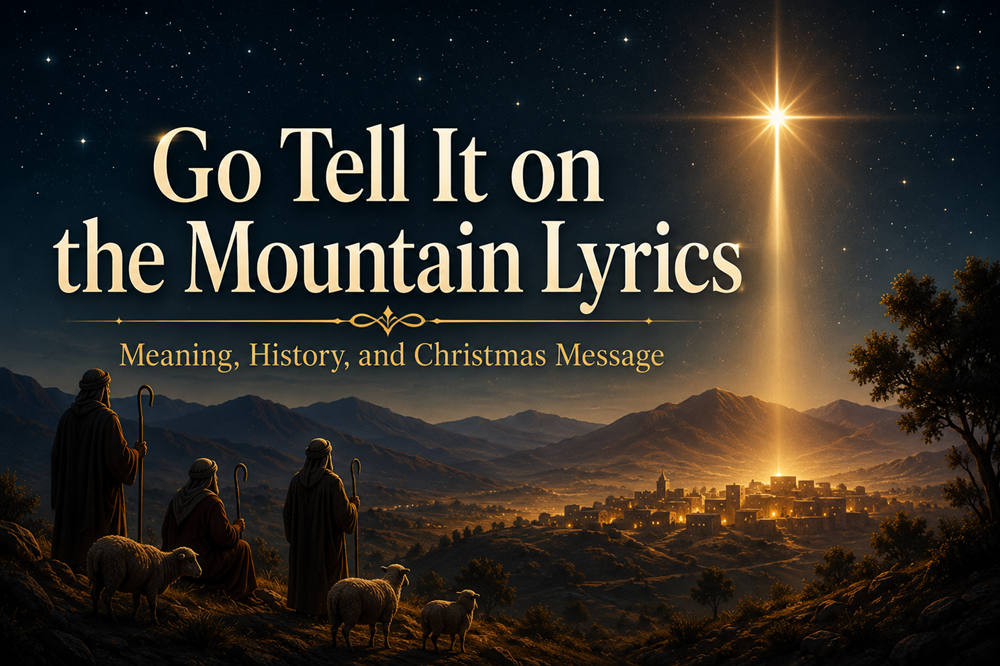
“Go Tell It on the Mountain” is a joyful Christmas spiritual about sharing the news of Jesus’ birth. Instead of presenting the Nativity as a quiet event to observe from a distance, the song calls people to speak openly about it.
The familiar refrain asks listeners to carry the message beyond one place or community. Its words are simple, but the instruction is clear: the birth of Christ is good news that should be shared everywhere.
You can read the traditional “Go Tell It on the Mountain” lyrics on Hymnary.
What Does “Go Tell It on the Mountain” Mean?
The song means that the birth of Jesus is too important to keep private.
Its story comes from the Gospel of Luke, where shepherds are watching their flocks at night. An angel appears and tells them that a Savior has been born in Bethlehem. After visiting the baby Jesus, the shepherds tell others what they have seen and heard.
The spiritual turns that biblical moment into a message for everyone singing it. The shepherds were the first messengers, but the responsibility does not end with them. Each singer is invited to continue spreading the news.
The main themes are:
- The birth of Jesus brings hope.
- Good news should be shared.
- Faith calls people to take action.
- Jesus entered the world in humble surroundings.
- Ordinary people can carry an important message.
The word “go” gives the song its energy. It does not ask listeners only to remember or admire the Christmas story. It asks them to respond.
Meaning of the Shepherds’ Story
The opening part of the song describes shepherds watching their animals during the night.
Their work is ordinary and probably quiet. Then the darkness is interrupted by a heavenly appearance and an unexpected announcement.
The shepherds matter because they are not wealthy rulers or religious leaders. They are working people carrying out a daily responsibility. Yet they are chosen to receive the news first.
This detail supports one of the Christmas story’s central ideas: the message is not reserved for people with power or status. It is offered to ordinary people, and ordinary people are trusted to share it.
The shepherds are initially frightened by the angel’s appearance. Their fear makes sense. They are suddenly surrounded by a glory they do not understand.
The angel reassures them and announces the birth of a Savior. The mood changes from fear to wonder and joy. Once the shepherds understand the message, they travel to Bethlehem to see the child for themselves.
Their response follows a simple pattern:
- They hear the news.
- They go to see Jesus.
- They tell others what happened.
“Go Tell It on the Mountain” invites the singer to follow that same pattern by receiving the Christmas message and passing it on.
Meaning of the Angels
The angels announce that Jesus has been born and praise God.
Their appearance shows the importance of an event that might otherwise seem small. Jesus is born far from a palace and placed in a manger, but heaven responds with celebration.
From the outside, the birth looks humble and easy to overlook. The angels reveal that it has a much greater meaning.
They also connect heaven’s message with the shepherds’ actions. The angels deliver the announcement, but the shepherds carry it into the human community.
Meaning of the Humble Manger
A manger is a feeding container for animals. It is not where anyone would normally expect to find a king.
By focusing on this setting, the spiritual emphasizes the humility of Jesus’ birth. He does not enter the world surrounded by luxury, political influence, or public ceremony.
The manger shows that greatness does not always arrive in an impressive form. In the Christian story, hope enters the world through a child born in simple surroundings.
This theme helped make the Nativity meaningful within the wider African American spiritual tradition. The image of a Savior born without wealth or social privilege offered comfort to communities that understood hardship and exclusion.
Jesus’ humble birth also makes him feel close to the overlooked. He does not appear separated from ordinary life. He enters directly into it.
What Does the Mountain Represent?
The mountain creates an image of a message being announced from a high and visible place.
Someone speaking from a mountain can be heard across a wider area. In the song, the mountain suggests boldness and reach. The news should not remain hidden or confined to one location.
The phrase “over the hills and everywhere” expands that idea. The message is intended to cross boundaries and travel from one community to another.
The mountain does not need to represent one specific biblical location. It works as a strong image of public proclamation: stand where your voice can carry, and tell the news clearly.
Meaning of the Refrain
The refrain contains the main message of the spiritual: go and announce that Jesus Christ is born.
Its repetition makes it easy to remember and gives the song a communal feeling. Each time the refrain returns, the singers repeat the invitation to share the Christmas message.
In many performances, the song uses the energy of gospel music and call-and-response singing. A leader may sing one line while a congregation or choir answers. This allows the message to be shared through the performance itself.
The song is not only about people from the past. Everyone joining the refrain becomes part of the announcement.
Its direct wording also helped the spiritual survive through oral tradition. A memorable melody and a clear refrain could be taught, repeated, and passed between generations without relying on written music.
Biblical Connection to Luke 2
The main biblical source for the song is Luke 2:8–20.
In this passage, shepherds are watching their flocks near Bethlehem. An angel tells them not to be afraid and announces the birth of a Savior. The shepherds find Mary, Joseph, and the baby lying in a manger.
Afterward, they spread the news they were given.
The spiritual does not retell every part of Luke’s account. Instead, it focuses on the movement from receiving the message to sharing it.
That is why the song feels active. The Christmas story is not presented only as something that happened long ago. It becomes a message that continues through the people willing to tell it.
History of “Go Tell It on the Mountain”
“Go Tell It on the Mountain” developed within the African American spiritual tradition. Its earliest singers and exact date of origin are unknown because it was passed down orally before it appeared in print.
John Wesley Work Jr., a Black educator, musician, and collector of folk songs, played an important role in preserving and publishing the spiritual. Members of the Work family collected and arranged spirituals during the early 20th century, helping the music reach a wider audience.
Work is often credited as an arranger or adapter rather than the spiritual’s original composer. The refrain likely came from an older oral tradition, while he helped preserve and shape the version that became widely known. The song’s publication and authorship history is explored in more detail by the Hymnology Archive.
Work belonged to a family deeply involved in documenting African American music. Their work was connected with Fisk University and the Fisk Jubilee Singers, whose tours introduced spirituals to audiences throughout the United States and abroad.
Without collectors and performers such as the Work family and the Jubilee Singers, many songs from the oral tradition might have disappeared or remained unknown outside the communities that created them.
Why Different Versions Exist
Different performances of “Go Tell It on the Mountain” may use slightly different verses.
That is normal for a song passed through oral tradition. Singers often remembered, adapted, or added lines while keeping the main refrain and message.
Some versions focus only on Jesus’ birth. Others include verses about personal faith, Easter, or social justice. Folk, gospel, country, and pop performers have also changed the tempo and arrangement to fit their musical styles.
These variations show how the song has remained active rather than frozen in one form. Its wording may change, but the central instruction stays the same: receive the good news and share it.
Why the Song Remains Popular
“Go Tell It on the Mountain” remains a Christmas favorite because it is joyful, memorable, and easy to sing.
Its lively rhythm matches its message. The song is about movement—going, telling, and carrying news from one place to another. Even quieter arrangements usually preserve that sense of purpose.
The spiritual also combines a simple Christmas story with a larger lesson about using your voice. The shepherds do not have wealth or influence, but they still have something valuable to share.
That idea continues to connect with listeners. Important messages do not always come from powerful people, and meaningful change can begin with someone willing to speak.
“Go Tell It on the Mountain” celebrates the birth of Jesus, but it also honors the messengers. Its lasting message is that hope should not remain hidden. It should be carried beyond familiar places and shared with anyone who needs to hear it.