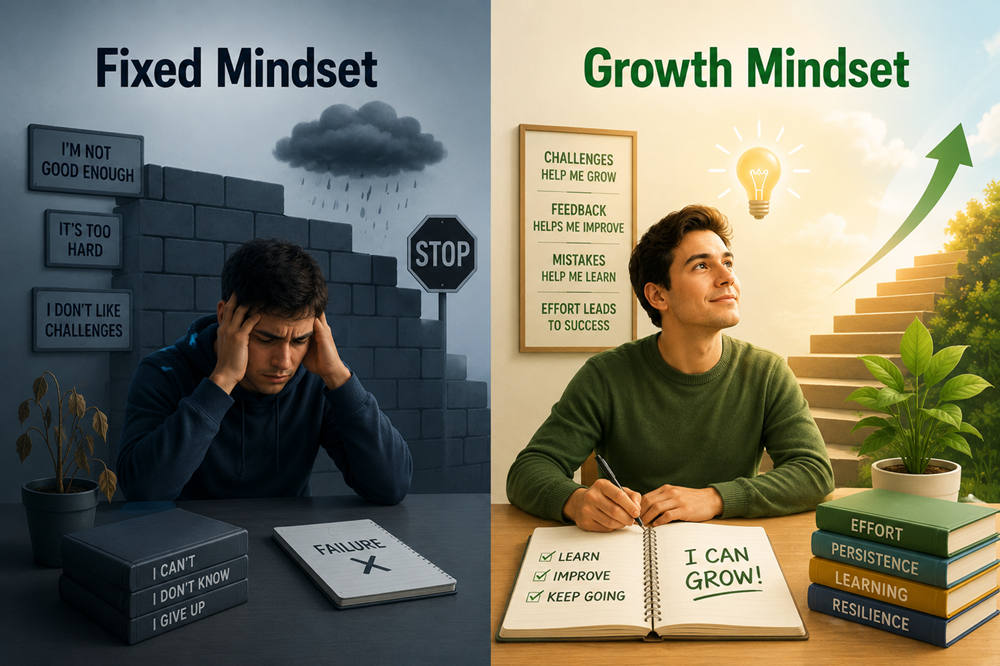
Growth mindset vs fixed mindset is more than a psychology phrase. It affects how you handle mistakes, feedback, pressure, learning, and slow progress.
A growth mindset helps you believe improvement is possible with better effort, strategy, support, and time. A fixed mindset makes your current ability feel permanent, which can turn setbacks into proof that you are not good enough.
What Is a Growth Mindset?
A growth mindset is the belief that your skills, intelligence, habits, and abilities can improve over time. Stanford’s Teaching Commons explains growth mindset as the belief that intelligence can develop through effort and learning, while a fixed mindset treats intelligence as something mostly set.
This does not mean you can become great at anything overnight. It also does not mean effort solves every problem by itself. A real growth mindset includes effort, but it also includes better strategies, useful feedback, practice, and support from others.
Someone with a growth mindset might say:
“I am not good at this yet.”
“I need a better approach.”
“This mistake is showing me what to work on.”
“I can learn from someone who is ahead of me.”
“I struggled today, but that does not mean I cannot improve.”
That small word “yet” matters because it keeps the door open. Instead of treating your current skill level as your final limit, it reminds you that your current result is only one stage of the process.
A growth mindset is especially helpful when you are learning something uncomfortable. Maybe you are trying to speak more confidently, build a business, improve your writing, manage money, communicate better, or become more disciplined. At first, it may feel awkward. That does not mean you are incapable. It means you are still learning.
What Is a Fixed Mindset?
A fixed mindset is the belief that your abilities are mostly set. The APA Dictionary of Psychology describes mindset theory as a framework for understanding how beliefs about ability can shape motivation, learning behavior, achievement, and resilience.
When you have a fixed mindset, you may see talent, confidence, creativity, or success as something people either have or do not have. This can make challenges feel threatening because every mistake seems to say something permanent about you.
A fixed mindset might sound like:
“I am just not good at this.”
“I am not a business-minded person.”
“I am terrible at public speaking.”
“If I fail, it means I am not talented.”
“I should not try unless I know I can win.”
A fixed mindset can feel protective at first. If you avoid hard things, you avoid embarrassment. If you never try, you never have to face the possibility of failing.
But over time, that protection becomes a limit. You stop trying things that could help you grow. You avoid feedback that could make you better. You compare yourself to people who are ahead of you and assume they were simply born different.
You may quit too early, not because you are incapable, but because you mistake discomfort for proof that you do not belong.
Growth Mindset vs Fixed Mindset: The Main Difference
The biggest difference between a growth mindset and a fixed mindset is how you explain struggle.
A fixed mindset sees struggle as a sign that you are not good enough. A growth mindset sees struggle as part of getting better.
| Situation | Fixed Mindset Response | Growth Mindset Response |
|---|---|---|
| You fail at something | “I am not cut out for this.” | “What can I learn from this?” |
| You get feedback | “They are criticizing me.” | “This can help me improve.” |
| Someone is better than you | “They are naturally gifted.” | “I can learn from how they practice.” |
| A task feels hard | “This proves I am bad at it.” | “This is where I build skill.” |
| Progress is slow | “Maybe I should quit.” | “Maybe I need a better strategy.” |
| You make a mistake | “I always mess up.” | “This shows me what to fix next.” |
This does not mean growth-minded people never feel discouraged. They do.
The difference is that they do not stop at the first emotional reaction. They may feel embarrassed, frustrated, or disappointed, but they eventually ask, “What is the next useful step?”
That question moves you from judgment to problem-solving.
Why Your Mindset Matters in Real Life
Your mindset affects what you do after things get hard.
That matters because most meaningful goals involve discomfort. Building a career, starting a business, learning a skill, improving your relationships, managing your emotions, or changing your habits will all test your patience.
A fixed mindset makes you more likely to avoid those tests. You may choose easy tasks because they protect your image. You may reject feedback because it feels personal. You may procrastinate because starting means facing the gap between where you are and where you want to be.
A growth mindset helps you stay in the process longer.
At work, this might mean you learn a new tool instead of saying, “I am not a tech person.”
In business, it might mean you improve your offer, message, or customer experience instead of deciding, “Nobody wants what I sell.”
In communication, it might mean you practice listening, asking better questions, and speaking more clearly instead of labeling yourself as awkward.
In productivity, it might mean you stop saying, “I am lazy,” and start asking, “What system would make this easier to repeat?”
Mindset does not replace action. It shapes the action you are willing to take.
Growth Mindset Is Not Just Positive Thinking
One common mistake is thinking a growth mindset means you should always be positive.
That is not true.
Growth mindset is not about pretending everything is easy. It is not about ignoring real limits, unfair situations, lack of support, or difficult circumstances. It is also not about repeating motivational quotes while doing the same thing over and over.
A real growth mindset is practical.
It says:
“I can improve, but I need to pay attention.”
“I can try harder, but I may also need a better method.”
“I can learn from feedback, even when it stings.”
“I can admit what is not working without attacking myself.”
This matters because effort alone is not always enough. If your strategy is wrong, more effort may only make you tired. If you keep practicing the wrong thing, you may get better at repeating the same mistake.
Growth requires effort, but it also requires reflection.
Research summarized by the Harvard Kennedy School points to this practical view: growth mindset is most useful when it is connected to real learning environments, helpful strategies, and support.
You work. You adjust. You ask questions. You learn from people who know more. You stop treating every mistake like a personal failure and start treating it like information.
Signs You May Be Stuck in a Fixed Mindset
Most people have a fixed mindset in at least one area of life.
You may be growth-minded about fitness but fixed-minded about money. You may believe you can learn new work skills but think you are hopeless at relationships. You may encourage other people to improve while quietly doubting that you can change too.
Here are a few signs you may be stuck in a fixed mindset:
You avoid things you might not be good at.
You take feedback personally, even when it is useful.
You compare yourself harshly to people who are ahead of you.
You quit quickly when progress feels slow.
You say “I am just not that kind of person” too often.
You feel embarrassed when you have to ask questions.
You hide mistakes instead of learning from them.
You only feel confident when success feels guaranteed.
You care more about looking smart than actually getting better.
None of these signs mean something is wrong with you. They simply show where fear may be making decisions for you.
A fixed mindset often grows from past embarrassment, criticism, comparison, or pressure to perform. If you were praised only for being smart, talented, or naturally good at something, mistakes may feel dangerous. If you were criticized harshly, you may have learned to avoid situations where you could be judged.
The goal is not to shame yourself for having fixed mindset thoughts. The goal is to notice them sooner and choose a better response.
How to Build a Growth Mindset
You do not build a growth mindset by forcing yourself to feel confident all the time. You build it by practicing better responses when doubt shows up.
Here are practical ways to start.
Add “Yet” to Limiting Thoughts
When you catch yourself saying, “I cannot do this,” add the word “yet.”
“I cannot do this yet.”
“I do not understand this yet.”
“I am not confident with this yet.”
That one word changes the meaning of the sentence. It reminds you that your current ability is not the final answer.
This works best when you pair it with action. After saying “yet,” ask yourself, “What is one thing I can practice next?”
Separate Identity From Performance
A bad result does not make you a bad person.
You can give a poor presentation without being a poor communicator forever. You can fail at a business idea without being a failure. You can struggle with consistency without being lazy as a person.
A fixed mindset turns performance into identity. A growth mindset separates the two.
Instead of saying, “I am terrible at this,” say, “My current method is not working yet.”
That gives you something to change.
Ask Better Questions
The questions you ask shape the answers you find.
A fixed mindset asks:
“Am I good at this?”
“What if I look stupid?”
“What if I fail?”
“What will people think?”
A growth mindset asks:
“What can I learn here?”
“What skill is missing?”
“What would make this easier next time?”
“Who can I learn from?”
“What is the next small improvement?”
Better questions help you stop arguing with reality and start working with it.
Use Feedback as Data
Feedback can be uncomfortable, especially when you care about what you are doing.
But feedback is not always an attack. Sometimes it is a shortcut. It shows you what you cannot see from inside your own habits.
You do not have to accept every piece of advice. Some feedback may be wrong, unclear, or not useful. But if you reject all feedback automatically, you also reject opportunities to improve.
A helpful mindset is: “I do not have to take this personally, but I can look for what is useful.”
That keeps you open without making you passive.
Change the Strategy, Not Just the Effort
If something is not working, do not only ask, “How can I try harder?”
Also ask, “How can I try differently?”
Maybe you need a simpler system. Maybe you need clearer instructions. Maybe you need more practice. Maybe you need to break the skill into smaller parts. Maybe you need a mentor, coach, course, book, or honest conversation.
Hard work matters, but smart adjustment matters too.
If you keep pushing in the wrong direction, you may confuse exhaustion with progress.
Track Small Wins
Growth is easier to believe when you can see evidence.
Track small improvements, even if they seem tiny. Maybe you spoke up once in a meeting. Maybe you wrote for 20 minutes. Maybe you practiced a skill three days this week. Maybe you handled feedback without shutting down.
Small wins build self-trust.
They remind you that change is not always dramatic. Sometimes growth looks like doing one hard thing a little better than last time.
Examples of Growth Mindset in Work, Business, and Life
A growth mindset becomes more useful when you apply it to real situations.
At Work
Fixed mindset: “I am not leadership material.”
Growth mindset: “I can build leadership skills by improving communication, decision-making, and follow-through.”
Leadership is not only a personality type. It includes skills you can practice. You can learn to listen better, organize ideas, solve problems, manage conflict, and support people more effectively.
In Business
Fixed mindset: “My business idea failed, so I am not meant for this.”
Growth mindset: “This result gives me information about the offer, audience, pricing, message, or timing.”
Business requires testing. Not every idea works. Not every launch lands. Not every product sells. A growth mindset helps you study the result instead of turning it into a personal verdict.
In Communication
Fixed mindset: “I am awkward.”
Growth mindset: “I can get better at asking questions, listening, and speaking clearly.”
Communication is a skill. You can practice eye contact, tone, timing, curiosity, storytelling, and emotional control. You do not have to become the loudest person in the room to become a better communicator.
In Productivity
Fixed mindset: “I am lazy.”
Growth mindset: “I need a better system for starting, focusing, and finishing.”
Sometimes the problem is not your character. It may be unclear priorities, too many distractions, poor sleep, unrealistic planning, or tasks that are too vague.
A growth mindset helps you look for the real obstacle instead of attacking yourself.
In Learning
Fixed mindset: “I am too old to learn this.”
Growth mindset: “I may need more time, but I can still improve.”
Learning something new can feel humbling, especially as an adult. You may not want to feel like a beginner. But being a beginner is not a weakness. It is the starting point of every skill you have ever built.
Stop Turning Struggles Into Labels
One of the most damaging fixed mindset habits is turning temporary struggles into permanent labels.
You miss a deadline and say, “I am irresponsible.”
You struggle with money and say, “I am bad with finances.”
You feel nervous speaking and say, “I am not confident.”
You try something once and say, “I am not good at this.”
Labels feel simple, but they can stop growth. Once you label yourself, you may stop looking for solutions.
A better approach is to describe the behavior, not your identity.
Instead of “I am irresponsible,” say, “I need a better reminder system.”
Instead of “I am bad with money,” say, “I need to learn basic budgeting and track my spending.”
Instead of “I am not confident,” say, “I need more practice handling this situation.”
Instead of “I am not good at this,” say, “I am still learning the steps.”
This kind of language gives you power back. It points to something you can change.
Can You Have Both a Growth and Fixed Mindset?
Yes, and most people do.
You might have a growth mindset in one area and a fixed mindset in another. You may believe you can improve your fitness but not your finances. You may believe you can learn new software but not become more confident. You may believe other people can change while secretly doubting that you can.
Mindset is not a permanent personality type. It can shift depending on the situation, your stress level, your past experiences, and how much support you have.
That is why self-awareness matters.
When you notice fixed mindset thinking, pause and ask:
“What am I afraid this means about me?”
“What else could be true?”
“What would I do next if I believed improvement was possible?”
Those questions create space between the thought and the decision.
A Simple Growth Mindset Exercise
Think of one area where you feel stuck.
Maybe it is your career, confidence, health, money, communication, creativity, or discipline.
Now write down the fixed mindset sentence you usually tell yourself.
For example:
“I am not good at staying consistent.”
“I will never be confident.”
“I am bad at selling.”
“I cannot learn this.”
Next, rewrite it in a growth-minded way.
“I am learning how to build systems that help me stay consistent.”
“I can become more confident through practice and preparation.”
“I can improve my sales skills by understanding people better.”
“I cannot do this yet, but I can learn the next step.”
Finally, choose one small action that supports the new belief.
Practice for 10 minutes. Ask one question. Watch one tutorial. Make one call. Write one paragraph. Review one mistake. Create one simple plan.
Growth mindset becomes real when it changes your next action.
Growth Mindset Does Not Mean You Never Quit
A growth mindset does not mean you must continue everything forever.
Sometimes quitting is wise. Sometimes a goal no longer fits. Sometimes the cost is too high. Sometimes your energy needs to go somewhere more meaningful.
The difference is why you quit.
A fixed mindset quits because struggle feels like proof of failure.
A growth mindset can quit after reflection, learning, and honest evaluation. A national experiment published in Nature also shows why context matters: growth mindset can help, but its effect depends partly on the environment around the learner.
That is a useful reminder for real life too. Growth is not about forcing every door open. It is about learning from the doors you try.
Final Thoughts
Growth mindset vs fixed mindset is really about how you respond to challenge.
A fixed mindset asks you to protect your image. A growth mindset asks you to protect your progress.
You do not have to pretend failure feels good. You do not have to love criticism. You do not have to become fearless. You only need to stay open enough to learn from what happens next.
Your current skills are not the full story. Your current confidence is not the final version of you. Your current results are not permanent proof of what is possible.
Real growth comes from better effort, better strategy, honest feedback, useful support, and the patience to keep practicing.
Meta description: Learn the difference between growth mindset vs fixed mindset and how better beliefs, feedback, and strategy help you improve.