
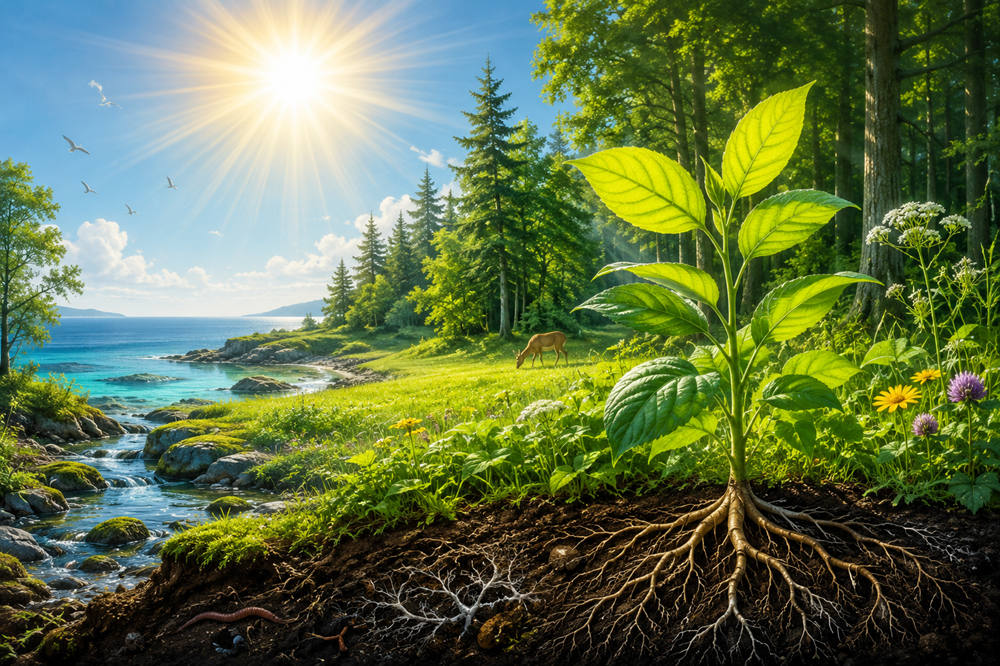
Net primary productivity, or NPP, measures how much plant growth an ecosystem gains after plants use some of their energy to stay alive.
In simple terms, it shows how much new plant material is available to support the rest of the food web.
What Is Net Primary Productivity?
Net primary productivity is the amount of energy or biomass that plants and other producers store after respiration.
Primary producers include plants, algae, phytoplankton, and some bacteria. These organisms make food through photosynthesis, using sunlight, carbon dioxide, and water. The total energy they produce is called gross primary productivity, or GPP.
But producers do not keep all that energy. They use some of it for respiration, which helps them grow, repair cells, move nutrients, and stay alive.
The energy left after respiration is net primary productivity.
The basic formula is:
NPP = GPP – respiration
So, if gross primary productivity is the total energy made, net primary productivity is the part that becomes usable growth.
A Simple Way to Understand NPP
Think of NPP like money left after basic expenses.
Gross primary productivity is like your full paycheck. Respiration is like paying for rent, food, bills, and other needs. Net primary productivity is what remains.
For plants, that “remaining energy” becomes new leaves, roots, stems, seeds, wood, and other plant material. That growth can then feed animals, insects, fungi, bacteria, and other living things.
This is why NPP is so important. It tells us how much energy is available beyond the plants themselves.
Why Net Primary Productivity Matters
Net primary productivity matters because it helps show how much life an ecosystem can support.
Plants and other producers form the base of most food webs. Herbivores eat plants. Carnivores eat herbivores. Decomposers break down dead material and return nutrients to the soil. When NPP is high, there is more energy moving through the ecosystem. When NPP is low, the whole system has less to work with.
NPP is also closely connected to the carbon cycle. As plants grow, they take carbon dioxide from the air and store carbon in their tissues. This makes NPP useful for studying forests, farms, oceans, climate change, and ecosystem health.
Scientists use NPP to understand questions like:
- How much plant growth is an ecosystem producing?
- How much carbon are plants storing?
- Is a forest, grassland, or ocean region healthy?
- How are drought, heat, or land-use changes affecting growth?
- How much food is available for animals?
Examples of Net Primary Productivity
Different ecosystems have different levels of NPP because they do not all have the same sunlight, water, temperature, and nutrients.
A tropical rainforest usually has high NPP. It receives plenty of rainfall, warm temperatures, and strong sunlight. Because the growing season is long, plants can keep producing new growth throughout much of the year.
A desert usually has low NPP. Deserts may get a lot of sunlight, but water is limited. Without enough moisture, plants cannot grow quickly or produce much biomass.
A grassland often has moderate to high NPP, depending on rainfall and soil quality. Many grasses store a large amount of their growth underground in roots, which helps them survive grazing, fire, and dry seasons.
In the ocean, much of the productivity comes from tiny organisms called phytoplankton. Even though they are small, they support marine food webs and play a major role in moving carbon through the planet’s systems.
Gross Primary Productivity vs Net Primary Productivity
Gross primary productivity and net primary productivity are related, but they measure different things.
Gross primary productivity is the total energy captured by producers through photosynthesis.
Net primary productivity is the energy left after producers use some of that energy for respiration.
The difference matters because ecosystems depend on the energy that is stored as new growth. That is the energy that becomes food, habitat, organic matter, and carbon storage.
A forest may capture a lot of energy through photosynthesis, but if the plants use much of that energy for respiration, the NPP will be lower. If growing conditions are strong and plants store more energy as biomass, the NPP will be higher.
What Affects Net Primary Productivity?
Several factors can raise or lower net primary productivity.
Sunlight gives plants the energy they need for photosynthesis. More available light can increase productivity, especially when water and nutrients are also present.
Water is one of the biggest limits on plant growth. When water is scarce, plants slow down to protect themselves from drying out.
Temperature affects how quickly plants can grow. Cold temperatures slow plant activity, while extreme heat can cause stress and water loss.
Nutrients such as nitrogen and phosphorus help plants build healthy tissues. Poor soil can limit NPP even in sunny, rainy places.
Growing season length also matters. A long warm season gives plants more time to produce new growth. A short growing season limits how much biomass can be created.
This is why a rainforest, a cornfield, a tundra, and a desert can have very different levels of productivity.
How Scientists Measure NPP
Scientists can measure NPP in different ways.
In small areas, they may measure plant growth directly by tracking new leaves, stems, roots, or total biomass over time.
For larger areas, scientists often rely on satellite data. Satellites can help estimate plant productivity across forests, farms, grasslands, and oceans. This makes it easier to see changes caused by drought, wildfire, deforestation, farming, or climate patterns.
NPP is not just a number in a science textbook. It is a way to understand how ecosystems are changing in real time.
Net Primary Productivity and Climate Change
NPP is important in climate science because plants absorb carbon dioxide as they grow. Some of that carbon becomes stored in leaves, roots, tree trunks, and soil.
Climate change can affect NPP in different ways. In some colder regions, warmer temperatures may lengthen the growing season. In other places, heat stress, drought, wildfires, and poor soil conditions may reduce plant growth.
That is why scientists pay close attention to productivity. Changes in NPP can reveal how ecosystems are responding to a warmer, less predictable climate.
Common Mistakes About NPP
One common mistake is confusing biomass with productivity. Biomass is the amount of living material already present. Productivity is the rate at which new living material is produced.
For example, an old forest may hold a huge amount of biomass, but that does not always mean it has the highest yearly NPP. A younger, fast-growing forest may produce new biomass more quickly.
Another mistake is thinking sunlight controls everything. Light is important, but plants also need water, nutrients, suitable temperatures, and healthy growing conditions.
It is also easy to forget respiration. Plants make energy, but they also spend energy. NPP focuses on what remains after that cost.
Summary
Net primary productivity is the usable plant growth an ecosystem produces after plants use some energy for respiration.
The formula is:
NPP = gross primary productivity – respiration
NPP helps us understand food webs, plant growth, carbon storage, ecosystem health, and climate change. A high NPP usually means an ecosystem is producing a lot of new growth. A low NPP usually means growth is limited by water, temperature, nutrients, light, or other conditions.
In the simplest sense, net primary productivity shows how much new life an ecosystem can build and share.