
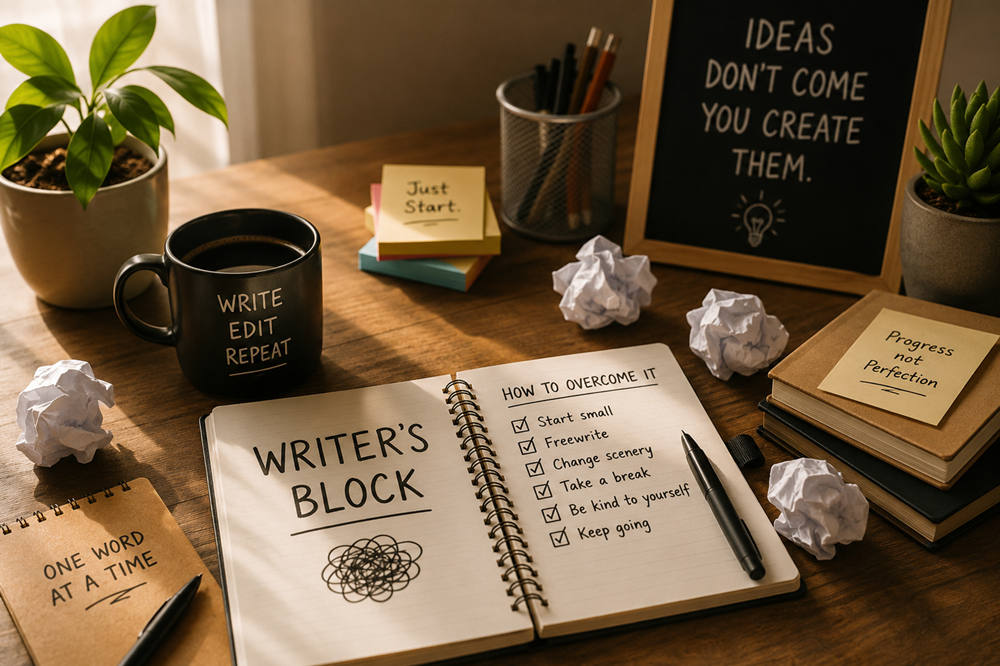
Writer’s block can make even simple writing feel heavy. You may have ideas in your head, but the moment you sit down, they seem to disappear. The blank page starts to feel like pressure instead of possibility.
The truth is, writer’s block does not mean you are out of talent or creativity. It usually means something in your process needs adjusting. Maybe the topic feels too big. Maybe you are trying to sound perfect too soon. Maybe your mind is tired, distracted, or unsure where to begin.
Here are practical ways to loosen the block and start writing again.
Start With a Rough Draft
The first draft does not need to be good. It only needs to exist.
Many writers get stuck because they try to make every sentence polished before they have even figured out what they want to say. That creates too much pressure. You write one line, judge it, delete it, and end up with nothing.
Instead, let the first draft be messy. Write the awkward sentence. Use simple words. Leave gaps. Repeat yourself if you need to. You can clean it up later.
A rough draft gives you something to shape. A blank page gives you nothing to work with.
A helpful rule is: write first, edit later. When you draft and edit at the same time, your inner critic interrupts every idea before it has a chance to grow. Let the words come first. The fixing can happen afterward.
Make the Topic Smaller
Sometimes writer’s block happens because the task feels too large. “Write an article,” “finish the chapter,” or “complete the report” can feel overwhelming because your brain sees the whole mountain at once.
Shrink the task.
Instead of trying to write everything, ask yourself one small question:
- What is the main point I want to make?
- What problem am I helping the reader solve?
- What is one useful tip I can explain?
- What would a beginner need to know first?
- What example could make this clearer?
You do not have to write the whole piece in one sitting. You can write one section, one paragraph, or even one list of ideas. Small starts matter because they break the feeling of being stuck.
Once one piece is written, the next piece usually feels easier.
Use a Simple Outline
An outline does not have to be formal or complicated. It is just a path for your thoughts.
When you do not know what comes next, your brain has to do two jobs at once: create ideas and organize them. That can quickly become overwhelming. A simple outline removes some of that pressure.
For example:
- Introduction
- Main problem
- Key idea one
- Key idea two
- Key idea three
- Summary
You can also write your headings first, then fill them in one by one. This makes the page feel less empty because each heading gives you a smaller place to begin.
After drafting, you can use a reverse outline to check whether each section has a clear purpose. This is especially helpful when a draft feels scattered but you are not sure why.
Write the Easiest Part First
You do not have to start with the introduction. In fact, the introduction is often the hardest part because it carries too much pressure. You may feel like the first line needs to be clever, clear, and perfect all at once.
Skip it for now.
Start with the part you already understand. Maybe that is a tip, an example, a story, a list, or a conclusion. Writing the easiest part first helps you build momentum without forcing your brain through the hardest doorway.
Once you have words on the page, the project feels less intimidating. You can return to the opening later, when your ideas are clearer and your voice feels more natural.
Writing does not have to happen in order. It only has to make sense when it is finished.
Set a Tiny Goal
When you are blocked, a big goal can make you avoid the work completely. “Write for three hours” or “finish the whole article today” may feel impossible.
Try a smaller goal:
- Write for 10 minutes.
- Write 100 words.
- Write one paragraph.
- Write five bullet points.
- Write a bad opening sentence.
- Write only the next idea.
Tiny goals work because they lower the emotional weight of starting. You are not asking yourself to finish everything. You are only asking yourself to begin.
Often, once you start, you keep going longer than planned. But even if you only meet the small goal, you still made progress.
Warm Up With Freewriting
A blank page can feel too open. Freewriting gives your mind a place to move before you worry about structure.
Set a timer for five minutes and write anything related to your topic. Do not stop to fix grammar. Do not delete sentences. Do not worry if it sounds messy. The goal is not to produce a finished paragraph. The goal is to get your thoughts moving.
You can start with prompts like:
- The main thing I want to say is…
- The reader may be struggling with…
- A simple way to explain this is…
- The most useful advice here is…
- I keep getting stuck because…
MIT’s writing resources also explain how freewriting can help generate ideas when you do not know where to begin.
You may not use most of what you write during a warm-up, and that is fine. Sometimes one honest sentence is enough to unlock the next paragraph.
Change Where or How You Write
Sometimes the problem is not your idea. It is your environment.
If you always get stuck at the same desk, on the same screen, with the same distractions, your brain may start connecting that space with stress. A small change can help reset the mood.
Try writing somewhere else: a different room, a library, a coffee shop, a quiet corner, or even outside. You can also switch tools. Use a notebook instead of a laptop. Use voice typing. Write in a plain document with no formatting.
You do not need the perfect writing setup. You only need a space that makes starting feel a little easier.
Also, remove obvious distractions. Put your phone across the room. Close extra tabs. Turn off notifications. Give your mind fewer reasons to escape the page.
Lower the Pressure
Writer’s block often grows when the writing feels too important. You may worry that your work will sound boring, that people will judge it, or that your ideas are not original enough.
That kind of pressure can make writing feel like a test.
The UNC Writing Center notes that writing anxiety can appear when a task feels stressful, personal, or high-stakes. In everyday terms, your brain may freeze because it is trying to protect you from criticism.
To lower the pressure, create a private practice draft. Name it something simple like “messy notes” or “draft one.” Remind yourself that nobody has to see this version.
You are allowed to write something ordinary before it becomes strong. Most good writing is not born polished. It becomes clear through revision.
Read, But Do Not Hide in Research
Reading can help when your mind feels empty. A useful article, chapter, or set of notes can give your brain something to respond to.
As you read, notice what sparks a reaction. Do you agree? Disagree? Want to explain it more simply? See a missing point? That reaction can become your way into the writing.
But be careful. Research can easily turn into procrastination. You may tell yourself you need “just one more source” before you start, when really you are avoiding the discomfort of drafting.
Set a limit. Read for 15 minutes, then write for 15 minutes. Let research support the writing, not replace it.
Talk Through the Idea
Some ideas are easier to speak than to write.
When you feel stuck, explain the topic out loud as if you are talking to a friend. You can record yourself, use voice typing, or simply say the main points before you write them down.
Start with: “What I’m trying to say is…”
Then keep going.
Speaking often sounds more natural because you are not trying so hard to be perfect. You may find simple phrases, examples, or explanations that were hiding behind formal writing pressure.
Afterward, turn the best parts of what you said into a rough draft.
Take a Real Break
Not every block should be forced through. Sometimes your brain is tired, and pushing harder only makes the page feel worse.
Take a real break. Stand up. Walk. Stretch. Make tea. Wash dishes. Step outside. Do something that gives your mind room to breathe.
Try not to spend every break scrolling. Social media can make your brain feel more crowded, not more rested.
A good break is not quitting. It is resetting. The key is to decide when you will come back, even if it is only 15 or 20 minutes later.
Find the Real Block
Writer’s block is not always the same problem. Before you try to fix it, ask what is actually getting in the way.
If the topic is unclear, define your main point.
If the project feels too big, write one small section.
If you are afraid it will sound bad, create a private rough draft.
If you have too many ideas, make an outline.
If you have no ideas, freewrite, read, or talk it out.
If you are exhausted, rest before forcing more work.
This matters because the right solution depends on the real cause. Purdue OWL also shares helpful writer’s block strategies for different types of stuck moments.
Once you name the block, it usually feels less mysterious and more manageable.
Build a Writing Routine
The best long-term way to reduce writer’s block is to make writing feel familiar. You do not need a dramatic routine or hours of free time. Short, regular sessions can train your brain to show up more easily.
Try this simple routine:
- Pick a regular writing time.
- Start with a small goal.
- Keep a running list of ideas.
- Draft before editing.
- End each session by writing down what to do next.
That last step is powerful. Before you stop, leave yourself a note like, “Next, explain the example,” or “Add the section about outlines.” This gives you an easy starting point when you return.
Writer’s block feels less scary when you have a process you can trust.
Summary
Writer’s block is frustrating, but it is not permanent. Most of the time, you do not need more pressure. You need a smaller start, a clearer plan, and permission to write imperfectly.
Begin with a rough draft. Make the task smaller. Use an outline. Write the easiest part first. Warm up with freewriting, change your environment, or talk through your ideas out loud. When your mind is tired, take a real break and come back with fresh energy.
The goal is not to create a perfect sentence right away. The goal is to get something on the page. Once the words are there, you can shape them into something clearer, stronger, and more useful.